Nathan could not move.
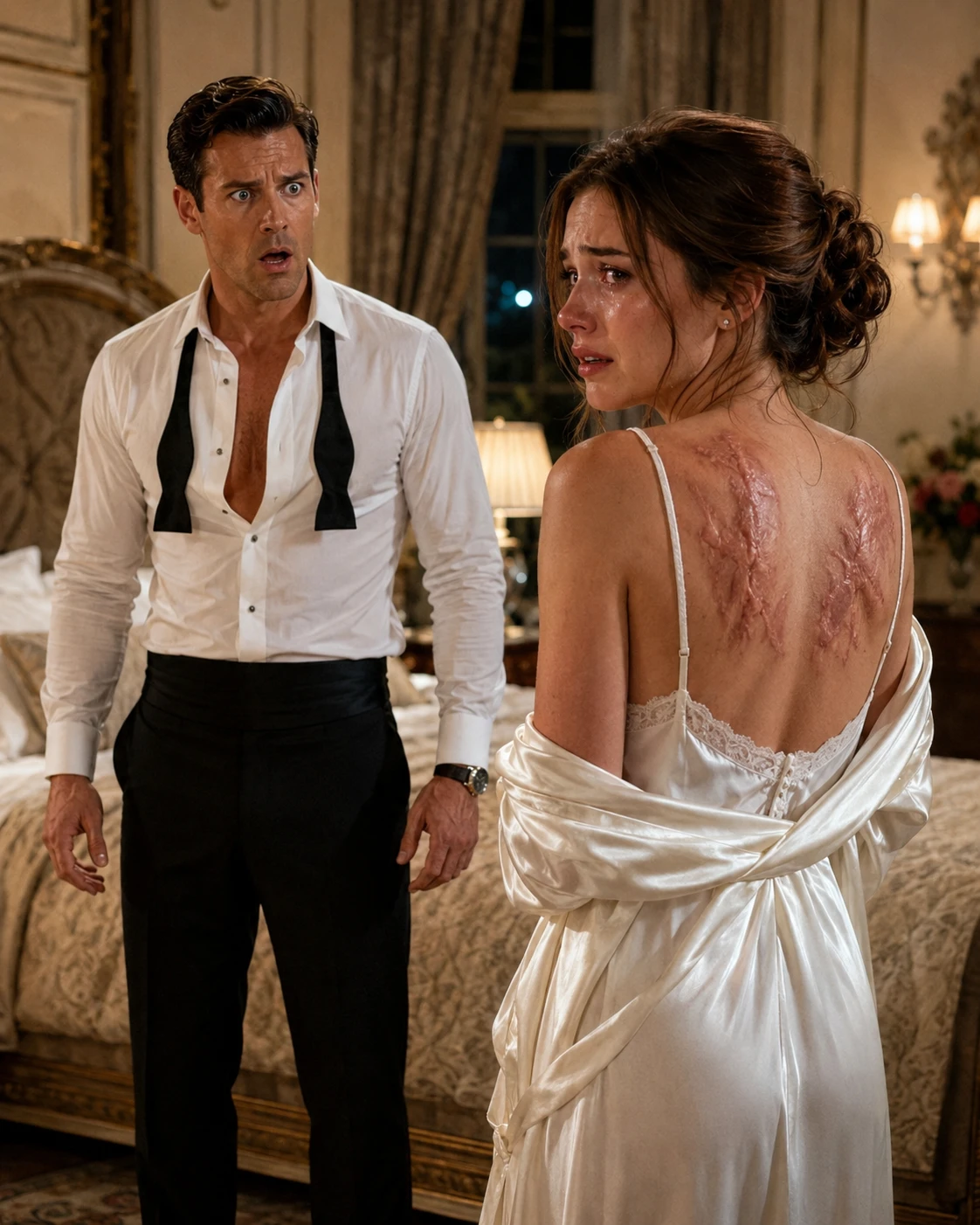
For one long second, the room seemed to lose its air. The low golden light of the bedside lamps fell across Emily’s shoulders, down her arms, over the delicate hollow of her throat—and then across the truth she had tried so hard to hide.
There were no stretch marks.

No signs of childbirth.
No evidence of the life everyone had imagined for her.
Instead, Nathan saw scars.
Not one or two, but many.
Thin, pale lines crossed her back like faded lightning. A long mark curved over her ribs. Near her left shoulder blade was a burn, old but unmistakable. On her upper arm were fingerprints of a past so cruel they seemed to still press into her skin.
Emily quickly pulled the nightgown back up.
Her face had gone white.
“I’m sorry,” she whispered.
Nathan blinked, as if waking from a dream. “Emily…”
“I should have told you.”
His voice came out hoarse. “Who did this to you?”
She turned away, clutching the fabric to her chest. “It doesn’t matter anymore.”
“It matters to me.”
Silence fell between them.
Outside, rain tapped softly against the windows of the Carter mansion. The same mansion where people had whispered behind polished doors, where servants had laughed about the poor maid with three fatherless children, where Nathan’s own mother had looked at Emily as if she were dirt dragged onto marble.
Nathan took one step closer, but Emily flinched.
He stopped immediately.
That small movement broke him more than the scars had.
“I won’t touch you unless you want me to,” he said softly.
Emily’s eyes filled with tears. “I know. That’s why I’m afraid.”
Nathan frowned. “Afraid of what?”
“Afraid that if you know everything, you’ll look at me differently.”
He shook his head. “The only thing I see is that someone hurt you.”
Emily looked down. For a moment, she seemed like the quiet maid again—the woman who moved silently through hallways, who never complained, who sent money home every month and answered questions with half-truths.
But now she was his wife.
And for the first time, Nathan realized he had married a woman surrounded by shadows he had never bothered to understand.
Emily sat on the edge of the bed. Her hands trembled in her lap.
“Johnny, Paul, and Lily are not my children,” she said.
Nathan’s heart tightened. “Then who are they?”
She swallowed.
“My siblings.”
Nathan stared at her.
Emily gave a painful smile. “That’s the first lie everyone told about me. I never corrected it because… because it was easier to let them think I was shameful than to explain the truth.”
“What truth?”
She closed her eyes.
“That I raised them because our mother died. That our father disappeared. That the men in my town saw a girl without protection and thought that meant she belonged to anyone who wanted her afraid.”
Nathan’s jaw tightened.
Emily continued, voice low. “I was sixteen when Mama died. Johnny was eight. Paul was six. Lily was only three. There was no money, no relatives willing to help, no one who cared unless there was something to take. I worked in kitchens, cleaned rooms, washed laundry, anything. But the man who owned the boardinghouse where we lived…”
Her voice broke.
Nathan knelt in front of her, not touching, just close enough for her to see he was listening.
“He said if I couldn’t pay rent, I had to pay another way. I refused. That night he locked me in the cellar.”
Nathan’s face darkened.
Emily’s fingers curled into the sheets. “I fought. I screamed. He beat me. That scar on my back came from a broken bottle. The burn came later, when I tried to run and he caught me near the stove.”
“Nathan,” she whispered, finally looking at him, “people say I was loose because it was easier for them to believe I invited shame than to believe respectable men in a small town could be monsters.”
Nathan felt something cold and violent rise in his chest.
“What was his name?”
Emily shook her head quickly. “No. Please don’t.”
“Emily—”
“I didn’t tell you so you could punish anyone. I told you because you deserve the truth before you regret marrying me.”
Nathan stared at her, stunned by the word.
Regret.
After everything she had endured, she was still afraid of being unwanted.
He slowly reached out his hand, stopping just before her fingers.
“May I?”
Emily hesitated, then placed her hand in his.
Nathan bowed his head and kissed her knuckles.
“I regret only one thing,” he said. “That you carried this alone.”
Emily began to cry then. Not the pretty tears she had shed at the altar, but broken, silent sobs that shook her whole body. Nathan pulled the blanket around her shoulders and sat beside her until she leaned into him.
For the first time in years, Emily let someone hold her without fear.
The next morning, the mansion awoke to news it had never expected.
Nathan Carter had ordered every staff member into the grand dining room.
They stood in rows, confused and whispering. The cooks came with flour still on their sleeves. The gardeners stood near the doors. The housekeepers exchanged nervous glances, especially the two women who had spread the worst rumors about Emily.
At the head of the table sat Margaret Carter, stiff as a statue, wearing pearls and displeasure.
Nathan entered with Emily beside him.
She wore a simple cream dress. Her face was pale, but her chin was lifted.
Nathan did not sit.
“As of today,” he said, “Emily Carter is not a maid in this house. She is my wife. She is the mistress of this mansion, and she will be treated as such.”
No one spoke.
Margaret let out a cold laugh. “Must we make a ceremony of obvious foolishness?”
Nathan turned to her. “Mother, you will not insult my wife again.”
Margaret’s eyes widened. “Your wife? That girl deceived you. She comes with three children and a filthy past.”
Emily flinched, but Nathan’s hand closed around hers.
“The three children are her siblings,” Nathan said. “Children she raised alone after their mother died.”
A murmur ran through the room.
One maid covered her mouth.
Margaret’s expression flickered, but only for a second. “And that proves what? That she is still beneath this family.”
Nathan looked at every person in the room.
“Anyone who repeats one more lie about Emily will leave this house immediately, without reference.”
The whispering died.
Then Nathan faced his mother again.
“And you,” he said quietly, “will apologize.”
Margaret rose slowly. “I will do no such thing.”
Nathan’s voice remained calm. “Then you will move to the east wing until you learn the difference between pride and cruelty.”
A gasp went through the staff.
Margaret’s face turned red. “You would exile your own mother in my husband’s house?”
“My father left this house to me,” Nathan replied. “And I will not let it be used to humiliate my wife.”
Margaret looked at Emily with pure hatred.
“This is not over,” she said.
Emily said nothing.
But Nathan felt her hand tremble.
That afternoon, Nathan asked Emily where her siblings lived. She resisted at first, saying they were safe with Mrs. Miller, an old neighbor in West Virginia. But Nathan had already seen enough of her pain to know that “safe” meant “surviving.”
Two days later, he flew with Emily to West Virginia.
The town of Black Hollow was tucked between hills that seemed to fold inward like tired shoulders. The houses were small, the roads cracked, the air heavy with coal dust and old grudges.
Emily became quiet as soon as they arrived.
Nathan noticed how people looked at her.
Some stared with curiosity.
Some with pity.
Some with something darker.
At a faded blue house near the edge of town, three children burst through the door.
“Emmy!”
A thin boy of seventeen reached her first. Johnny was tall but underfed, with protective eyes too old for his face. Paul, fifteen, followed with a limp Nathan instantly noticed. Lily, twelve, ran into Emily’s arms and clung to her like she had been waiting her whole life.
Emily fell to her knees and held them all.
Nathan stood back, throat tight.
These were the “three children” everyone had mocked.
Not shame.
Not scandal.
A family.
Mrs. Miller, a small elderly woman with silver hair, invited them inside. The house was warm but worn. The roof leaked in one corner. The kitchen table had only three chairs. Lily’s shoes were too small.
Nathan saw everything.
Emily saw him seeing everything.
“I sent what I could,” she whispered.
“You kept them alive,” Nathan said.
Johnny stepped forward, suspicious. “Are you really married to her?”
Nathan nodded. “Yes.”
“Are you going to take her away from us?”
Emily’s eyes filled again.
Nathan crouched slightly so he was level with the boy. “No. I came to bring you with us, if that’s what Emily wants—and what you want.”
Paul looked stunned. Lily clutched Emily tighter.
Johnny’s face hardened. “People like you don’t raise kids like us.”
Nathan accepted the blow without blinking. “Maybe not. But I can learn.”
Johnny studied him.
Then Lily spoke in a tiny voice. “Will Emily still be our Emily?”
Nathan smiled faintly. “Always.”
For the first time, Johnny’s expression cracked.
But just as hope entered the room, the front door opened.
A man stepped inside without knocking.
He was heavyset, with gray in his beard and a sheriff’s badge pinned crookedly to his coat. His eyes landed first on Emily, then on Nathan’s expensive suit.
“Well,” he said slowly. “Look who came back dressed like a rich man’s doll.”
Emily stood so fast the chair scraped the floor.
Nathan noticed the change instantly. Her face drained. Her shoulders curled inward. Her breathing shortened.
This was not fear from memory.
This was fear from recognition.
“Sheriff Doyle,” she said.
The man smiled.
Nathan’s blood went cold.
Doyle.
Emily had not given him the name, but Nathan knew.
The boardinghouse owner. The man from the cellar. The man who had scarred his wife.
“You should’ve told me you were coming home, Emily,” Doyle said. “Old friends deserve notice.”
Nathan stepped between them.
The sheriff’s smile widened. “And who are you?”
“Nathan Carter.”
“Carter.” Doyle’s eyebrows lifted. “That sounds expensive.”
“I’m Emily’s husband.”
For a second, Doyle’s face changed. Just a flicker. Surprise. Then amusement.
“Husband? Well, congratulations. Did she tell you what kind of girl she was before she ran off?”
Johnny lunged forward. “Shut up!”
Doyle’s hand moved toward his belt. Nathan stepped in front of Johnny.
Emily whispered, “Please. Don’t.”
Doyle chuckled. “Still begging, Emmy?”
Nathan’s voice was quiet. “Leave.”
The sheriff looked around the poor little room and laughed. “This is my town, Mr. Carter. People don’t tell me to leave.”
Nathan took out his phone and pressed one button.
“What are you doing?” Doyle asked.
“Calling my attorney.”
Doyle’s expression hardened.
Nathan held his gaze. “And after that, federal contacts. Then the state police. Then every reporter from here to Charleston. You may own this town, Sheriff Doyle, but you do not own the world.”
For the first time, Doyle’s confidence faltered.
Emily stared at Nathan as if she had never seen such a thing: a man refusing to be afraid of the monster who had ruled her nightmares.
Doyle leaned close. “Careful. Accidents happen on mountain roads.”
Nathan smiled without warmth. “Then I suggest you pray nothing happens to my family. Because if it does, your name will be the first one spoken.”
The room went deadly silent.
Doyle looked at Emily one last time.
“You should’ve stayed gone,” he said.
Then he left.
That night, Nathan rented the only decent rooms in the small inn. Emily barely slept. She kept checking the locks, checking the windows, checking on her siblings.
At dawn, Nathan found Johnny sitting outside on the steps.
“You hate him,” Johnny said.
Nathan sat beside him. “Yes.”
Johnny looked surprised by the honesty.
“He hurt Emily,” Johnny said. “Everyone knew. Nobody helped.”
Nathan said nothing.
Johnny’s voice trembled. “I was eight. I heard her screaming once. Mrs. Miller held me back because I tried to go. I wasn’t strong enough.”
Nathan looked at the boy.
“You were a child.”
Johnny’s eyes filled, but he refused to let the tears fall. “She stopped being one because of us.”
Nathan rested his arms on his knees. “Then we make sure she gets to live now.”
By noon, arrangements were made. Nathan would bring Johnny, Paul, and Lily to Connecticut. They would have doctors, tutors, rooms of their own, and, most importantly, Emily.
But leaving Black Hollow was not simple.
As they packed the children’s few belongings, Mrs. Miller pulled Emily aside.
“There’s something you need to know,” the old woman whispered.
Emily frowned. “What is it?”
Mrs. Miller glanced toward the road. “Your father didn’t disappear.”
Emily went still.
Nathan, standing nearby, heard the words but did not interrupt.
Emily’s voice became fragile. “What do you mean?”
Mrs. Miller’s eyes filled with old guilt. “I should’ve told you years ago. But I was afraid. We all were.”
“My father left after Mama died.”
“No,” Mrs. Miller said. “He came back.”
Emily’s lips parted.
“He came back with money. Said he’d found work in Ohio. He wanted to take all four of you away. But he went to Doyle first, asking about the rent debt.”
Emily slowly sat down.
Mrs. Miller took her hand. “Your father never made it home that night.”
Nathan felt the air thicken.
Emily whispered, “No.”
“Doyle told everyone he ran off drunk. But two days later, I found your father’s watch near the old mine road. I kept it.”
Mrs. Miller went to a cabinet and took out a small tin box. Inside lay a cracked silver watch, stopped at 11:17.
Emily touched it with shaking fingers.
“My father didn’t abandon us,” she whispered.
Nathan’s phone rang before he could speak.
It was his attorney.
Nathan answered, listened, and his face changed.
“What is it?” Emily asked.
He looked at her, then at the children.
“My investigator found records. Sheriff Doyle bought several properties after your father disappeared. Paid in cash.”
Emily stared at him.
Nathan continued, voice low. “One of them was your family’s land.”
Johnny stood. “Our land?”
Nathan nodded. “Your father owned forty acres outside town. After his disappearance, Doyle claimed unpaid debts and took it through a local court.”
Mrs. Miller covered her mouth.
Emily looked as though the floor had vanished beneath her.
“All these years,” she said, “I thought we had nothing because he left us.”
Nathan closed his hand around hers.
“No,” he said. “Someone took everything.”
They left Black Hollow before sunset.
But as the black SUV climbed the mountain road, Emily looked back through the rear window.
A sheriff’s cruiser sat at the corner.
Watching.
The children were silent during the drive to the airport. Lily slept against Emily’s shoulder. Paul stared out the window. Johnny kept his fists clenched.
Nathan made calls. Quiet calls. Powerful calls.
By the time they reached Connecticut, Sheriff Doyle’s name had already been sent to people who did not answer to small-town fear.
For a few weeks, the Carter mansion changed.
Lily laughed in rooms that had never known children’s laughter. Paul began treatment for his injured leg, an old fracture that had healed badly. Johnny refused every luxury at first, then secretly cried when Nathan gave him a warm coat that fit.
Emily slowly began to bloom.
She still woke from nightmares. She still avoided mirrors. But some mornings, Nathan found her in the garden with Lily, sunlight in her hair, smiling like a woman remembering she was alive.
Nathan loved her more each day.
But Margaret Carter did not soften.
She watched the children with icy dislike. She called them “guests,” never family. She refused to dine when they were present.
One evening, Nathan returned home early and heard voices from the library.
Margaret’s voice cut through the closed door.
“You think you’ve won because my son feels sorry for you?”
Emily answered softly. “I don’t want to win anything, Mrs. Carter.”
“Don’t lie. Girls like you survive by clinging to men with money.”
There was a pause.
Then Emily said, “I survived without Nathan’s money.”
Margaret laughed. “And now you’ve brought three hungry mouths into my house.”
“They are my family.”
“No,” Margaret snapped. “They are proof that you will always drag the gutter behind you.”
Nathan opened the door.
Margaret froze.
Emily turned, startled.
Nathan looked at his mother with a disappointment colder than anger.
“I warned you,” he said.
Margaret lifted her chin. “Good. Then hear this too. I hired someone to investigate her. You are being deceived.”
Nathan narrowed his eyes. “What?”
Margaret walked to the desk and picked up a folder.
“She is not who she says she is.”
Emily went pale.
Nathan took the folder slowly.
Inside were old documents: birth certificates, property records, newspaper clippings from West Virginia, and one faded photograph.
Nathan looked at the photograph.
A much younger Emily stood beside a woman who must have been her mother. Next to them was a man with kind eyes, holding baby Lily.
But it was not the family photo that stunned Nathan.
It was the name written on the back.
Thomas Whitmore and family.
Nathan looked up. “Whitmore?”
Emily’s face crumpled.
“My father’s name,” she whispered. “Thomas Whitmore.”
Margaret smiled, believing she had found the scandal that would destroy the marriage.
“Not Carter. Not some poor nobody. Whitmore. Does that name mean anything to you, Nathan?”
Nathan’s grip tightened on the photograph.
Of course it did.
Whitmore Industries had once been one of his father’s greatest rivals. A company that collapsed suddenly twelve years ago after its founder disappeared under suspicion of fraud. Carter Global had purchased several of its assets for almost nothing.
Nathan slowly turned the documents over.
One page showed a transfer of land.
Another showed signatures.
One signature belonged to Sheriff Doyle.
The other belonged to someone Nathan knew.
His late father.
Richard Carter.
The room seemed to tilt.
Emily looked from Nathan to Margaret. “What is this?”
Margaret’s smile faded as she noticed Nathan’s expression.
“Nathan?” she asked.
He did not answer her.
He read the final page.
A private settlement agreement. Sealed. Signed. Dated the same week Thomas Whitmore vanished.
Nathan felt the blood leave his face.
Emily stepped closer. “Nathan, what is it?”
He looked at his wife, and for the first time since their wedding night, fear entered his eyes.
“My father knew yours,” he said.
Emily whispered, “What?”
Nathan’s voice dropped.
“Emily… I think my family helped destroy your family.”
The silence that followed was worse than screaming.
Margaret snatched the paper from his hand. Her eyes raced across the lines. Her face changed from arrogance to shock, then to something like terror.
“No,” she breathed. “Richard told me it was business.”
Nathan turned to her. “What did Father do?”
Margaret backed away. “I don’t know.”
“What did he do?”
“I said I don’t know!”
But her trembling voice betrayed her.
Emily stood perfectly still. The woman who had endured gossip, poverty, scars, and humiliation now faced a truth far sharper than all of them.
She had married into the house that may have profited from her ruin.
Johnny appeared in the doorway, having heard enough.
“What does that mean?” he demanded. “What did your family do to our father?”
Nathan could not answer.
Because suddenly, all the kindness he had offered seemed small beside the possibility that his fortune had been built on Emily’s loss.
That night, Emily did not sleep in the master bedroom.
She stayed with Lily.
Nathan sat alone in his study, surrounded by documents Margaret had meant to use as weapons. He read until dawn. Every page revealed another shadow. His father’s company had bought Whitmore land. Whitmore patents. Whitmore contracts. All after Thomas Whitmore disappeared.
And at the center of it all was Sheriff Doyle.
By morning, Nathan had made a decision.
He called his board of directors.
Then his legal team.
Then the federal prosecutor his father had once tried to bury.
At nine o’clock, Emily entered the study. Her eyes were swollen, but her voice was steady.
“Tell me the truth,” she said.
Nathan stood.
“I don’t know all of it yet,” he replied. “But I know enough to say this: I will not hide it. Even if it destroys Carter Global. Even if it destroys my name.”
Emily looked at him for a long moment.
“Your name is not what I married,” she said softly.
Nathan’s breath caught.
Then the study phone rang.
He answered.
The voice on the other end belonged to his investigator.
“Mr. Carter,” the man said, “we found something at the old Whitmore property.”
Nathan’s heart began to pound.
“What?”
“A buried car. Registered to Thomas Whitmore.”
Emily grabbed the edge of the desk.
Nathan’s voice went cold. “Was there a body?”
The investigator hesitated.
“No, sir. That’s the strange part.”
Nathan looked at Emily.
“There was no body. But there was a locked metal case in the trunk.”
“What was inside?” Nathan asked.
The answer came slowly.
“Documents. A tape recorder. And a letter addressed to Emily.”
Emily covered her mouth.
Nathan whispered, “From her father?”
“Yes, sir,” the investigator said. “And there’s one more thing.”
Nathan closed his eyes briefly.
“What?”
“The letter says Thomas Whitmore was still alive after everyone thought he disappeared.”
Emily’s knees nearly gave out.
Nathan caught her just in time.
The investigator continued.
“And according to the last page, if anything happened to him, Emily was supposed to find a man named Victor Hale.”
Nathan froze.
Victor Hale was not a stranger.
He was the one man Richard Carter had feared.
A billionaire recluse.
A former partner.
And the mysterious guest who had just sent Nathan a message that morning:
Your wife is not the maid you think she is. Bring her to me before Doyle finds her first.
Nathan looked at Emily, and the past opened like a door beneath their feet.