PART 1: THE NIGHT MY DAUGHTER FOUND HER VOICE
Grant Holloway, a forty-six-year-old real estate developer from Greenwich, Connecticut, returned home unexpectedly at 2:15 in the morning after cutting short a business trip to London. An anonymous message had warned him that he would discover something disturbing about the woman caring for his six-year-old daughter, Ruby.
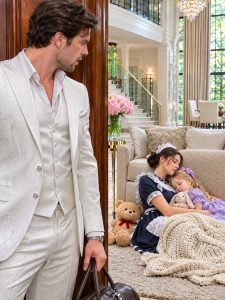
Inside the living room, Grant found Ruby sleeping on a blanket beside the sofa, clutching her worn stuffed rabbit. Her nanny, twenty-eight-year-old Tessa Morgan, knelt protectively beside her, while the housekeeper, Doreen, watched from the doorway with an unmistakably satisfied expression.
“Get out of my house! I don’t pay a nanny to let my daughter sleep on the floor!”
Tessa tried to explain that Ruby suffered from severe nightmares and repeatedly returned to that particular corner whenever she was taken upstairs. Since Caroline, Grant’s wife, had died in a car accident eleven months earlier, Ruby hadn’t spoken a single word.
Grant had attempted to help his daughter by hiring specialists, purchasing expensive toys, and renovating her bedroom. When none of those efforts improved her condition, he’d buried himself in work, convincing himself that providing financial security was enough.
“She sleeps here because this is where Caroline used to read to her. Ruby doesn’t need a more expensive bedroom, Mr. Holloway. She needs to feel that someone is staying beside her.”
Tessa’s explanation briefly unsettled Grant, but Doreen immediately accused the nanny of questioning his parenting. Embarrassed in front of his employees, Grant allowed his anger to overrule his judgment and dismissed Tessa on the spot.
Despite the heavy rain outside, he refused the cook Bernadette’s request to let Tessa remain until morning. The young woman quietly packed her belongings, then returned downstairs to kiss Ruby’s forehead before leaving.
“Please don’t leave her alone when she wakes up. Even when Ruby doesn’t answer, she hears everything.”
As Tessa opened the front door, Ruby awakened and rushed toward her, wrapping both arms around the nanny’s legs. Then, after eleven months of complete silence, the little girl suddenly spoke.
“Daddy, please don’t send Tessa away! Mommy died, you’re always gone, and she’s the only person who stays with me!”
Grant stood speechless, overwhelmed by the realization that his daughter’s first words were a desperate plea not to lose another person she loved. Nevertheless, his pride prevented him from reversing his decision, and Tessa disappeared into the rain.
Ruby eventually cried herself to sleep in Bernadette’s arms. Later that night, Grant returned to the living room and sat on the rug where Caroline had once spent countless evenings reading bedtime stories to their daughter.
Beneath the sofa, he discovered a blue notebook filled with Tessa’s careful observations about Ruby’s favorite foods, frightening memories, and comforting songs. A photograph slipped from its pages, showing Caroline lying in a hospital bed while holding the hand of a young woman wearing medical scrubs.
Grant immediately recognized the woman as Tessa. On the back of the photograph, she’d written a promise to Caroline that her daughter would never be left alone.
The next morning, Ruby sat beside the front door waiting for Tessa to return. Grant contacted his driver, Walter, who explained that he’d occasionally taken Tessa to visit her mother in Bridgeport.
Grant drove to the modest apartment where Tessa’s mother, Gloria, lived. Gloria angrily confronted him for humiliating her daughter and revealed that Tessa had once worked as a certified nursing assistant before losing her hospital position following an accusation involving a missing piece of jewelry.
Someone claiming to represent the Holloway family had made the allegation, although Grant insisted he’d never authorized any complaint. Gloria then explained that Tessa was leaving for Philadelphia to begin another job.
Grant hurried to the Stamford bus station and reached Tessa before she boarded. When he showed her the hospital photograph, she revealed something that completely changed his understanding of Caroline’s final hours.
“Your wife tried to call you before she died. Someone answered your phone and told her that you didn’t want to speak to her.”
Grant remembered that his longtime business partner, Whitney Sterling, had been holding his phone during an important investor meeting that afternoon. Suddenly, he realized she might have prevented him from hearing his wife’s final words.
PART 2: THE PROMISE CAROLINE MADE TESSA KEEP
Tessa allowed her bus to leave after Grant showed her a drawing Ruby had made that morning. It depicted the living room, a yellow moon, and two people embracing, while a man carrying a suitcase stood far away from them.
Grant admitted that Ruby had identified the distant figure as her father, and he couldn’t deny that her drawing accurately reflected their relationship. Tessa eventually agreed to explain everything over coffee near the station.
Eleven months earlier, Caroline had been brought to St. Gabriel Medical Center following a serious collision on the Merritt Parkway. Tessa was completing her hospital shift when Caroline arrived, conscious but critically injured.
Caroline repeatedly asked to speak with Grant and Ruby, but her own phone had been destroyed in the accident. Tessa lent her a phone, and they attempted to contact Grant four times.
“On the final call, a woman answered. Caroline begged to speak with you, but the woman said you were busy and should not be disturbed.”
Grant remembered Whitney taking responsibility for his phone during a meeting with investors. He’d never known Caroline had called, and for nearly a year he’d believed she’d died without attempting to contact him.
After the final unsuccessful call, Caroline asked Tessa to remain beside her. She spoke about Ruby, their nightly storytelling tradition, and her fear that her daughter would feel abandoned.
Before losing consciousness, Caroline entrusted Tessa with a small silver locket engraved with a moon. Inside was a photograph of Caroline holding Ruby as a baby, and she wanted her daughter to receive it when the time was right.
“She asked me to help Ruby feel safe until you could find a way to be present for her.”
Tessa had intended to honor that promise, but someone accused her of stealing the locket after Caroline’s death. Although no criminal investigation or conviction followed, the accusation cost her temporary hospital contract and disrupted the clinical placements she needed to complete her nursing education.
Months later, she discovered Grant’s advertisement for a nanny and applied because she wanted to help Ruby. She hadn’t intended to replace Caroline or interfere with Grant’s family, but she recognized the little girl’s profound loneliness.
Grant apologized for treating her so harshly and admitted that she’d understood Ruby’s emotional needs better than he had. Together, they visited St. Gabriel Medical Center to examine the circumstances surrounding the complaint.
Tessa’s former supervisor, Marianne Doyle, located the hospital records and confirmed that the termination followed threats of legal action rather than proven theft. The complaint identified Whitney Sterling as the person claiming to represent Grant Holloway.
“I never gave Whitney permission to make that accusation.”
Marianne explained that another nurse had witnessed Caroline handing the locket to Tessa and was willing to confirm what happened. Before they could discuss the matter further, Grant received an urgent call from Bernadette.
Whitney had arrived at the Greenwich estate accompanied by two representatives from a residential boarding program. She claimed Grant had authorized Ruby’s enrollment and insisted that the child needed to leave immediately.
Grant rushed home and discovered Ruby crying near the entrance while two women prepared to take her away. Doreen stood nearby as Whitney calmly explained that Ruby needed specialized care and that Grant couldn’t repeatedly abandon business responsibilities to handle family problems.
“Nobody is taking my daughter anywhere!”
Whitney produced an authorization form bearing Grant’s genuine signature. He remembered signing a collection of documents she’d presented weeks earlier without carefully reading them, but he had never knowingly agreed to send Ruby away.