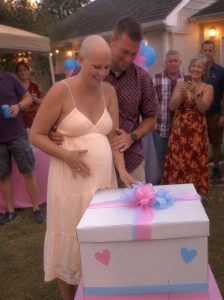
Part 2: The Letter Beneath the Blanket
The backyard went silent.
I could hear the paper lanterns knocking softly against their strings. I could smell cut grass and lemonade, and under it all, the faint hospital scent that had followed my daughter for six months.
There were no balloons in that box.
There was only a pink baby blanket, folded in thirds, with a hand-stitched edge. On top of it lay a single sheet of paper with a cancer center letterhead.
Beside it sat a small card in Michael’s handwriting. It said only, Show them.
Maren’s hands were shaking too hard to lift the page. She pressed it into mine instead.
I took my reading glasses from my pocket. It took me two tries to get them onto my nose.
The letter was from Dr. Okafor, her oncologist. It was dated that very morning, and it was short.
I read the third line out loud, slowly, because I did not trust my own eyes.
The interim scan showed a complete metabolic response. There was no evidence of active disease.
I read that sentence three times, and it did not change.
Six weeks earlier, Dr. Okafor had shown us a scan of a mass resting beside my daughter’s heart. She had told us, gently, that the road ahead would run well past the birth. I had memorized words I never wanted to know, like cycles and staging and surveillance.
A response this early was possible, she had said. But it was uncommon, and we should not count on it.
That was why I had said impossible. I had not meant it as a scream. I had meant it as a prayer that finally had an answer.
Maren found her voice then, thin and cracked.
She told the guests that she had heard the news that morning, on the phone, sitting on the edge of her bed. She said she and Michael had cried for an hour, and then they had decided to keep it quiet until she could hear it again with all of us around her.
Mr. Delgado from next door took off his cap and held it against his chest. Michael’s mother sat down on the grass as if her knees had simply let go.
Someone near the back began to cry out loud, and then someone else. Soon, no one was holding it in.
I lifted the blanket from the box, and a small tag fell from the corner.
There was a name stitched there in white thread. Lucy Grace.
So it was a girl.
I looked at my daughter, bald and radiant in her white dress, and I could not tell where the sorrow of the past six months ended and this joy began. Perhaps they had never really been separate.
She leaned into me and whispered that Lucy was named for my mother.
I had to hold the box to stay upright.
Michael touched my arm then. His eyes went to the bottom of the box, where the blanket had been resting.
Beneath it, flat against the white cardboard, was a second envelope.
My name was written across the front in Maren’s handwriting. Under it, in smaller letters, she had added three words.
Only if. Mom.
Maren looked at me, steady and tearful.
She said she had written it the night after her diagnosis, when she did not know how this would end. She said she had been carrying it for months, and she wanted to watch me open it herself.
My fingers were not steady as I broke the seal.
Part 3: The Letter Maren Wrote in the Dark
I unfolded the pages. Maren stood very close to me, and the guests stood very still.
The first line was in her careful, rounded handwriting, the same hand that once practiced her name on the back of grocery receipts.
Mom, if you are reading this, you are probably angry at me for being brave in the wrong way.
I laughed through tears. She knew me so well.
I need you to know that I was not afraid of the hospital, or the needles, or the hair. I was afraid of one thing only. I was afraid of leaving her before I had the chance to know her.
I stopped and pressed the page flat against my chest.
I remembered that night. It was a Tuesday, three days after the diagnosis. I had sat in my car outside the hospital for twenty minutes before I could make myself walk in and be steady for her.
I had thought I was hiding my fear. She had been writing hers down in the next room.
I kept reading.
If I am not here, please tell Lucy three things. Tell her I sang off-key in the car and never apologized. Tell her I laughed in the chemo chair because the nurses brought me lemon cookies. And tell her I picked her name because of the strongest woman I know.
There was a smudge at the bottom of that paragraph, a small round one. A tear, long since dried.
Mom, you taught me to ride a bicycle in the parking lot behind the church. You ran beside me holding the seat, and then one day you let go, and you did not tell me. I only knew because I turned around and saw how far away you were.
Letting go of the seat was the bravest thing you ever did. I am asking you now to do the opposite. Please hold on a little longer. Hold on to Lucy for me.
I could not read the last paragraph aloud.
I handed the pages to Maren, and she took them gently, as if they might still break.
She said she was giving them to me now because the letter had been written for a different ending. This was the ending we had been given. She wanted me to have both, so that I would always know how much she had loved us in the dark.
I held my daughter then, in front of all forty of them, and I did not care who saw.
Her shoulders were so thin under the white dress. But the baby kicked once against my stomach, firm and sure, and we both laughed.
For the first time in six months, I let myself believe we were going to be all right.
The afternoon softened after that. People ate cake. Someone put on a record. Mr. Delgado told a story about his own mother that made even Maren giggle.
Dr. Okafor had asked that Maren finish the remaining treatment as planned, just to be safe. Maren agreed. She said she was not done being careful.
The weeks that followed were quiet, ordinary, and wonderful in a way I had forgotten ordinary could be.
We folded tiny socks. We painted a nursery the color of pale butter. Maren took naps in the afternoon sun with the blanket across her knees.
Eight weeks went by like that.
Then, at 2:14 on a Thursday morning, my phone lit up in the dark.
It was Michael, and his voice was tight and fast.
He said Maren’s water had broken.
She was only thirty-four weeks along.
Part 4: The Longest Night
I do not remember dressing. I remember keys, and a red light I should not have crossed, and the empty highway unrolling beneath the streetlamps.
I remember saying her name out loud in the car, over and over, as if it could keep the road smooth.
The hospital smelled of antiseptic and burned coffee. A young nurse met me at the doors and walked me down a long hallway, and the fluorescent lights hummed above us like a held note.
Maren was already in a labor room, pale against the white pillow.
Michael sat beside her, gripping her hand with both of his. He looked up at me and tried to smile.
The room was fuller than I expected. There was an obstetrician, two nurses, and a woman in blue scrubs whom I recognized only when she turned.
It was Dr. Okafor.
She had driven in from across the city at three in the morning. When I asked why, she said that an oncology patient in labor was not a situation she would leave to anyone else.