Part 2/2
Frank’s smile widened. He took a slow sip of champagne. Later, Claire would remember the exact sound of ice touching glass. It was small, delicate, and obscene.
Webb squeezed harder. Pain shot up her arm. Under the sleeve, the bruise was already being written. Claire kept her voice quiet because she knew what the radio network did not yet know.
At that moment, the communications watch had already flagged the corridor delay. The east entrance was not just a door. It was part of a controlled movement path tied to Claire’s scheduled delivery.
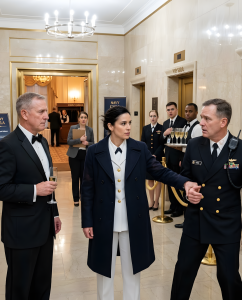
The radio crackled.
Static snapped through the hallway, sharp enough to silence the little whispers beginning behind her. Webb paused. Frank lowered his glass. The aide finally stopped pretending to study her clipboard.
Then the fleet commander’s voice came through.
“Captain Webb, remove your hand from Director Navaro immediately.”
Webb’s face changed before he let go. It went from anger to confusion, then from confusion to recognition. His hand opened slowly, as if each finger needed separate permission to release her.
Frank’s smile disappeared.
The commander continued over the radio. “Confirming identity: Claire Navaro. Navy Intelligence. Special access cleared. East corridor authorized. Captain Webb, you will release her and stand by for instruction.”
Webb stepped back. His mouth opened, but no useful words arrived. “Ma’am, I didn’t realize—”
“No,” Claire said. “You didn’t ask.”
The east corridor doors unlocked from inside. The magnetic seal gave a clean metallic click, and a communications officer stepped out with a sealed gray envelope. Claire’s full title was printed across the front.
DIRECTOR CLAIRE NAVARO.
The officer held it with both hands. That small courtesy landed harder than any raised voice could have. Everyone in the hallway understood then that Claire had not wandered into authority. Authority had been waiting for her.
Frank stared at the envelope. His champagne glass hovered uselessly near his chest. For twelve years, he had built a private version of Claire that made him comfortable: harmless, clerical, smaller than him.
Paper destroyed that version in seconds.
Webb tried again. “Director Navaro, I apologize. I thought—”
Claire took the envelope. “You thought force was a shortcut.”
The fleet commander’s voice returned. “Director Navaro, shall I have Command Security escort Colonel Frank out before or after you deliver the brief?”
Frank flinched when his name came through the radio. That was the first honest reaction Claire had ever seen from him about her work. Not pride. Not respect. Fear.
Claire looked at him across the hallway. Around them, the officers had gone completely still. The waiter lowered the tray only when one glass began to tremble against another.
“After,” Claire said. “He can wait.”
The words were not loud, but they carried. Frank’s face reddened. Webb stared at the floor. The junior officers found sudden discipline in silence.
Claire entered the restricted corridor and delivered the brief at 20:44, one minute ahead of the required time. The bruise on her arm darkened while she spoke. She did not mention it until the operation was complete.
Afterward, procedure took over. Webb’s radio transmission had recorded the exchange. The corridor camera had captured his hand on Claire’s arm. The access log showed her authorization before he touched her.
A command incident report was opened that same night. The security office pulled badge data, radio audio, and hallway footage. Claire gave a statement because competent systems require documentation, not performance.
Webb was relieved from gala security duty before midnight. The next morning, he was ordered into formal review. His apology arrived through channels, polished and useless.
Frank’s removal was quieter. Command Security escorted him out after the brief concluded. No shouting. No scene. Just two uniformed personnel, one stunned retired Colonel, and the end of a very long illusion.
In the car later, Claire’s mother called three times. Claire did not answer until the fourth. When she did, her mother was crying, not because Frank had been embarrassed, but because she finally understood what Claire had endured in silence.
“He told everyone you exaggerated,” her mother whispered.
Claire looked at the bruise blooming beneath her sleeve. “He always did.”
That became the fracture no family dinner could repair. Frank sent one message the next day, then another through her mother. He said he had not known. He said he had been proud in his own way.
Claire did not argue with him. Arguing would have required pretending the issue was misunderstanding. It was not. He had been offered years of her dignity and chose to spend them cheaply.
The official consequences belonged to Navy channels. Webb faced review, mandatory statements, and a permanent record of conduct unbecoming around a cleared senior official. Claire did not need revenge; the paper trail was colder and cleaner.
The personal consequence belonged to Frank. For the first time, he was not allowed to define her in a room she had earned access to. He was not even allowed to remain in the hallway.
Months later, the bruise was gone. The memory was not. Claire still wore dress whites when required. She still carried sealed folders. She still kept secrets because that was the work.
But she no longer gave Frank the gift of silence he had weaponized.
At a later family gathering, someone joked lightly about Claire’s “desk job,” then stopped when nobody laughed. Frank looked down at his plate. Claire said nothing at first.
Then she lifted her glass and said, “Administrative work can be very sensitive.”
Her mother smiled. Frank did not.
An entire hallway had taught him what Claire had known for twenty-two years: quiet service is still service, hidden authority is still authority, and the truth does not become smaller just because insecure people need it that way.
She had spent decades disappearing in plain sight. That night, at the Washington Navy Yard, the radio said her name out loud.