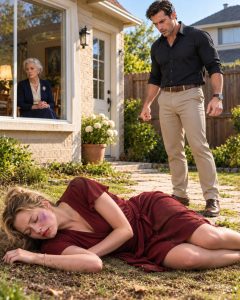
“My husband beat me every single day because I had failed to give him the son he believed he was entitled to.
One afternoon, the pain became so unbearable that my body finally gave up, and I collapsed unconscious in the backyard before I could even protect my face.
He rushed me to the hospital and lied with terrifying ease, telling the doctor I had fallen down the stairs.
But Richard never imagined that the X-ray would reveal something so chilling that, the moment he saw it, his face lost all color and his body froze in pure fear.
Every morning in that house began with the same horrible certainty.
Richard would pull me out into the backyard like I was not his wife, but a mistake he needed to punish again and again.
Then he would beat me, always spitting the same cruel words as if they explained everything:
“I married you, but you are completely useless because you cannot give me a boy.”
First came the slaps, sharp and humiliating, splitting the quiet morning air.
Then came the kicks, heavy and brutal, driving the breath out of my lungs.
After that, he struck wherever his anger landed—my face, my ribs, my back, my shoulders.
It did not matter to him where I hurt, because pain was exactly what he wanted me to feel.
The neighbors heard my screams.
I knew they did.
Their houses were too close, their windows too thin, and my cries too desperate to be mistaken for anything else.
But they only closed their blinds.
They only shut their windows.
They only chose silence.
His mother stayed inside the house as if the walls could separate her from the truth.
She sat with her rosary beads wrapped around her fingers, whispering prayers beneath the framed picture of a saint, never once stepping outside to stop her son.
And me?
I curled up in the dirt like a wounded animal, holding my arms over my head and waiting for the next blow.
I no longer prayed for love.
I no longer prayed for justice.
I only prayed that it would end quickly, so I could drag myself back inside and cook his breakfast before his rage returned.
We had two daughters.
Two beautiful, innocent girls with gentle voices and eyes that had learned fear far too early.
But in Richard’s house, they were not seen as blessings.
They were treated like a curse, like proof that I had failed as a woman, as a wife, as everything he believed I should have been.
Every time Richard looked at them, his anger grew darker.
Every time he heard them laugh, his face hardened.
And every time he remembered that they were girls, he made me pay for it with my body.
That Tuesday began just like the others, with the same dread sitting heavy in my chest.
He stood over me in the backyard, shouting until his voice cracked, kicking me while I tried to cover my ribs with trembling arms.
The dirt was cold against my cheek, and the sky above me blurred as tears and pain mixed together.
Then my ears began to ring violently.
The sound grew louder and louder until Richard’s voice faded into something distant, distorted, almost unreal.
The yard, the fence, the house, even the sunlight all began to dissolve into a dark, spinning blur.
With one final, vicious strike, my body went completely still.
I blacked out on the cold dirt.
When I finally opened my eyes again, I was lying in a sterile hospital bed at Parkland Memorial Hospital in Dallas.
The lights above me were painfully bright, my body ached with every breath, and Richard was standing right beside me, performing the role of a terrified husband perfectly.
His eyes were soft for the doctor.
His voice was calm for the nurses.
His hand rested near mine like he had not been the reason I was there.
Then he quickly told the attending physician his lie:
“My wife took a terrible fall down the stairs.”
I was too weak to argue.
My lips felt dry, my throat burned, and my body was so heavy that even opening my eyes took effort.
So I said nothing.
I simply let my eyelids close, swallowing the truth like I had swallowed every scream, every bruise, every humiliation inside that house.
But my injuries were too severe to be explained away with one simple lie.
The doctor examined me carefully, his expression tightening with every bruise, every swollen mark, every place where pain answered before I could.
He ordered scans and X-rays immediately.
The nurses wheeled my gurney through the hospital hallway and into a freezing imaging room filled with harsh white light.
The cold bit into my skin, and the machines hummed around me as if they were about to speak the truth I had been too broken to say.
About an hour later, the doctor called Richard into the hallway.
I remained lying alone in the hospital room, barely moving beneath the thin blanket.
But the door had been left open just a crack, and through that narrow space, I could hear them clearly.
The doctor’s voice was not gentle anymore.
It was controlled.
It was hard.
It sounded like a man who had just found something no lie could bury.
“Sir, I need you to take a look at these X-rays right now.”
Richard said absolutely nothing.
For the first time in all the years I had known him, there was no yelling, no threat, no arrogant excuse, no quick answer waiting on his tongue.
Only silence.
A few long minutes passed.
Then the heavy door slowly opened.
Richard walked back into the room like a man returning from his own judgment.
His face was ghostly pale, his lips trembled, and both of his hands were gripping a large X-ray film so tightly that the edges shook.
He stood there staring at me.
His mouth opened.
Then closed.
Then opened again.
But not a single sound came out.
The doctor stepped into the room behind him, his eyes fixed on my husband with a cold, unforgiving glare.
He let the silence stretch until even the machines beside my bed seemed to stop breathing, and then he said…”
“Richard, your wife did not fall down the stairs.”
The words seemed to drain every bit of air from the room.
My husband stood beside my hospital bed, still gripping the X-ray film.
For years, I had watched him terrify everyone around him with his anger.
Now, for the first time, I watched fear take possession of his face.
The doctor stepped closer.
“My name is Dr. Thomas Bennett,” he said, looking directly at me. “And I need you to understand something very important.”
I struggled to keep my eyes open.
He lowered his voice.
“Your injuries are serious, but you’re receiving treatment. We’re going to do everything we can to help you.”
Richard swallowed.
“Doctor, I already explained what happened.”
Dr. Bennett turned toward him.
“Yes. You said your wife fell down the stairs.”
Richard nodded quickly.
“That’s right.”
The doctor looked at the images.
“Then perhaps you can explain why she has multiple fractures in different stages of healing.”
Richard stopped moving.
I felt my stomach tighten.
Dr. Bennett continued.
“Some of these injuries are recent. Others appear to have occurred weeks or months ago.”
He pointed toward the film.
“There are signs of previous rib fractures, injuries involving the shoulder, and a more recent fracture in the spine.”
Richard’s lips parted.
“But…”
The doctor didn’t let him finish.
“These findings require further evaluation, but they raise serious concerns about repeated trauma.”
I stared at the ceiling.
Repeated trauma.
Two words.
So clinical.
So ordinary.
Yet they described years of mornings when I had curled into myself and waited for Richard’s anger to end.
The doctor looked at my husband.
“A single fall does not adequately explain what we’re seeing.”
Richard tried to laugh.
It came out as a strange, broken sound.
“My wife is clumsy.”
The doctor said nothing.
“She falls all the time.”
Still, the doctor remained silent.
Richard’s voice rose.
“She doesn’t take care of herself!”
I flinched.
Immediately.
Without thinking.
The movement sent pain through my ribs.
Dr. Bennett noticed.
His expression changed.
He turned toward the nurse standing beside the door.
“Could you please arrange for our patient to be assessed privately?”
Richard’s head snapped toward him.
“Privately?”
“Yes.”
“I’m her husband.”
The doctor nodded.
“And right now, she needs an opportunity to speak without anyone answering for her.”
Richard stared at him.
Then looked at me.
I knew that look.
It was the warning he gave me before guests arrived.
Before family gatherings.
Before anyone asked why I was wearing long sleeves in summer.
Say the wrong thing, and you’ll regret it.
I lowered my eyes.
Richard stepped closer.
“Sweetheart, tell him what happened.”
My heart began pounding.
He smiled.
That terrible smile.
The one he wore whenever someone else was watching.
“Tell the doctor you fell.”
I couldn’t speak.
My throat felt locked.
Then Dr. Bennett stepped between us.
“Sir, I need you to wait outside.”
Richard’s expression hardened.
“I’m not leaving my wife.”
The doctor remained calm.
“Hospital staff will help her. Please step outside.”
Richard looked toward the nurse.
Then back at me.
For one frightening moment, I thought he might refuse.
But there were people watching.
And Richard had always cared deeply about how strangers saw him.
He straightened his jacket.
“Fine.”
Then he leaned slightly toward me.
“I’ll be right outside, darling.”
His voice was sweet.
His eyes were not.
When the door closed, I began trembling.
Not a little.
My whole body shook.
The nurse approached my bed.
She was a woman in her forties with kind eyes and a soft voice.
“I’m Nurse Angela,” she said. “You’re safe here right now.”
I stared at her.
Safe.
I had almost forgotten what that word meant.
Dr. Bennett pulled a chair beside my bed.
“Can you tell me your name?”
I swallowed.
“Grace.”
He nodded.
“Grace, I’m going to ask you a difficult question.”
My eyes filled.
“Okay.”
He looked at me carefully.
“Did your husband cause these injuries?”
I closed my eyes.
For years, the answer had lived inside me.
It had followed me through every room of our house.
It had sat beside me at the dinner table.
It had lain awake with me through sleepless nights.
But I had never spoken it aloud to someone who might actually help.
My lips trembled.
I thought about my daughters.
Emma and Lily.
Emma was nine.
Lily was six.
Two little girls who had learned to recognize their father’s footsteps before they learned to understand why those footsteps frightened them.
I opened my eyes.
“Yes.”
The word was barely a whisper.
But the room changed.
Angela gently took my hand.
Dr. Bennett nodded.
“Thank you for telling us.”
Tears spilled down my cheeks.
“He hurts me.”
My voice cracked.
“Every day.”
Angela’s expression softened.
Dr. Bennett remained steady.
“Grace, I’m sorry this has been happening to you.”
I began crying harder.
“He says it’s my fault.”
The doctor waited.
“Because I didn’t give him a son.”
For a moment, neither spoke.
Then Angela whispered, “Oh, Grace.”
I stared at the blanket.
“We have two daughters.”
My voice broke.
“They’re beautiful girls.”
Angela squeezed my hand.
“I believe you.”
I began sobbing.
“But he hates them because they’re not boys.”
Dr. Bennett leaned forward.
“Grace, none of this is your fault.”
I shook my head.
“He says I failed him.”
The doctor spoke gently.
“You did not fail anyone by having daughters. The sex of a baby is determined by which sex chromosome the fertilizing sperm contributes. It is not something a mother can choose or control.”
I stared at him.
For years, Richard had insisted that I was responsible.
That my body had betrayed him.
That I had somehow denied him the son he deserved.
Now a doctor was telling me the truth.
And the truth was so simple that I almost couldn’t understand why I’d been punished for so long.
I covered my face.
Angela waited until I could breathe more comfortably.
Then she asked, “Grace, are your daughters safe right now?”
My eyes flew open.
The girls.
I had been so overwhelmed by pain that I hadn’t even asked where they were.
“They’re at home.”
My voice shook.
“With Richard’s mother.”
Angela looked toward Dr. Bennett.
Then back at me.
“Does his mother know about the abuse?”
I nodded.
“She hears it.”
My throat tightened.
“She never stops him.”
Angela’s face became serious.
“Has Richard ever hurt the girls?”
I hesitated.
“He shouts at them.”
My eyes filled.
“He grabs Emma when he’s angry.”
I swallowed.
“And Lily hides under her bed whenever he comes home.”
Dr. Bennett nodded slowly.
“Grace, we need to make sure they’re safe.”
Panic rose inside me.
“If Richard finds out I told you…”
Angela leaned closer.
“We’ll work with the hospital’s social worker and the appropriate authorities to make a safety plan.”
I shook my head.
“He’ll kill me.”
The words escaped before I could stop them.
The room went silent.
I stared at Angela.
Then whispered, “He told me so.”
She squeezed my hand.
“Thank you for telling us. We’re taking that seriously.”
For the first time, I saw someone understand the danger without asking why I hadn’t simply left.
Dr. Bennett explained that I needed further treatment and monitoring.
He also told me the hospital would document my injuries and help me speak with a social worker and law enforcement if I chose.
I nodded weakly.
But my mind was still at home.
With Emma.
With Lily.
With the two little girls who were waiting for their mother to return.
An hour later, a hospital social worker named Rebecca entered my room.
She sat beside me.
She didn’t rush.
She didn’t ask why I’d stayed.
She didn’t tell me what she would have done in my position.
Instead, she asked what I needed most.
“My daughters,” I whispered.
“I need my daughters.”
Rebecca nodded.
“Then we’ll focus on their safety.”
She helped me contact my younger sister, Hannah.
Hannah lived forty minutes away.
We hadn’t spoken properly in almost a year.
Richard hated her.
He said she interfered in our marriage.
Eventually, he made every visit so unpleasant that I stopped inviting her over.
But I still remembered her number.
When she answered, her voice was cheerful.
“Grace?”
I began crying.
“Hannah…”
Her tone changed instantly.
“What’s wrong?”
I couldn’t speak.
“Grace?”
I swallowed.
“I’m in the hospital.”
Silence.
Then she whispered, “What happened?”
I looked toward Rebecca.
She nodded reassuringly.
I took a breath.
“Richard hurt me.”
For several seconds, Hannah said nothing.
Then I heard her begin crying.
“Oh, Grace.”
My voice broke.
“I need help.”
She answered immediately.
“Tell me what to do.”
I explained that Emma and Lily were at home with Richard’s mother.
Hannah’s voice became firm.
“I’m coming.”
Rebecca helped coordinate the next steps with the appropriate authorities so that the girls could be checked on safely.
I didn’t want Hannah confronting Richard alone.
I knew what he was capable of.
And for once, I refused to put another person in danger by pretending everything would somehow work out.
Meanwhile, Richard remained in the hospital waiting area.
He called my phone repeatedly.
When I didn’t answer, he began sending messages.