Part 2
Cold rain air poured into the apartment. Marcus stood in uniform with a duffel in one hand and joy still fading from his face. He had come home early to surprise me. Instead, he walked into evidence.
His eyes moved from the red mark on my cheek to the spit on my sleeve, from Monica’s pocket to Brett’s bulging jacket, from Sandra’s raised hand to the white envelope no longer on the table.
The duffel hit the floor like a gunshot. “Who hit my wife?” Marcus asked.
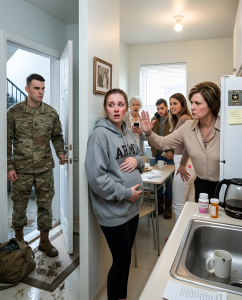
No one answered. Sandra blinked at him as if he had violated the rules by appearing before she was finished. Monica tried to speak first, but Marcus lifted one hand and pointed to her pocket.
“Phone,” he said. Monica laughed weakly and told him he did not understand what I had been doing while he was gone. Marcus did not raise his voice. He did not move closer. He simply repeated the word until her hand shook.
“Phone.” The hallway door across from ours opened then. Mrs. Chun stood outside in slippers, holding her phone with both hands. She had heard the hit through the wall. She had called the police. She had recorded what came after.
Sandra’s face changed at the word recorded. It was small, almost invisible, but Marcus saw it. Brett saw it too. He whispered, “Mom,” like a boy who had just realized adults could be punished.
Monica finally handed my phone back. The screen was still lit. Sergeant Williams had sent two messages. The first said Marcus had landed early. The second said he was outside and not to let anyone leave.
Marcus read both. His jaw tightened, but his voice stayed calm in a way that scared even me. He looked at his mother and asked how long this had been happening.
I could not answer at first. Not because I wanted to protect Sandra anymore, but because the truth had become too large to lift. Eight months is not one incident. It is a weather system.
Mrs. Chun answered before I did. She told him about the shouting she had heard on other afternoons, the time Brett blocked the hallway, the day Monica left laughing while I cried behind my locked bathroom door.
The police arrived six minutes later. Marcus stepped aside and let them in. He did not perform rage for them. He gave them the cash envelope, my phone, Mrs. Chun’s recording, and the doctor’s bed-rest note from the fridge.
I remember one officer asking if I wanted medical attention. I remember saying the twins had moved after the slap, then hating how small my voice sounded. Marcus turned toward me, and his expression finally broke.
He did not touch me until I nodded. Then he held my hand like it was something fragile he had almost lost, and told the officer we were going to the hospital whether I felt fine or not.
At the hospital, the monitors found both heartbeats. Fast at first, then steady. I stared at the strip of paper printing their rhythm and cried harder than I had cried in the apartment.
Marcus sat beside the bed with his forearms on his knees, still in uniform, rain drying in darker patches on his sleeves. He looked older than he had on our last video call.
“I’m sorry,” I said. He looked up like I had slapped him. “For what?”
“For not telling you.” Marcus took my hand carefully because of the IV tape. “You were trying to survive alone,” he said. “That is not the same thing as lying.”
The police report used words that sounded cleaner than the day felt: assault, theft, unlawful entry, harassment. Mrs. Chun’s recording filled in what paperwork could not. Monica’s spit. Brett’s laughter. Sandra’s voice.
The copied key became its own problem. Sandra claimed Marcus had given it to her. Marcus told the officer he had not, then remembered a weekend before deployment when Sandra had offered to water a plant.
That plant had died three weeks later. The key had not. Sandra called Marcus seventeen times that night. Monica texted from a new number. Brett sent one message about family being family. Marcus read none of them aloud. He blocked them in front of me.
The next morning, he changed the locks before breakfast. Sergeant Williams came over with coffee, a toolbox, and the kind of quiet presence that made me understand why Marcus trusted him. He replaced the chain too.
Marcus also opened the blue folder where I had saved receipts, copays, prescription labels, appointment cards, and every grocery list. I thought he would see proof that I had been careful. He saw proof that I had been afraid.
“Never again,” he said. That did not mean everything healed quickly. Fear does not leave just because the people who fed it are gone. For weeks, I flinched when the hallway floor creaked. I checked the lock twice, then four times.
Marcus went with me to every appointment after that. He learned which protein shakes I could keep down, which pharmacy had the iron prescription cheaper, which chair in the waiting room helped my back.
When Sandra tried to show up at the clinic, the receptionist already had her photo. Marcus had given copies to the doctor’s office, the building manager, and the hospital security desk. Care became a system.
The charges did not turn into a dramatic courtroom scene. Real consequences are often quieter. Sandra accepted a plea arrangement for assault and unlawful entry. Monica was cited for harassment and theft-related conduct. Brett paid restitution on the stolen cash.
More important than the legal file was the no-contact order. For the first time in months, I had a document that said my peace mattered. Marcus kept a copy by the door until I stopped needing to see it.
The twins were born six weeks later, smaller than expected but loud enough to make nurses laugh. Marcus cried when he held them. I cried because the sound of them breathing filled a space fear used to occupy.
Sandra did not meet them at the hospital. Monica did not receive photos. Brett did not know their room number. The first family picture we took had Marcus holding both babies while I slept in the bed behind him.
People told Marcus he would regret cutting off his mother. They said anger fades, blood remains, babies need grandparents, and families should forgive. He listened once, then gave the same answer every time.
“My wife and daughters are my family.” Years later, I still have the crooked courthouse photo. Marcus straightened it that night, but the frame never sat perfectly afterward. I keep it anyway because it reminds me of the line between damage and destruction.
They had mistaken my silence for permission. Marcus taught me silence could end. Mrs. Chun taught me witnesses matter. The twins taught me that survival is sometimes just one protected breath after another.
And Sandra taught me something too. A person can wear a cross heavy enough for everyone to notice and still never understand mercy. What matters is not the symbol at your throat. It is what your hands do.