PART 1: The Seats They Said We Didn’t Deserve
The first time I heard my youngest daughter cry that morning, I was standing inside the cockpit of a passenger jet, preparing to fly nearly two hundred people across the country.
I had spent eighteen years learning how to remain calm under pressure. I had flown through violent thunderstorms, handled mechanical emergencies, and made decisions where seconds mattered.
But nothing in my training prepared me for the sound of my little girl whispering, “Daddy, she said we shouldn’t be sitting here.”
My name is James Mitchell. I’m forty-three years old, a commercial airline captain, and the father of two beautiful girls named Amara and Zuri.
Amara was ten. Zuri had just turned eight.
They were the center of my world.
And on that particular morning, they were supposed to be enjoying the beginning of a special trip.
Instead, a stranger had decided to humiliate them before our aircraft even left the ground.
What happened next would teach everyone in that first-class cabin a lesson about respect.
But to understand why I made the decision I did, you need to understand what those two little girls meant to me.
Three years earlier, my wife, Naomi, had passed away after a long illness.
Before she died, she made me promise something.
“James,” she whispered from her hospital bed, squeezing my hand, “don’t let our girls grow up believing they’re less important than anyone else.”
I promised her.
And I meant it.
After losing Naomi, I struggled to balance my career with raising two daughters.
There were nights when I came home exhausted from a fourteen-hour duty day and still had to help with homework. There were mornings when I learned to braid hair while watching tutorials on my phone.
I burned pancakes.
I ruined laundry.
I once accidentally sent Zuri to school wearing two different shoes.
But I never stopped trying.
Amara was the serious one. She loved books, asked thoughtful questions, and often behaved as though she were responsible for protecting her younger sister.
Zuri was different.
She was sunshine.
She laughed loudly, talked to strangers, and believed every person she met might become her friend.
For months, both girls had begged to see what their father actually did at work.
They knew I flew airplanes.
They had seen pictures of me in uniform.
But they had never flown on a flight I was operating.
So when an opportunity came up during their school break, I arranged something special.
I purchased two confirmed first-class tickets on my flight from Atlanta to Seattle.
They would sit together near the front of the aircraft, supervised by the cabin crew while I worked.
My sister would meet us at the airport after landing, and we would spend several days visiting family and exploring the city.
It was supposed to be a celebration.
The night before departure, Zuri packed her purple backpack three separate times.
“Do you think people will know you’re our daddy?” she asked.
I laughed.
“Only if you tell them.”
Amara looked up from her book.
“Are we allowed to say you’re the captain?”
“Of course.”
Zuri grinned.
“Then I’m telling everybody.”
I smiled and shook my head.
“How about we just enjoy the trip?”
Neither of us knew how important those words would become.
The next morning, we arrived at the airport before sunrise.
Both girls wore matching denim jackets and carried the purple backpacks their mother had bought them before she died.
Zuri held my hand as we walked through the terminal.
Amara walked beside us, carefully studying every departure screen.
When we reached the gate, I knelt in front of them.
“Remember our rules?”
Amara nodded.
“Stay together. Listen to the flight attendants. Don’t leave our seats without permission.”
“And?” I asked.
Zuri threw her arms around my neck.
“Have fun!”
I hugged them both.
Then I kissed their foreheads and watched Kelly, our lead flight attendant, escort them aboard.
I had known Kelly for several years.
She was professional, patient, and especially good with nervous passengers.
I trusted her completely.
Before entering the cockpit, I watched my daughters disappear down the jet bridge.
They were laughing.
That was the last time I saw them smile that morning.
For the next several minutes, everything proceeded normally.
My first officer, Daniel Brooks, reviewed the flight paperwork while I completed our preflight checks.
The weather looked favorable.
The aircraft was ready.
We were scheduled to depart on time.
Then my headset crackled.
“Captain Mitchell?”
It was Kelly.
Her voice was controlled, but I immediately recognized something unusual in her tone.
“Go ahead.”
“Captain, we have a passenger situation in first class.”
I glanced at Daniel.
“What kind of situation?”
There was a brief pause.
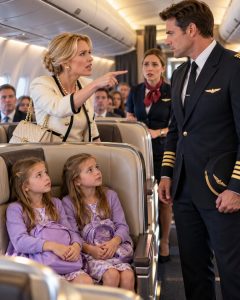
“A passenger is demanding that two children be removed from their assigned seats.”
My hand stopped moving across the checklist.
“Which seats?”
Another pause.
“Two Alpha and Two Bravo.”
My daughters.
I felt something tighten in my chest.
“Are the children causing a disturbance?”
“No, Captain. They haven’t done anything wrong.”
“Then what’s the problem?”
Kelly lowered her voice.
“The passenger says she refuses to sit near children.”
I looked through the cockpit door.
For a moment, I considered letting Kelly handle it.
Flight attendants deal with difficult passengers every day. I respected their authority and had no desire to interfere unnecessarily.
But then Kelly added something that changed my mind.
“Captain, one of the girls is crying.”
I removed my headset.
“Daniel, you have the flight deck.”
He looked at me.
“Everything okay?”
I stood.
“I’m going to find out.”
And when I opened the cockpit door, I heard a woman say something I would never forget.
“Those children have no business sitting in first class.”