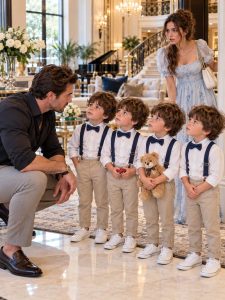
Then I found an old message from my own mother: “Never contact me again.” I called off the engagement that same night, but a $4 million transfer exposed a secret far more horrifying than I could have imagined.
PART 1
At 7:30 p.m., I was supposed to propose to Blair Whitmore in front of nearly 150 guests. At 6:42 p.m., I was locked in the bathroom of a Manhattan restaurant, staring at 4 six-year-old boys who looked like exact copies of me.
They wore navy blue sweaters and were arguing over who had taken the longest to wash his hands. One of them absentmindedly rubbed the back of his neck with his left hand.
I stopped breathing for a second.
I had done exactly the same thing since I was a little boy.
“How old are you?”
The tallest one answered without fear.
“Six.”
That number landed on me with the full weight of a memory I had spent years trying to bury.
Six years earlier, I had loved Lauren Ferris.
It hadn’t been an elegant affair between two important family names. Lauren was an interior designer, the daughter of a Charleston antiques restorer, independent, uncomfortably honest, and completely foreign to the power games of the Ashfords, my family.
She was the only woman for whom I had been willing to walk away from the family business empire.
She was also the woman who had disappeared without saying goodbye.
A woman’s voice came from the hallway.
“Mason! Henry! Theo! Wyatt! Does it take a committee meeting to get out of the bathroom?”
I knew that voice.
The boys opened the door, and Lauren appeared on the other side.
For a few seconds, neither of us reacted.
She had changed. She was thinner, her hair was pulled back, and there was a strange serenity in her eyes. But she still pressed her lips together the same way when she was nervous.
She went pale when she saw me.
Wyatt, the youngest, looked at me and then at his mother.
“Mom, why does this man look like the man in the picture in your box?”
Lauren closed her eyes.
“Wyatt…”
“The picture from the beach,” he went on. “Where you’re hugging him.”
The other three started comparing their faces.
“He has Mason’s nose,” said Henry.
“No,” protested Theo. “Mason has his own.”
I felt the floor disappear beneath my feet.
“Lauren.”
She gathered up the coats.
“We’re leaving.”
“Are they mine?”
She stopped.
“Not here.”
“Just tell me one thing. Are they my sons?”
Her eyes filled with tears, but her voice came out steady.
“You have no right to show up after 6 years asking questions like you’ve been looking for us.”
I froze.
“Looking for you? You’re the one who disappeared.”
Her expression changed.
“Is that what they told you?”
Before I could answer, she took the boys by the hand.
Mason turned his head.
“Mom… is he our father?”
Lauren didn’t answer.
She didn’t need to.
My phone began to vibrate.
My mother.
Blair.
My uncle Walter.
The event planner.
At the family estate in Greenwich, photographers were waiting, along with executives, retired politicians, friends of both families, and a ring that cost more than most people’s homes.
I slid a hand into my pocket and touched the small velvet box.
Then I watched Lauren walk away with 4 boys who had my eyes, my gestures, and even my way of walking.
At 7:02 p.m., I called Blair.
“I’m not coming.”
There was silence.
“What does that mean?”
“Cancel the celebration.”
“Carter, our families are here.”
“I know.”
“Is there another woman?”
I looked out the window as Lauren buckled the boys into a car.
“Yes.”
Blair took a few seconds.
“Lauren Ferris.”
I felt cold.
“How do you know that name?”
Her answer was even worse.
“Because everyone in your family knows it.”
That night I understood that perhaps Lauren had never abandoned me.
And that for 6 years someone very close to me had made sure we both believed exactly the opposite.
PART 2
I reached Lauren’s house in Brooklyn without bodyguards, lawyers, or gifts.
She came out before I could knock.
“You are not going to barge in and turn their lives upside down.”
“I just need the truth.”
She kept her distance.
I asked again.
“Are all 4 of them mine?”
This time she answered.
“Yes.”
One single word was enough to bring 6 years crashing down.
She had discovered the pregnancy 2 weeks after she left. At 9 weeks, she learned she was expecting 4 babies.
“I tried to come back,” she explained. “I came to New York to talk to you.”
“You never came.”
“I did. Your mother met with me.”
I felt a hollow pit in my stomach.
For years I had lived with a simple version of events: Lauren had accepted $4,000,000 to disappear. There was a transfer to her father’s old company, a signed agreement, and a letter in which she apparently said she didn’t want to start a family inside the Ashford world.
She looked at me in disbelief.
“I never received that money. And I never signed any agreement.”
That same night, I went back to the family residence.
My mother, Constance, was in the living room with Walter, my late father’s brother.
“Did you know Lauren was pregnant?”
She tried to deny it.
Then I said the boys’ names.
Mason.
Henry.
Theo.
Wyatt.
The silence betrayed her.
“We didn’t know there were 4,” she finally admitted.
I felt nauseous.
Lauren had come back pregnant and asked to see me.
My mother had refused.
She had explained that if I left the family group, I would lose my position, my shares, and a large part of my fortune. And she had made something even crueler clear to Lauren: if she used the pregnancy to pull me away from the family, the Ashfords had enough lawyers and resources to start a custody battle.
Lauren was 26 years old, had just lost her father, and was expecting multiple babies.
She ran.
But the lie went even deeper.
The $4,000,000 transfer had passed for 48 hours through the old design company of Lauren’s father before returning, through intermediary shell companies, to a structure controlled by my mother.
The letter was fake too.
A forensic handwriting analysis later confirmed that the signature had been forged.
I went back to Lauren’s house with the evidence.
She cried as she understood what had happened.
“So you thought I sold you for money.”
“Yes.”
“And I thought you knew you had children and didn’t want to meet them.”
I looked up.
She took out an old phone.
When the babies were 2 months old, she had sent photographs to my mother. Mason had been hospitalized for a breathing complication, Henry barely slept, Theo struggled to gain weight, and Wyatt cried for hours.
She hadn’t asked for money.
She had only asked that I know my children existed.
My mother’s reply was still saved:
“Carter knows the situation. He has decided not to have contact. Don’t write again.”
I had to sit down.
“I never saw this.”
“I know that now,” Lauren said. “But back then, I had to believe it.”
I wanted to talk about lawyers, press charges, publicly confront my family.
She stopped me.
“Our children are not going to become pieces in another family war.”
That sentence changed everything.
“Then tell me what I can do.”
She took a long time to answer.
“Nothing spectacular. Show up. Follow through. Listen. And accept that being their biological father doesn’t mean you’re already their dad.”
I thought that discovering the truth had been the hard part.
I didn’t yet know that earning a place in the lives of those 4 boys would be far more difficult than confronting my entire family.
PART 3
Lauren first consulted a child psychologist in Manhattan, Dr. Marlene Sutter.
I went in expecting some formula that would let me quickly make up for the lost years.
Marlene destroyed that idea in less than 10 minutes.
“You can’t get 6 years back.”
I stayed silent.
“You can build the next ones,” she added.
The conversation with the boys took place on a Saturday.
Lauren spoke to them first. I waited in a nearby coffee shop until I got a text:
“You can come.”
I found all 4 sitting on the couch.
Mason had his arms crossed.
Henry had been crying.
Theo was holding a notebook.
Wyatt was eating cookies.
Mason fired the first question.
“Mom says you’re our father.”
“Yes.”
“Did you know we existed?”
“No.”
“Why not?”
I had promised myself I wouldn’t burden four six-year-olds with the mistakes of adults.
“Because there were people who kept your mother and me from being able to talk. When you’re older, you’ll learn more about the details.”
“I don’t like that answer.”
“I don’t either.”
Henry asked, almost in a whisper:
“Are you going to disappear again?”
That question hurt more than any accusation.
“No.”
“Are you sure?”
I took a breath.
“I can’t promise I’ll never make a mistake. But I can promise I won’t disappear without telling you where I am.”
Theo raised his hand.
“I want a DNA test.”
Lauren sighed.
“Theo, this isn’t school.”
“I want data.”
I almost smiled.
“We’ll do it.”
Wyatt finished his cookie.
“Are you rich?”
“Wyatt…”
“You said we could ask questions, Mom.”
I answered:
“Yes.”
“A lot?”
“Quite a bit.”
“More than Batman?”
I decided that correcting certain concepts could wait.
The test confirmed paternity with virtually absolute certainty.
Theo studied the report before accepting the result.
“Okay.”
“Is that it?” I asked.
“Now we have data.”
It was the beginning.
There were no mansions handed over, no private vacations the following week.
There were two-hour afternoons.
Games in the park.
Homework.
Snacks.
Arguments over video games.
I discovered that Mason needed a small night-light to sleep. Henry drew when he was worried. Theo asked questions until he wore out any adult. Wyatt turned every room into an experiment.
One afternoon, I found Wyatt trying to put cereal inside a toaster.
“What are you doing?”
“Theo said heat transforms matter.”
“That doesn’t mean you can transform breakfast into a house fire.”
I unplugged the toaster.
He looked at me, disappointed.
“Dad ruined it.”
I froze.
Dad.
Wyatt kept talking as if nothing had happened.
I walked to the bathroom, closed the door, and cried sitting on the edge of the tub for several minutes.
I never demanded that the other 3 use that word.
Henry took months.
Theo initially saved it for when he needed something.
Mason took almost a year.
I finally understood what Lauren had meant.
Being a father didn’t begin with a genetic test.
It began with showing up on Tuesday after showing up on Monday.
Meanwhile, the Ashford structure was cracking.
My mother demanded to meet her grandchildren.
I refused.
“They’re my family.”
“Being related doesn’t give you automatic access.”
“I’m their grandmother.”
“And you’re also the person who kept their father from knowing they existed.”
She threatened to bring in lawyers.
I set copies of the fake transfer, the handwriting report, and the messages sent to Lauren on the table.
“Go ahead. But all of this stops being private.”
She understood.
Walter reacted differently.
He asked to apologize to Lauren.
She said no.
Walter accepted the refusal without pushing.