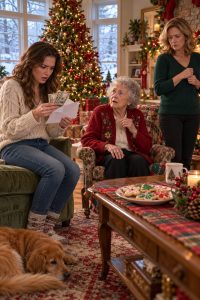
The first time I saw my mother look genuinely terrified, I was holding five hundred dollars in my hands.
It was Christmas afternoon in Syracuse, New York, and twenty-four years of family tradition had just shattered in front of me.
My grandmother, Ruth Walsh, had been giving me an envelope every Christmas since I was five years old.
Inside, there was always a twenty-dollar bill and a handwritten letter.
The money never changed.
The letters did.
They followed me through scraped knees, terrible school pictures, first heartbreaks, high school graduation, and the day I became a certified union pipefitter.
But that Christmas, when I opened the envelope, there was no letter.
Instead, five crisp hundred-dollar bills rested against a Christmas card decorated with a red cardinal.
“Grandma!”
I laughed.
“What did you do, rob a bank?”
She didn’t laugh.
Her smile disappeared so suddenly that I felt something cold move through my chest.
She stared at the money.
Then at the empty envelope.
Then directly at my mother.
“That’s not what I put in there.”
My mother, Elaine Mercer, was standing beside the Christmas tree, arranging sugar cookies on a platter.
For one brief second, her hands stopped moving.
Then she smiled.
“Oh, Mom,” she said lightly.
“Remember Tuesday?
We put money in everyone’s cards.
You said you wanted to do something extra special this year.”
Grandma’s expression hardened.
She was eighty-one, barely five feet tall, and stubborn enough to argue with a snowplow driver about where he deposited snow.
She handled her own finances, completed crossword puzzles before breakfast, and remembered things everyone else had forgotten.
She had never once forgotten what she put in my Christmas envelope.
“No, Elaine,” she said quietly.
“That’s not what I put in Nola’s envelope.”
My mother crossed the room.
“You’re exhausted.
Come get some water.”
She placed one hand on Grandma’s shoulder and guided her toward the kitchen.
My stepfather, Frank, looked up from the coffee maker instruction manual he’d been studying.
“She’s eighty-one, sweetheart,” he said with a sympathetic smile.
“People get mixed up.”
I wanted to believe him.
Frank had been my father in every way that mattered since I was five.
He taught me to change a tire, attended my softball games, and spent an entire Saturday helping me prepare for my first welding certification.
He was dependable, patient, and steady.
But something about his smile that afternoon bothered me.
It was the kind of smile people use when they want a conversation to end.
I looked down at the envelope again.
For twenty-four Christmases, Grandma had given me twenty dollars and a letter.
This year, someone had replaced both with five hundred dollars.
And my grandmother was frightened.
I was twenty-nine that Christmas.
My life was ordinary enough that I never imagined my family could be hiding something extraordinary.
I worked on industrial boilers and steam lines in hospitals, schools, and university buildings.
I rented a small apartment on Syracuse’s east side, drove a ten-year-old pickup, and usually came home smelling faintly of metal and machine oil.
My name was Nola Mercer.
At least, that’s what everyone called me.
Legally, I was Nola Claire Keating.
Keating was my biological father’s surname.
According to my mother, he’d died in a motorcycle accident when I was three.
She said he’d been troubled, that his relatives had rejected us, and that she’d destroyed his photographs because remembering him was too painful.
Whenever I asked questions, she became upset.
Eventually, I stopped asking.
Frank married her when I was five.
I called him Dad.
There had never been any reason not to.
Until Christmas.
Mom and Grandma remained in the kitchen for nearly twenty minutes.
When they returned, Grandma looked smaller.
She had her rosary wrapped tightly around one hand.
Mom stayed close to her for the rest of the afternoon, bringing her coffee, adjusting her blanket, and answering questions before she could speak.
By the time I was leaving, I felt sick with uneasiness.
I bent down to kiss Grandma goodbye.
She grabbed my wrist.
Her fingers were astonishingly strong.
“Come see me alone, sweetheart,” she whispered.
I stared at her.
“Grandma?”
Her eyes flicked toward the doorway.
Mom was watching us.
“The roads are getting icy, Nola,” she said.
“You should head home.”
Grandma squeezed my wrist one final time.
And when she released me, there were tears in her eyes.
I didn’t sleep that night.
Every time I closed my eyes, I saw her face.
The next morning, I called.
Mom answered Grandma’s phone.
“She’s resting,” she said immediately.
“Can I speak to her?”
“Not right now.”
“Mom, why are you at Grandma’s house?”
A pause.
“Because she’s been confused lately.”
“Since when?”
“Nola, please don’t start.”
“I’m not starting anything.
I just want to talk to her.”
My mother’s voice hardened.
“You got five hundred dollars for Christmas.
Why can’t you just be grateful?”
I looked at my old shoebox sitting on the bedroom shelf.
Twenty-four letters.
Twenty-four years of someone telling me I mattered.
“Because Grandma didn’t give me five hundred dollars,” I said.
“Somebody else did.”
The line went silent.
Then Mom said something strange.
“Your grandmother doesn’t understand what she could ruin.”
Before I could respond, she hung up.
I stood there holding my phone, listening to the dead connection.
That sentence changed everything.
Two days after Christmas, I drove to Grandma’s house without telling anyone.
Fresh snow covered the driveway.
The ceramic snowman beside her front steps had lost its red scarf, and her porch light was still on despite the afternoon sunshine.
She opened the door before I knocked twice.
When she saw me alone, relief washed across her face.
“Thank God.”
She pulled me inside and locked the deadbolt.
“Grandma, what’s happening?”
“Did your mother come with you?”
“No.”
“Did Frank?”
“No.”
She nodded.
“Good.”
Her hands trembled as she led me into the kitchen.
A pot of coffee sat untouched on the counter.
She opened a drawer beneath the silverware organizer and removed an old photograph.
The corners were yellowed.
It showed a dark-haired man holding a toddler.
Beside him stood a young woman with long brown hair.
I recognized the woman immediately.
Or thought I did.
“Mom?”
Grandma didn’t answer.
I studied the man.
He had dark eyebrows, a narrow nose, and a crooked smile.
My stomach tightened.
His eyes looked like mine.
“That’s my father?”
Grandma nodded.
“Thomas Keating.”
I ran my thumb over the photograph.
For twenty-six years, I’d believed every image of this man had been destroyed.
“Why did Mom tell me there weren’t any pictures?”
“Because she didn’t want you asking questions.”
“About what?”
Grandma sat slowly.
Her eyes filled.
“Oh, sweetheart.
I should have told you years ago.”
“Told me what?”
She reached across the table and gripped my hand.
“Your father didn’t die in a motorcycle accident.”
The kitchen seemed to tilt.
“What?”
“There was an accident.
But he survived.”
I stared at her.
“You’re telling me he’s alive?”
She lowered her eyes.
“Yes.”
The word barely reached me.
I heard the refrigerator humming.
The radiator clicking.
A car passing outside.
Everything sounded impossibly normal.
“My father is alive?”
Grandma nodded again.
“Where is he?”
She opened her mouth.
Then a car door slammed outside.
Her expression changed instantly.
“Oh, Lord.”
A fist struck the front door.
“Nola!”
My mother’s voice.
“Nola, I know you’re in there!”
Grandma stood so quickly her chair scraped against the tile.
“Put the photograph away.”
“Grandma—”
“Now!”
I slipped it into my coat pocket.
The pounding continued.
“Mom!
Open this door!”
Grandma looked at me with naked fear.
“Whatever happens next,” she whispered, “don’t let anyone convince you that you’re imagining things.”
Then she unlocked the door.
My mother entered like a winter storm.
Her cheeks were red from the cold, and her hair was escaping its carefully arranged ponytail.
She looked at Grandma.
Then at me.
“What have you told her?”
“Enough,” Grandma answered.
Mom closed her eyes.
“Oh, God.”
“She says my father is alive,” I said.
Mom looked at me.
The expression on her face wasn’t anger.
It was grief.
“Sweetheart—”
“Don’t sweetheart me.
Is it true?”
She leaned against the kitchen counter.
For several seconds, she seemed unable to speak.
Finally, she whispered, “Yes.”
I felt as though she’d struck me.
“Twenty-six years?”
“Nola, you don’t understand.”
“Then explain it.”
She rubbed both hands over her face.
“Your father was involved in something terrible.”
“What?”
“A fire.”
I remembered nothing about a fire.
Mom had never mentioned one.
“He was convicted,” she continued.
“People died.
He went to prison.”
The words came slowly, each one worse than the last.
“Prison?”
“Yes.”
“For what?”
She looked at Grandma.
Grandma stared back.
“Tell her the whole truth, Elaine,” she said.
Mom’s voice broke.
“I don’t know the whole truth anymore.”
I looked between them.
“How can you not know?”
Mom reached for my hand.
I pulled away.
She flinched.
“Frank said it was better if you believed Thomas had died.
You were little.
You’d already been through so much.”
“What had I been through?”
Neither answered.
A terrible silence filled the kitchen.
Then Grandma said, “She deserves to know about Clara.”
Mom turned white.
“Don’t.”
“Elaine—”
“Please.”
I looked at Grandma.
“Who’s Clara?”
Before she could answer, Mom said, “Your grandmother is confused about details.
We need to talk about this carefully.”
“Stop telling me she’s confused!”
My voice echoed through the house.
Grandma began crying.
That frightened me more than anything.
She had cried when Grandpa died.
She had cried when I graduated.
But I’d never seen her cry out of fear.
I reached for my coat.
Mom stepped toward me.
“Where are you going?”
“To find my father.”
Her face crumpled.
“Nola, please don’t.”
“Why?”
“Because sometimes the truth destroys more than the lie.”
I opened the door.
“Then you should have thought about that before lying to me for twenty-six years.”
I walked out into the snow.
The photograph stayed beside my bed that night.
I must have picked it up fifty times.
Thomas Keating.
The name felt unfamiliar and strangely intimate.
I studied the young woman beside him.
She looked like my mother, but something was different.
Her smile was wider.
Her face softer.
And above her left eyebrow was a tiny crescent-shaped scar.
Mom didn’t have a scar there.
I turned the photograph over.
On the back, in faded blue ink, someone had written:
C., Tommy, and our little miracle.
August 1998.
C.
Claire?
Clara?
I remembered Grandma beginning to say something about Clara before my mother stopped her.
At two in the morning, I opened my laptop.
I searched Thomas Keating Syracuse fire 1999.
Several old newspaper references appeared.
Most were inaccessible without subscriptions.
Then I found a digitized headline from the Syracuse Herald-Journal archives.
FORMER BUILDING TECHNICIAN CONVICTED IN MAPLE STREET CENTER FIRE.
My hands went cold.
The article was dated September 14, 2001.
Thomas Keating, thirty-two, had been convicted in connection with a February 1999 fire at the Maple Street Community Center.
The blaze had killed two people.
Investigators claimed that Keating had knowingly disabled a boiler’s safety system and ignored warnings about combustible materials stored nearby.
He had maintained his innocence.
A photograph accompanied the article.
Thomas stood outside a courthouse, handcuffed, with his head lowered.
Even in the grainy image, I recognized his face.
My father’s face.
He had received a sentence of twenty-two years.
I read the article three times.
Then another.
And another.
Finally, I found a later report.
Thomas Keating had been released on parole in 2017.
My father had been free for eight years.
Eight years during which I had graduated from my apprenticeship, bought my pickup, earned promotions, and celebrated birthdays.
Eight years when he could have contacted me.
Had he tried?
Or had he really wanted nothing to do with me?
I kept searching.
An archived article mentioned the names of the people killed in the fire.
Victor Lyle, a night custodian.
And Clara Walsh Keating, thirty-one.
I stopped breathing.
Keating.
I enlarged the photograph again.
The woman beside Thomas.
The woman who looked like my mother but wasn’t quite my mother.
I whispered, “Clara.”
Then I searched her name.
The first result made my heart drop.
Clara Walsh Keating was the eldest daughter of Martin and Ruth Walsh.
My grandparents.
The article listed a surviving younger sister.
Elaine Walsh.
My mother.
I sat motionless.
Clara had been my mother’s sister.
And Thomas Keating’s wife.
Then what did that make me?
I didn’t go to work the next morning.
I drove to the Onondaga County Public Library and spent four hours reading newspaper archives.
I learned that the Maple Street Community Center had served working-class families for decades.
It offered after-school programs, community meals, and free childcare.
Thomas had been its maintenance supervisor.
Clara worked part-time in its administrative office.
The fire began shortly after seven on a Thursday evening.
Witnesses described an explosion in the basement boiler room.
Flames spread through a rear corridor.
Two adults died.
One small child was rescued.
The child’s name wasn’t included.
But the age was.
Three.
I stared at the screen.
I had been three years old.
My eyes moved to the next sentence.
The rescued child had suffered smoke inhalation and minor burns.
I looked down at my left forearm.
A pale, irregular scar crossed the skin just beneath my elbow.
Mom always said I’d burned myself on a camping stove when I was six.
I rubbed the scar with my thumb.
Suddenly, I remembered something.
Not a complete memory.
Just fragments.
A roaring sound.
Heat against my face.
Someone screaming.
A woman singing.
I pushed away from the computer.
My pulse hammered.
All my life, I’d suffered occasional nightmares about being trapped in a dark room while something thundered beneath the floor.
Mom said they were ordinary childhood dreams.
What if they were memories?
I printed everything I could find.
Then I drove to the union hall.
Our local had maintained records going back generations, including old safety complaints and contractor disputes.
I wasn’t expecting much.
But our retired business agent, Walter “Red” Harlan, knew the Maple Street case.
He was seventy-four, wore hearing aids, and still smelled faintly of pipe tobacco despite having quit twenty years earlier.
When I mentioned Thomas Keating, his face changed.
“Where’d you hear that name?”
“He’s my father.”
Red slowly removed his glasses.
“Well, I’ll be damned.”
“You knew him?”
“Everybody knew Tommy Keating.”
“Was he dangerous?”
Red looked offended.
“Tommy?”
“He was convicted of killing two people.”
Red stared at me.
Then he said something I would remember for the rest of my life.
“A jury can convict a man, Nola.
That doesn’t mean they got the right man.”
Red took me into a storage room behind the union office.
Steel filing cabinets lined the walls.
He pulled a drawer open and searched through folders.
“Tommy was a good mechanic,” he said.
“Better than most.
Wouldn’t sign off on anything unsafe.”
“Then why did they convict him?”
“Because somebody had to take the fall.”
He found a folder.
Inside was an old union grievance.
Thomas had filed it three days before the fire.
The complaint concerned repeated pressure to operate a gas-fired boiler despite a defective safety shutoff and an improperly installed bypass assembly.
Red tapped the page.
“He wanted the building closed until repairs were made.”
“Who refused?”
“The city inspector.”
I read the signature at the bottom.
F.
Mercer.
My stomach turned.
Frank Mercer.
My stepfather.
The man who taught me to weld.
The man who attended every school concert.
The man who made pancakes on snowy Saturdays.
I stared at the signature.
“Frank worked as a city inspector?”
Red nodded.
“Before he went into private consulting.”
I knew Frank had been involved in building inspections years ago.
But he’d never mentioned Maple Street.
Never mentioned Thomas Keating.
Never mentioned the fire.
“Was Frank involved in the investigation?”
I asked.
Red’s expression darkened.
“He signed the final inspection report.”
“What did it say?”
“That everything was operating safely before the fire.”
I looked down at Thomas’s complaint.
Three days earlier, he’d reported that it wasn’t.
Something inside me began to rearrange itself.
“Red, do you have copies of the technical drawings?”
He searched another cabinet.
Eventually, he found an old set of blueprints and maintenance photographs.
I spread them across the desk.
For nearly an hour, I studied the boiler connections.
One photograph showed an unauthorized bypass pipe.
Another showed the same section after the fire.
As a pipefitter, I knew exactly what I was looking at.
The configuration in the official report didn’t match the original installation.
Someone had changed the system.
More importantly, the report described a safety device that could not have operated correctly in that configuration.
“Red,” I whispered, “this inspection doesn’t make sense.”
He leaned closer.
“How so?”
I pointed to the diagram.
“The report says Thomas disabled the safety shutoff.
But this bypass was installed before his last inspection request.
If Frank approved the system, he approved the dangerous modification.”
Red grew very quiet.
Then he opened another folder.
Inside was a photograph of Thomas standing outside the community center, smiling beside three fellow workers.
Red handed it to me.
“He spent years writing letters from prison,” he said.
“To who?”
“People who might listen.”
I swallowed.
“Did he ever write to his family?”
Red looked at me for a long moment.
“Every Christmas, Nola.”
The room seemed to lose its air.
“What?”
“Every Christmas.
I know because he used to ask me whether I’d heard anything about his little girl.”
My fingers tightened around the photograph.
“He thought his daughter was dead.”
I stared at him.
Red’s eyes filled with sadness.
“That’s what they told him.”
I left the union hall shaking.
My father hadn’t simply been told I didn’t want him.
He’d been told I was dead.
I drove to the nearest parking lot, turned off the engine, and sat there until my breathing steadied.
Somewhere in New York, a man had spent twenty-six years believing his child was buried.
And I had spent the same twenty-six years believing he was.
It was monstrous.
I called Grandma.
She answered on the third ring.
“Nola?”
“Did Thomas think I died in the fire?”
Silence.
Then a broken whisper.
“Yes.”
“Who told him?”
She began crying.
“Grandma, please.”
“Elaine signed the papers.”
“What papers?”
“I didn’t know everything at the time.
Your grandfather said it was necessary.
He said people would get hurt if we didn’t.”
“Who would get hurt?”
“You.”
I gripped the steering wheel.
“Where is Thomas now?”
She hesitated.
“Grandma.”
“Utica,” she finally said.
“He lives outside Utica.”
“Do you have an address?”
“Yes.”
“Give it to me.”
There was a long silence.
Then she whispered, “I already wrote it down.”
My heart thudded.
“Where?”
“In your Christmas letter.”
I closed my eyes.
“What else was in that letter?”
“A photograph.
Copies of documents.
A small brass key.”
“To what?”
“Your grandfather’s safe-deposit box.”
I leaned forward until my forehead rested against the steering wheel.
“Why now?”
Grandma’s voice trembled.
“Because I found something in October that made me realize how badly I’d failed you.”
“What?”
“An old inspection file.”
I straightened.
“Frank’s?”
“Yes.”
“Grandma, did Frank know Thomas was my father?”
She laughed once, a terrible sound.
“Oh, sweetheart.”
Then she said, “Frank knew Thomas Keating before you were born.”
I drove to Utica the following afternoon.
Grandma gave me an address for a modest house on the edge of town.
I parked across the street and sat watching the front porch.
A plastic cardinal hung from the railing.
There was a small garden beneath the window, its flower beds covered with snow.
My father lived there.
For several minutes, I couldn’t move.
What did you say to someone whose existence had been erased from your life?
Hello, I’m your daughter.
Sorry it took me twenty-six years.
Finally, I crossed the street.
My hand shook as I knocked.
Footsteps approached.
The door opened.
The man standing there was older than the photograph.
His hair had gone mostly silver.
Deep lines bordered his eyes.
He wore jeans, a faded flannel shirt, and a worn leather watch.
But his face was unmistakable.
He looked at me.
Then his hand moved to the doorframe.
“Nola?”
He said my name as though it might break if spoken too loudly.
I nodded.
He stared.
For a moment, I thought he might collapse.
Then he whispered, “You’re alive.”
Something inside me gave way.
I had imagined anger.
Questions.
Accusations.
Instead, I stepped forward and wrapped my arms around a stranger.
He held me as though he had been waiting his entire life.
And in a way, he had.
We stood in the doorway crying while snow drifted around our feet.
Eventually, he led me inside.
The house smelled of coffee and sawdust.
He made wooden birdhouses, he explained, and volunteered at a community repair workshop.
On the mantel stood a photograph of a little girl.
Me.
At two years old.
Wearing a yellow dress.
I stared at it.
“Where did you get that?”
“Your mother took it.”
I looked at him sharply.
“Elaine?”
He shook his head.
“No.”
Then he swallowed.
“Clara.”
The name hung between us.
“Who was Clara?”
I asked.
His eyes filled.
“My wife.”
I sat down.
“And she was my…?”
He couldn’t finish.
He didn’t need to.
“Clara was your mother, Nola.”
The words struck harder than anything I’d heard so far.
Elaine wasn’t my biological mother.
She was my aunt.
The woman who had raised me.
The woman who tucked me into bed, braided my hair, helped with homework, and cried at my graduation.
My aunt.
I pressed a hand against my mouth.
Thomas sat beside me.
“I’m sorry.”
“For what?”
“For not finding you.”
“You thought I was dead.”
“I should have questioned it.”
“How could you?”
He looked at the photograph on the mantel.
“I used to dream you were alive.
Sometimes I’d wake up convinced I’d heard you calling me.”
His voice broke.
“Then I’d remember what they told me.”
I reached for his hand.
“Who told you?”
He stared at the floor.
“Elaine brought me the documents.”
My chest tightened.
“She told you I died?”
He nodded.
“And that Clara was gone.
She said there was nothing left for me to fight for.”
I looked at his worn hands.
“Why didn’t you tell people you were innocent?”
“I did.
For years.”
He opened a drawer and removed a stack of letters.
Appeals.
Requests for records.
Petitions for reconsideration.
Twenty years of paper.
“They called me a liar until I started wondering whether anyone would ever believe me.”
I examined one letter.
It was addressed to Elaine.
Another to Ruth.
Another to Frank.
Every envelope had been returned unopened.
Then Thomas showed me a small wooden box.
Inside were birthday cards.
Twenty-nine of them.
One for every year of my life.
Some were written before my supposed death.
Others afterward.
“Why did you keep writing them?”
I whispered.
He smiled sadly.
“Because writing to you was the only way I could still be your dad.”
I began crying again.
He placed the box in front of me.
“I don’t expect you to call me anything,” he said.
“I know another man raised you.”
I looked at him.
“His name is Frank.”
Thomas went completely still.
“Frank Mercer?”
“Yes.”
The color drained from his face.
He stared at me.
Then he whispered something that made every hair on my arms rise.
“Frank Mercer is the reason I went to prison.”
Thomas told me everything he knew.
He had worked at Maple Street for six years.
The community center’s heating system was old and dangerously neglected.
Management had hired an outside contractor to make inexpensive modifications rather than replace failing equipment.
Thomas objected repeatedly.
He filed complaints.
He requested inspections.
He refused to restart the boiler without repairs.
Frank Mercer was the inspector assigned to review the system.
At first, Thomas thought Frank was simply careless.
Then he discovered that Frank had a financial connection to the contractor through a consulting partnership.
If the city condemned the equipment, both men stood to lose money.
“The last time I saw Frank before the fire,” Thomas said, “he told me I worried too much.”
I thought of Frank teaching me to weld.
Always check your work twice, sweetheart.
Never trust somebody else’s signature.
I’d heard those words hundreds of times.
Now they sounded obscene.
“What happened the night of the fire?”
I asked.
Thomas stared into his coffee.
“Clara went back to the center to collect paperwork.
She had you with her because the babysitter canceled.”
He swallowed.
“I was on my way there when I got a call about an explosion.”
He had reached the building as firefighters were carrying people outside.
Someone told him Clara hadn’t made it.
Someone else told him a child had been taken to the hospital.