Part 2
She has been told for too long that her own instincts are wrong.
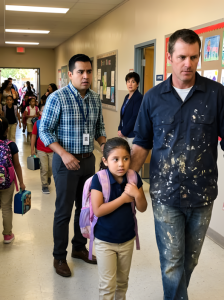
Behind them walked the same female officer from the first call and a county child protection investigator named Marisol Grant.
Principal Brooks stood.
“This is highly inappropriate,” she said.
Marisol did not blink.
“We received a report involving possible child endangerment and interference with reporting.
We need to speak with Mrs.
Reyes and Valentina privately.”
“My office is available,” Brooks said quickly.
“No,” Marisol replied.
“Not your office.”
They used the nurse’s room.
Daniel waited in the hallway, feeling every second scrape across his nerves.
Through the door, he heard muffled voices.
Once, he heard Isabel begin to cry.
Once, he heard Valentina say, very softly, “I told you.”
An hour later, the door opened.
Isabel came out first.
Her face had collapsed under the weight of what she now understood.
She walked straight to Daniel.
“I thought she was acting out,” Isabel whispered.
“Elaine told me children make stories when they want attention.
She said calling police would traumatize Valentina and ruin her life.”
Daniel looked past her at Principal Brooks, who had gone pale.
Marisol stepped into the hallway and spoke with the officer.
Within minutes, another patrol car arrived.
Marcos Velez was located at a job site and taken in for questioning.
Valentina was transported with her mother to a child advocacy center, where trained professionals could examine her and interview her safely.
The investigation moved faster after that.
It turned out there had been signs for months.
Missed school days.
Sudden stomachaches.
A nurse’s note about unexplained distress that had never been forwarded.
A counselor referral marked “resolved” even though the counselor had never met with Valentina.
Every document had one thing in common.
Principal Brooks had touched it.
She had been close to Isabel for years, an older friend from church who helped with school paperwork after Isabel remarried.
Isabel had trusted her.
When Valentina cried at home and begged not to be alone with Marcos, Isabel had panicked and called Elaine for advice.
Elaine had told her not to overreact.
She had told her little girls sometimes resent stepfathers.
She had told her involving authorities would bring shame, questions, and custody trouble.
Most unforgivably, she had told her to watch Valentina more carefully for lying.
When the district reviewed the file, Brooks was placed on administrative leave.
After the county investigation confirmed that she had discouraged reporting and failed to follow mandatory procedures, she resigned before the school board could vote on termination.
Her credential was reported to the state licensing authorities.
Marcos faced criminal investigation based on evidence gathered outside the school, Valentina’s forensic interview, and other corroborating details.
Isabel obtained a protective order and moved with Valentina to her sister’s apartment across town.
Daniel did not hear the details of the case, and he did not ask.
He only needed to know that Valentina was safe.
Three weeks later, a substitute principal visited Room 12 and quietly told Daniel that Valentina would be returning part time with support from a counselor.
On her first day back, Daniel rearranged the room.
He removed her old chair and replaced it with a soft floor cushion near the reading corner.
He did not make an announcement.
He did not ask questions.
He
simply greeted her at the door the same way he greeted every child.
“Good morning, Valentina.
I’m glad you’re here.”
She looked different.
Still small.
Still careful.
But not as alone.
At art time, she asked for paper.
Daniel gave her a fresh sheet.
This time, she drew Room 12.
She drew the windows.
The bookshelves.
The goldfish bowl.
The rug with its faded blue squares.
She drew herself standing beside the reading corner.
Then she drew Mr.
Carter near the door.
Not huge.
Not heroic.
Just there.
When she finished, she brought him the picture.
“This is a place I know,” she said.
Daniel looked at the drawing and had to breathe carefully before answering.
“It’s a very good place to know,” he said.
Months later, after the meetings, the statements, the district review, and the whispers among parents had faded into something quieter, Daniel still thought about the first morning.
He thought about how close everyone had come to missing it.
One frightened sentence.
One red drawing.
One child who almost stopped trying to be believed.
Some people called Daniel brave.
He never liked that word.
Brave made it sound dramatic.
To him, it had been simple.
A child whispered that she hurt.
An adult was supposed to listen.
The part that haunted him was not only what Marcos had done, or what Brooks had hidden.
It was how easily fear, reputation, friendship, and paperwork had almost buried a little girl’s truth under polite language.
In the end, the school survived the scandal.
Its reputation cracked, then rebuilt.
But Valentina only got one childhood.
And the question that stayed with every adult who heard the story was painfully simple: how many warning signs does a child have to draw before someone finally decides the truth matters more than comfort?