Part 1 — The Locked Gate
My mom and twin sister made me leave home at nineteen, and I spent years rebuilding my life from almost nothing. Twelve years later, they showed up at the gate of the house and business I had built—with three children, taped boxes, and a moving truck—already talking about which rooms they would take. I looked at the camera above them, kept the gate locked, and finally gave them the answer they had never expected from me… They still believed I was the quiet daughter who would step aside whenever my sister needed more space. They had no idea what that locked gate represented—or how carefully I had prepared to protect everything behind it.
The first thing my mother said was not hello.
“Open the gate, Paige. We’ve been driving for three hours, and the children are tired.”
Her voice came through the intercom beside my desk while I was reviewing payroll for twelve employees.
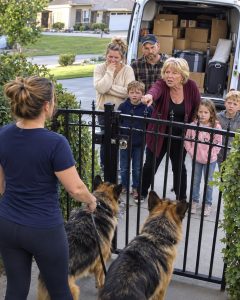
On the security monitor, Diane Whitaker stood under the camera wearing a beige coat and the same impatient expression I remembered from childhood. My twin sister, Mallory, waited beside her husband and three children. A rented moving truck blocked half of the gravel entrance.
Boxes were stacked beside the gate.
Every single one had been taped shut before anyone had asked if they were welcome.
Mallory leaned toward the intercom.
“The downstairs suite will be perfect for us. The kids can use the rooms across the hall.”
Her husband, Grant, looked past the bars toward my detached workshop.
“Does that building have heat? I could set up a furniture business in there.”
I watched them calmly discuss my property as if I had already agreed.
My mother glanced toward the neighboring driveway.
“Don’t embarrass me by making everyone stand outside.”
For twelve years, I had imagined what I might say if they ever came back needing something from me.
In those imagined conversations, I was always eloquent.
Standing behind a locked gate, I realized I needed very few words.
Mallory and I were born seven minutes apart, but our mother treated those minutes like proof that my sister had arrived first in every way that mattered.
Mallory got the bedroom with the window. The new winter coat. Dance lessons. Birthday parties planned around her friends.
I got her old clothes and constant reminders that I was easier.
“You’re independent,” Mom would say whenever Mallory needed something I had.
It sounded like praise until I understood that independent meant no one planned to show up for me.
The only person who noticed was our grandmother Elaine.
She took me to estate sales on Saturday mornings and taught me how to inspect repaired furniture.
“Never be ashamed of a crack,” she once told me. “Just pay attention to what caused it.”
At her kitchen table, I was allowed to speak without being told I was making things difficult.
When Grandma passed during my senior year, the balance inside our home changed almost immediately.
Mallory stopped pretending to share.
Mom stopped pretending to be fair.
A few months after graduation, Mallory announced she was expecting a baby.
Her boyfriend, Grant, moved into our rented duplex with two laundry baskets, an oversized television, and no steady paycheck.
Mom decided my bedroom was the only room big enough for a crib.
I asked if I could sleep on the couch until community college started.
“Grant has back trouble,” she said. “He may need the living room.”
“What about the basement?”
“We need it for baby supplies.”
Then Mom folded her arms and said the sentence that separated my old life from everything that came after it.
“You’re nineteen, Paige. At some point, you have to stop being my responsibility.”
Mallory stood behind her with one hand resting on her stomach.
“You’ve always acted like you don’t need us,” she said. “This should be easy for you.”
I packed two trash bags while they watched television in the next room.
Mom handed me canned soup and crackers before I left.
“Tell people you chose to move out,” she said. “It sounds more mature.”
For several weeks, I slept on friends’ floors.
When those arrangements ended, I bought a discount tent and hid it behind the storage sheds of a roadside flea market outside Ridge Hollow.
I washed in gas-station bathrooms before work. I kept my clean shirt sealed inside a grocery bag so it would not smell like wet grass.
One rainy afternoon, Mom saw me collecting shopping carts outside the grocery store.
Our eyes met through her windshield.
Mallory sat beside her, laughing at something on her phone.
Mom did not stop.
She drove away slowly enough for me to understand that she had recognized me and chosen not to turn around.
That night, I held my prepaid phone for nearly an hour without calling her.
Instead, I made myself a promise.
I would never again measure my safety by whether someone else decided I deserved room.
I did not promise to become rich.
I did not promise to prove anybody wrong.
At nineteen, sitting inside a leaking tent with rainwater gathering near my shoes, those kinds of promises would have sounded ridiculous.
I promised something smaller.
I would find one safe place to sleep.
Then I would find the next.
That was how the next twelve years happened.
One safe place at a time.
A cashier named Maribel learned I was sleeping behind the flea market and introduced me to her aunt, who rented me a room for two hundred dollars a month if I helped paint the porch.
An elderly furniture dealer named Wesley Boone caught me examining the underside of a walnut table at the flea market and asked how I knew it had been repaired.
“My grandmother taught me.”
He turned the table over.
“Then your grandmother knew what she was doing.”
Wesley paid me to clean inventory on Saturdays. Later, he taught me to strip old varnish without gouging wood, replace veneer, match stain, and recognize when a piece deserved restoration and when it deserved to be left alone.
That distinction became one of the most important lessons of my life.
Not everything damaged should be forced back into its original shape.
Some things needed a different future.
By twenty-four, I was restoring pieces independently.
By twenty-seven, I had three employees.
At twenty-nine, I bought nine neglected acres outside Ridge Hollow with a farmhouse whose porch tilted like a tired smile and an old dairy building that became my workshop.
I named the business Elaine House Restoration.
Not after the house.
After Grandma.
The first year, I slept upstairs while contractors repaired downstairs between jobs.
The second year, we built a finishing room.
The third, an architect helped convert the old dairy stalls into work bays and storage.
Then came the gates.
Not because I was afraid.
Because customers entrusted us with pieces worth more than some houses, and the insurance company required better security.
Still, when the iron gate rolled into place for the first time, I stood in my driveway longer than necessary.
It felt like more than security.
It felt like choosing who entered.
Now, twelve years after leaving home, the people who had once decided there was no room for me stood on the other side of it.
“Paige?”
Mom’s voice snapped me back.
I looked at the monitor.
The youngest child, a girl of about six, had sat down on one of the boxes. The oldest boy was kicking gravel. None of this was their fault.
That mattered.
It did not mean the gate had to open.
I pressed the intercom.
“There’s a motel seven miles east. I called them twenty minutes ago. They have two adjoining rooms available tonight.”
Silence.
Mallory blinked.
Grant looked at my mother.
Mom leaned closer.
“What are you talking about?”
“I’m telling you where you can stay tonight.”
“We’re staying here.”
“No.”
One word.
No explanation.
No apology.
The word felt unfamiliar in my mouth only because I had spent so much of childhood swallowing it.
Mallory stepped forward.
“Paige, stop. We sold the house.”
That was new information.
I glanced at the boxes.
“When?”
“Last month.”
“And you didn’t think to mention this?”
“Mom said she talked to you.”
My eyes moved to Diane.
She did not look away.
That was another childhood memory.
Mom could maintain eye contact through almost any lie.
“She did not,” I said.
Mallory stared at her.
“Mom?”
Diane sighed.
“I told Paige we might need family support.”
“You left me a voicemail saying you wanted to talk sometime.”
“Exactly.”
“No. Not exactly.”
Grant shifted his weight.
“We drove a long way.”
“I understand.”
“The truck is paid through Monday.”
“I understand that too.”
Mallory’s face tightened.
“You have six bedrooms.”
“I have four. One is my office. One is used by visiting clients.”
“So three.”
“No, Mallory. Four.”
She stared at me.
The sentence was not about arithmetic.
She understood that eventually.
Behind her, her daughter leaned against one of the boxes and looked exhausted.
I pressed the button again.
“The children can use the restroom in the reception building. I’ll unlock the pedestrian entrance remotely. You and the kids can come in for twenty minutes. Grant and Mom stay outside.”
Diane’s mouth fell open.
“You’re treating us like strangers.”
I almost answered immediately.
Instead, I waited.
Because the truth was complicated.
Strangers had been kinder to me than my family had.
But there were children standing beside the road, and I refused to make them collateral damage in an argument that began before they were born.
“I’m treating you like people who arrived without permission and brought a moving truck.”
The pedestrian gate clicked.
Mallory looked at her mother, then at me through the camera.
For the first time since they arrived, uncertainty moved across her face.
She took the youngest child’s hand.
The older two followed.
When Mallory entered the reception building ten minutes later, I was waiting beside the water cooler.
She stopped in the doorway.
For years, whenever I imagined seeing my twin again, I pictured discovering some visible difference that explained everything.
There wasn’t one.
Same gray-green eyes.
Same dark hair, though hers was shorter now.
Same small scar near the left eyebrow from when we had collided on bicycles at eight.
But there was a tiredness around her mouth I did not recognize.
Her children wandered toward the reception chairs.
The oldest—Eli, I remembered from photographs I had seen online—noticed a display cabinet filled with before-and-after photographs.
“You fixed those?”
“Yes.”
He pointed at a ruined oak desk transformed into a polished writing table.
“That one too?”
“That one took four months.”
His eyes widened.
Mallory watched the exchange.
Then she said quietly, “You really built all this?”
Something in the question irritated me more than the moving truck.
“You knew I owned a restoration company.”
“I knew you had a business.”
“That is the business.”
“No, I mean…”
She looked through the interior window toward the workshop, where lights glowed over long benches and rows of labeled cabinets.
“I didn’t know it was this.”
There it was.
The assumption beneath everything.
I had survived, certainly.
But apparently survival, in Mallory’s imagination, had remained small enough not to inconvenience anyone.
“What happened to your house?” I asked.
Her shoulders dropped.
“Grant’s cabinet shop failed last spring.”
I looked toward the gate.
“He had a cabinet shop?”
“He tried.”
That one word held an entire year.
“We fell behind. Mom helped for a while. Then she said it didn’t make sense for all of us to keep paying separate bills when you had this place.”
I stared at her.
“She said that?”
“She said you’d agreed.”
“I did not.”
Mallory looked toward the children.
Her voice lowered.
“She said you understood because Grandma intended everything to be shared anyway.”
Every sound in the room seemed to soften.
I heard the refrigerator compressor beneath the reception counter.
The hum of the overhead lights.
Rain beginning faintly against the windows.
“What does Grandma have to do with this?”
Mallory frowned.
“You know.”
“I don’t.”
She searched my face.
For the first time that afternoon, I saw something that looked less like entitlement and more like confusion.
“Paige, Grandma left you money.”
My throat tightened.
“No, she didn’t.”
“Yes, she did.”
“I received nothing when Grandma died.”
Mallory’s expression changed.
It happened slowly.
First disbelief.
Then calculation.
Then something closer to fear.
She glanced toward the security monitor, where our mother stood beside the moving truck with her arms folded.
“How much did Mom tell you?” Mallory whispered.
“About what?”
Mallory looked at me again.
“When Grandma died, there was an account in your name.”
The room seemed to tilt, though nothing moved.
I remembered being eighteen.
My mother telling me the estate was simple.
No savings.
No inheritance.
Only a few pieces of furniture divided among relatives.
I remembered asking about Grandma’s old rolltop desk and being told it had been sold to cover funeral expenses.
I remembered the tent.
The wet shoes.
The grocery-store parking lot.
My mother’s car moving past me in the rain.
“How much?” I asked.
Mallory swallowed.
“I don’t know exactly.”
“How much, Mallory?”
“Mom said around twenty-two thousand dollars.”
For several seconds, I could not speak.
Twenty-two thousand dollars would not have made me wealthy.
But at nineteen, twenty-two thousand dollars would have meant rent.
Tuition.
A used car.
A bed.
A door that locked.
“Where did it go?”
Mallory looked toward the gate again.
“I thought you knew.”
“I didn’t.”
Her next words were barely audible.
“Mom used it.”
The rain strengthened.
Outside, Diane Whitaker stood beneath the security camera, waiting for me to open a gate she had never imagined I could keep closed.
And suddenly I understood that the family standing outside my house had not simply brought boxes.
They had brought twelve years of missing history with them.