Part 2
nothing.
According to one of the paramedics, she stood by the kitchen counter with both hands locked together and stared at the bloodless center of the room as if she were looking at a mess no one had asked her to clean.
I woke up two days later at Miami Valley Hospital with an oxygen tube in my nose and a bruise spreading purple under my collarbone.
Every breath felt borrowed.
Detective Harris sat beside my bed with his notebook closed, which was the first sign that maybe this time I would not have to perform my own suffering for it to count.
He waited until I looked at him.
“Emily,” he said, “we found the recorder.”
I cried so hard it made the monitor complain.
He told me Maya had arrived while deputies were still outside the house.
She gave them the envelope, the photos, and the cloud folder login.
Between the vent recorder, the earlier recordings I had stored away, the timestamped injuries, and the message I had sent, the case had shape before I could even sit up.
For the first time in my life, the evidence spoke before anyone could call me unstable, hysterical, or confused.
It still took three months to get to court.
In those three months, I learned how many people are comfortable with violence as long as it arrives wearing the word family.
Relatives called to ask whether I really wanted to ruin my father’s life.
One aunt suggested counseling instead of charges.
A neighbor told me Linda had always seemed sweet.
Sweet, I learned, is a word people use when they have never watched someone hear a plea for help and decide to let it pass.
The morning of the hearing, I wrapped a scarf around my neck and collarbone, not to hide the marks from the court, but because I was tired of strangers reading my body before they read my face.
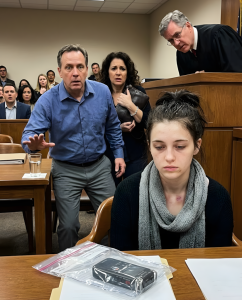
Rob walked into Montgomery County Court in a pressed blue shirt and carried himself like a man attending an inconvenience.
Linda sat behind him clutching her purse to her chest.
Her silver bracelet flashed whenever her hand shook.
Rob’s lawyer called me unstable before lunch.
Then the prosecutor placed a small clear evidence bag on the table.
Inside it was the black recorder from the vent.
The judge leaned forward.
The clerk pressed play.
The speakers filled with the sound of my living room: the wall clock, the lamp chain rattling once, the soft scrape of shoes on carpet.
Then Rob’s voice came through, cold and unmistakable.
“No one will ever save you.”
The courtroom changed shape around those words.
Rob’s hand froze halfway to his water glass.
His lawyer stopped writing.
Even before the file ended, the prosecutor had everything needed to dismantle the defense theory that I had invented the assault after a family argument.
Then the judge removed his glasses, looked at the prosecutor, and said, “Play the next file.”
The second recording was timestamped two weeks earlier.
It began with kitchen sounds, a drawer sliding open, and Linda’s voice.
Calm.
Ordinary.
Familiar enough to make my stomach turn before the sentence had even ended.
“Not her face this time,” she said.
“She has work in the morning.”
No one moved.
Rob laughed on the
recording.
Then Linda spoke again, lower but still perfectly clear.
“Keep it where her shirt covers it.
The old photos took too long to fade.”
My mother dropped her purse in the real courtroom with a thud loud enough to snap half the room out of its shock.
She didn’t bend to pick it up.
That was the moment the case stopped being about whether my father had attacked me one night and became what it had always been: a system inside a house, with one person doing the hitting and another person managing the visibility.
The prosecutor wasn’t finished.
He played a short excerpt from later on the night my heart stopped.
In it, there was the sound of hurried footsteps and my mother’s voice saying, “Move the bag.
Wipe the table.
If she wakes up, she fell.
If she doesn’t, tell them it’s her breathing again.”
Rob said, “She texted someone.”
Linda answered, “Find the phone.”
I watched Detective Harris rise from his seat before the clip was even over.
The defense had spent months trying to paint Linda as frightened and passive.
The audio buried that version of her in less than thirty seconds.
Maya testified next.
She described the word BLUE, the envelope at her apartment, the photos, the recordings, and the cloud folder I had updated whenever things got bad.
The prosecutor showed dates.
Then the emergency physician testified that my injuries were consistent with assault and oxygen deprivation, not a random collapse.
A paramedic testified that there had been a delay before anyone in the house called for help.
A forensic analyst confirmed the files had not been altered.
Rob’s lawyer tried to recover by saying families say terrible things under stress and that Linda had only been panicking.
But panic does not explain instructions about where bruises can hide.
Panic does not explain old recordings, prepared lies, or a mother discussing what story to tell if her daughter stops breathing.
The jury took less time than I expected.
Rob was convicted on the assault charges, on the counts tied to the threats on the recording, and on the charge connected to the violence that stopped my heart.
When the judge sentenced him, he said something I still hear in my head sometimes: “The victim survived in spite of this home, not because of it.” Rob stared at me like he wanted me to flinch.
I didn’t.
He left that courtroom in handcuffs, still wearing the same blue shirt he had chosen because he thought it made him look trustworthy.
Linda’s case moved separately after that.
She was charged because the recordings and testimony showed she had done more than fail to protect me.
She had coached concealment, discussed prior injuries, and helped prepare a false story for police and paramedics.
For weeks she insisted she had only said those things because she was afraid of him.
Maybe some of that was true.
Fear can explain many silences.
It cannot explain strategy repeated over time.
In the end, she took a plea rather than face a full trial with the recordings and cloud files laid out in front of a jury.
She stood in court months later and cried while reading an apology that sounded practiced until the last two lines, where her voice
finally cracked on the word daughter.
She said she had told herself surviving him was the same thing as protecting me from him.
She said she had been wrong.
The judge gave her prison time anyway.
I did not feel triumphant.
People imagine justice as a clean feeling, a door slamming on the right side of a story.
It was not clean.
It was paperwork, testimony, waiting rooms, scar cream, therapy appointments, and waking up at 3:00 a.m.
because the air vent in my apartment made a sound too much like that recorder sliding deeper into metal.
It was signing the lease on a small place in Columbus with the money I had saved to run away and realizing I was finally using it to live instead.
Maya helped me move.
We unpacked mugs before books because she said every safe place should look like morning first.
For a while I slept with the bathroom light on.
For a longer while I jumped whenever someone said my name too sharply.
But the first night in that apartment, no one checked my phone, no one controlled the keys, and no one decided how much fear I was allowed to name.
That silence felt different.
It wasn’t empty.
It was mine.
The strangest part came later, after the trials, after the headlines, after relatives split into camps and some of them stopped speaking to me.
A few people asked whether I really thought my mother deserved charges when she had never held the belt.
I understood the question.
It is easier for people to identify evil when it arrives loud.
It unsettles them more when it arrives in a trembling voice from the kitchen, wrapped in excuses and thin concern.
I still think about her bracelet clicking against the counter while I fought for air.
I think about the second recording, the calm in her tone when she discussed where bruises would hide best.
The biggest red flag in that house was not only the man who promised no one would save me.
It was the person who heard that promise, believed it, and organized her life around helping him be right.
He was wrong in the end.
I was saved.
But not by the people who were supposed to love me first.
That is the aftershock that stays: deciding which betrayal was worse, the hand that hit me or the one that stood inches away and learned how to make the damage disappear.