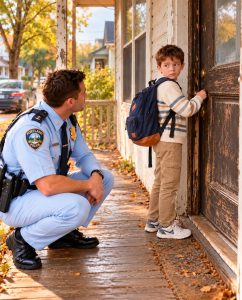
PART 2: “I CAN’T GO TO SCHOOL IF EMMA IS SICK.”
The paramedics arrived eleven minutes later.
By then, I’d opened the curtains and found bottled water in the kitchen.
Emma was still feverish.
Lily sat beside Noah on the sofa, clutching her rabbit.
And Noah watched every movement the paramedics made.
Not with curiosity.
With responsibility.
When one of them lifted Emma gently from the bed, Noah stood immediately.
“Be careful with her.”
The paramedic smiled.
“We will.”
“She doesn’t like strangers.”
“That’s okay.”
“And she gets scared when people talk loudly.”
The paramedic nodded.
“We’ll be gentle.”
Noah followed them toward the door.
“Can I come?”
I stepped beside him.
“We’re going to make sure you know what’s happening.”
He looked at me.
“Are they taking her away?”
“She’s going to get checked by medical professionals.”
His eyes filled.
“Will she come back?”
I crouched.
“I don’t know exactly what the doctors will decide yet.”
He swallowed.
“But I’m going to make sure the people helping her know how important it is to keep you informed.”
He nodded slowly.
Then whispered:
“She likes it when I sing.”
My throat tightened.
“What do you sing?”
He looked embarrassed.
“The moon song.”
I smiled gently.
“What’s the moon song?”
He hesitated.
Then began singing in a tiny voice.
“Moon up high, stars so bright…”
His voice trembled.
“Keep my baby safe tonight…”
He stopped.
I looked at him.
“Who taught you that?”
He stared at the floor.
“My mom.”
I swallowed.
“Does she still sing it?”
He shook his head.
“No.”
I waited.
Then he whispered:
“She left.”
I sat beside him.
“When?”
“Last winter.”
I nodded.
“Do you know where she went?”
He shook his head.
“Daddy says she didn’t want us.”
I felt my jaw tighten.
But I kept my expression calm.
“Has she called?”
Noah looked uncertain.
“Sometimes the phone rings and Daddy gets mad.”
I filed that away.
A social worker arrived shortly afterward.
Her name was Rachel Morgan.
She spoke softly to the children.
She explained what would happen next.
And she listened when Noah asked whether Lily could bring her stuffed rabbit.
“Of course,” Rachel said.
Noah looked relieved.
Then he asked:
“What about my backpack?”
Rachel smiled.
“You can bring that too.”
He hesitated.
“Can I bring my homework?”
I stared at him.
Rachel’s expression softened.
“Yes, Noah.”
He nodded.
“Okay.”
Then he whispered:
“Because if I don’t turn it in tomorrow, I’ll get in trouble.”
I looked away for a moment.
The boy was facing a frightening situation.
His little sister needed medical care.
His father wasn’t home.
And he was worried about homework.
That was when I understood how completely he’d learned to carry responsibilities no child should have.
At the hospital, Emma was evaluated and treated for dehydration and an infection.
The medical team monitored her carefully.
Lily stayed close to Noah.
And Noah refused to sit down until someone told him Emma was receiving care.
When Rachel finally convinced him to eat a sandwich, he divided it into three pieces.
One for himself.
One for Lily.
And one he placed on a napkin.
“For Emma,” he explained.
Rachel’s eyes filled.
I sat beside him.
“Noah, the hospital will make sure Emma gets what she needs.”
He looked at the sandwich.
“But what if she’s hungry?”
I swallowed.
“Then they’ll help her.”
He nodded.
But he still saved the piece.
Later that evening, his father arrived.
His name was Thomas Bennett.
He was thirty-four.
Tall.
Broad-shouldered.
Wearing a construction company jacket.
He entered the hospital waiting area looking furious.
“Where are my kids?”
Rachel stood.
“Mr. Bennett?”
“Yes.”
She introduced herself.
Then explained that the children were safe and that Emma was receiving medical attention.
Thomas looked toward me.
“You took my children out of my house?”
I remained calm.
“Your son asked for help.”
His face reddened.
“Noah?”
The boy shrank against the sofa.
Thomas looked at him.
“What did you do?”
Noah’s eyes filled.
“I didn’t—”
Thomas stepped forward.
“You brought the police home?”
I moved slightly between them.
“Mr. Bennett, let’s speak away from the children.”
He glared at me.
“This is a family matter.”
I nodded.
“And there are serious concerns about the children’s supervision and safety.”
He scoffed.
“I work.”
Rachel spoke gently.
“We understand you have employment responsibilities.”
Thomas turned toward her.
“Then you understand I can’t be everywhere.”
She nodded.
“But a seven-year-old cannot safely be expected to supervise a four-year-old and a two-year-old for hours.”
Thomas laughed bitterly.
“You people have no idea what it’s like.”
I looked at him.
“Then tell us.”
He stared.
I continued.
“Tell us what happened.”
For a moment, he said nothing.
Then his shoulders sagged.
“My wife left.”
His voice was suddenly quieter.
“I work ten-hour shifts.”
He looked down.
“The daycare closed. My mother lives three states away. I couldn’t afford another place.”
Rachel nodded.
“Those are serious challenges.”
Thomas swallowed.
“So what was I supposed to do?”
I looked toward Noah.
The little boy was sitting beside Lily.
Holding her hand.
Watching his father.
Waiting to see whether he’d be punished.
I turned back.
“You were supposed to ask for help.”
Thomas’s face hardened.
“From who?”
Rachel stepped closer.
“From the school. From community services. From relatives. From agencies that help families access childcare.”
Thomas looked away.
She continued.
“We can help you understand what resources are available.”
He shook his head.
“You’ll take my kids.”
Rachel answered carefully.
“Our immediate responsibility is their safety. Decisions about placement and reunification will be made through the appropriate process.”
Thomas stared at the floor.
Then whispered:
“I didn’t want anyone knowing I couldn’t handle it.”
I felt anger rise.
Not because he was struggling.
But because his pride had placed three children in danger.
I looked at him.
“Your son is seven.”
Thomas nodded.
“He’s been trying to keep your family together.”
His eyes filled.
I continued.
“He thought it was his fault the house was messy.”
Thomas closed his eyes.
“He thought he was responsible for his sisters being hungry.”
A tear slipped down Thomas’s cheek.
“And he was terrified that asking for help would get him in trouble.”
Thomas covered his face.
For a long moment, nobody spoke.
Then he whispered:
“I never meant for it to get this bad.”
I looked at him.
“But it did.”
He nodded.
And for the first time that evening, he didn’t argue.