The alarm went off at 5:00 a.m.
And for once in my life, I didn’t hit snooze.
I reached over and turned it off before it could beep a second time. Daniel was asleep beside me, flat on his back, one arm thrown over his eyes, snoring softly. He didn’t move.
I slipped out of bed. I pulled on yesterday’s sweatshirt from the chair in the corner. Gray, with a coffee stain on the cuff. I tiptoed across the old wooden floor, avoiding the board by the door that creaks, and I crept downstairs.
The house was still dark.
Outside the big kitchen window, the lake was a flat sheet of black glass. No wind. No birds yet. The only sound was the old refrigerator humming in the corner of my mother’s kitchen.
My mother’s kitchen.
That mattered to me a lot more that morning than it had a week before.
My mom has a little place by the lake.
It’s not fancy. It’s a two-story cedar cabin with a green metal roof and a screened porch and a wooden deck that looks out over the water. It has three bedrooms upstairs and one bathroom that everybody fights over. The kitchen still has the orange countertops from 1978. The couch in the living room is older than I am.
My dad bought it the year I was born. He paid for it with money he saved from twenty years of working overtime at the paper mill. He used to say it was the only thing he ever bought that was worth more than he paid for it.
He died when I was nineteen. A heart attack. On the dock, actually. Fishing for bass.
Mom almost sold the cabin after that. She couldn’t stand to be there. For two summers, she didn’t even go up. Then one day in June, she called me and said, “I think I’m going to go open up the lake house.” And she did. And she’s gone every summer since.
It’s hers now. Completely hers. She pays the taxes. She fixes the roof. She planted every single flower around it. She painted the shutters blue two summers ago, by herself, on a ladder, which I yelled at her about for a week.
“Your father would have painted them blue,” she said. “He always wanted blue.”
Daniel and I got married in the spring. In May. In a little church in my hometown, and then a reception at a barn with string lights and a taco truck.
This was the first summer our families spent together.
The first time Daniel’s parents, Susan and Richard, came up to the lake, my mother was nervous for a whole week before. I’ve never seen her so nervous. Not even at my wedding.
She called me every single night that week.
“What do they like to eat, honey?”
“Mom, they eat normal food.”
“Does Susan drink coffee or tea?”
“Coffee. I think. I don’t know.”
“Do they have any allergies?”
“I don’t think so.”
“What kind of pillows does Richard like? Firm or soft?”
“Mom. I have no idea what kind of pillows my father-in-law likes.”
She drove to the city and bought brand-new sheets for the guest room. Four-hundred-thread-count. Pale blue. She bought new towels. Fluffy white ones. She bought a little basket for the bathroom with tiny soaps and tiny lotions and a candle, like at a hotel.
She scrubbed the whole cabin from top to bottom. She washed the windows. She had the carpets cleaned.
“Mom,” I said, when I came up the Friday before, and found her on her hands and knees scrubbing the baseboards with a toothbrush. “What are you doing?”
“I want everything to be nice.”
“It’s always nice. It’s a lake cabin. People expect it to be a little messy.”
She sat back on her heels. She had a smear of cleaning spray on her cheek.
“They’re family now, honey,” she said. “You married Daniel. That means we’re all married to each other now. In a way. I want them to feel welcome.”
I didn’t know what to say to that. So I got down on the floor and helped her scrub the baseboards.
The weather held all summer. Warm and sunny, week after week. So we’d been going up to the lake almost every weekend since the middle of June.
Daniel and me. Susan and Richard. And Mom.
And every single weekend looked exactly the same.
My mom got up at six.
Every morning. Before anybody else. I’d hear her moving around downstairs. The coffee maker gurgling. The frying pan on the stove. The radio playing low. She always listens to the old country station in the morning.
She made breakfast for six people. Five of us, plus she always made extra. Bacon and eggs and pancakes. Or French toast. Or her famous blueberry muffins, from scratch, with the crumbly sugar on top.
Then she cleaned it all up. Every plate. Every pan. Every fork.
Then she stripped the beds and washed the towels and hung them on the line out back.
Then she drove forty minutes round trip to the big grocery store in town. Because the little store by the lake didn’t carry the right mayonnaise.
Susan didn’t eat regular mayonnaise.
She only ate the kind made with avocado oil. In the glass jar. Eleven dollars a jar. Mom found that out the first weekend, when Susan took one bite of her chicken salad sandwich and put it down and said, “Oh. Is this regular mayo?”
Mom drove to town the next morning and bought three jars.
Then she came back and made lunch.
Then she cleaned up lunch.
Then she cooked dinner. Always something nice. Grilled salmon. Pot roast. Chicken piccata. Homemade pasta. She made a peach cobbler every Saturday night because Richard mentioned once that he liked peach cobbler.
Then she cleaned up dinner.
Then she went to bed around ten. And got up at six and did it all over again.
And Susan?
Susan arrived on Friday evening. She walked through the cabin. She said, “Oh, this is so cute,” every single time, like she’d never seen it before.
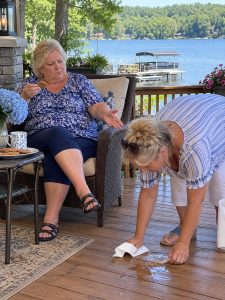
Then she walked out onto the deck. She got into the big lounger with the striped cushion. The one right in the middle of the deck with the best view of the water. She put her sunglasses on. She had her iced tea in one hand and her phone in the other.
And that was it.
That was her weekend.
All summer, she never once asked if she could help.
Not once.
Not in eight weekends.
She never carried a single plate to the sink. She never chopped an onion. She never wiped a counter. She never folded a towel.
She didn’t even bring her own coffee cup inside. She’d leave it on the little side table next to the lounger. Every morning. And by noon there’d be a ring on the wood, and my mom would come out and pick it up and wipe the ring off with a dish towel.
Susan would say, “Oh, thanks, Maggie,” without looking up from her phone.
And at some point, somewhere in July, she stopped saying even that.
She stopped saying thank you.
That was the part that actually got me. More than the coffee cups. More than the mayonnaise.
My mother would set a plate of food in front of her, a plate she’d spent two hours cooking, and Susan would just start eating. Looking at her phone. Not a word. Like the food had appeared out of thin air.
I talked to Daniel about it once. In July. In bed, with the lights off, whispering so nobody would hear through the thin cabin walls.
“Your mom never helps,” I said.
“I know,” he said.
“She never even says thank you anymore.”
“I know.” He was quiet for a moment. “She’s always been like that, babe. At home, my dad does everything. She plans stuff. She decides stuff. But she doesn’t do stuff.”
“But this isn’t her home. This is my mom’s home.”
“I know.”
“Should I say something?”
He was quiet for a long time.
“I don’t know,” he said honestly. “I don’t know what that would do.”
We didn’t talk about it again. Not for a few weeks.
But it was the flower boxes that finally pushed me over the edge.
The Saturday before, my mother had put new geraniums along the deck railing.
Six wooden flower boxes. She’d built them herself, in the spring, in the garage at home. Painted them the same blue as the shutters. And she’d filled every one of them with bright red geraniums.
She’d been looking forward to it for weeks. She told me all about it in the car on the way up. She showed me pictures on her phone. Pictures of the flowers at the garden center. Pictures of the boxes in her garage, drying after she painted them. Pictures of the little bags of potting soil.
“Your father always said red geraniums looked cheerful,” she said. “He used to say they looked like they were having a party.”
She showed me those pictures like she’d planted a prize-winning garden. Instead of six little boxes of red flowers.
She got up at five-thirty that Saturday morning to put them out. Before breakfast. So they’d be there when everybody came downstairs.
I came out on the deck with my coffee and saw them. All six blue boxes. Lined up along the deck railing. Full of bright red flowers. With the blue lake behind them.
It looked like a postcard.
“Mom,” I said. “They’re beautiful.”
She beamed.
Then Susan came out.
She was wearing a white linen cover-up and big sunglasses. She had her iced tea. She walked to the lounger. The big one in the middle, with the striped cushion.
The cushion my mother had put out for her that morning. Fluffed up. Brushed off.
Susan sat down. She stretched out her legs. She looked out at the water.
And then she saw the flowers.
She frowned. She lowered her sunglasses.
“Oh,” she said. “No. No, these are all wrong here.”
My mother was standing in the doorway with a tray of blueberry muffins. She stopped.
“I’m lying right here,” Susan said. She waved her hand at the flower boxes. “And they’re blocking my whole view of the water. I can’t see anything. Don’t do that again.”
Don’t do that again.
In my mother’s house.
About my mother’s flowers.
From the lounger my mother had put a fresh cushion on that morning.
I was standing there with my coffee cup. I couldn’t move.
And my mother said, “Oh. I didn’t think of that. I’m sorry, Susan.”
And she put down the tray of muffins.
And she started moving them.
She moved her own flowers.
One box at a time. Carrying them from the railing in front of the lounger to the far corner of the deck. Where nobody could see them. Behind the grill. Next to the trash cans.
While Susan watched.
Susan didn’t get up to help. She didn’t say oh, you don’t have to do that right now. She didn’t say never mind, it’s fine, leave them.
She just sat there in the lounger with her iced tea. Watching my mother carry six heavy wooden boxes full of dirt and flowers across the deck.
When the last one was moved, Susan put her sunglasses back on.
“That’s so much better,” she said. “Thanks, Maggie.”
It was the first time she’d said thank you in a month.
I knew my mother.
She’s soft. She’s always been soft. She’s the kind of woman who apologizes to a chair when she bumps into it. She’ll swallow anything to keep the peace. Anything.
Especially for me.
She would have moved those flowers a hundred times. She would have driven to town for the eleven-dollar mayonnaise a hundred times. She would have picked up a thousand coffee cups off that side table. And she’d never say a single word.
Because she didn’t want to cause trouble. For me. For my new marriage. For my new family.
That’s exactly why I wasn’t going to swallow it.
But I also knew that shouting wouldn’t do anything.
If I’d marched out on that deck and yelled at Susan, she would have gone home and told everybody. Her sister. Her friends at church. Her book club. Daniel’s new wife attacked me. Out of nowhere. At her mother’s lake house. I didn’t do anything.
And I didn’t want to spend the next thirty Christmases sitting across the table from a woman who thought I despised her. A woman who’d be at every birthday party for my future children. Every graduation. Every holiday. For the rest of my life.
So I didn’t say a word that Saturday.
Not at breakfast. Not at lunch. Not at dinner.
I watched my mother serve dinner to a woman who’d made her move her own flowers. I watched my mother clean up after her. I watched my mother go to bed at ten o’clock, exhausted.
And then I went upstairs and set my alarm for five in the morning.
“What are you doing?” Daniel asked. He was lying in bed, watching me set the alarm on my phone.
“I’m getting up early tomorrow.”
“Why?”
“I’m going to fix something.”
He propped himself up on one elbow.
“Is this about the flowers?”
“It’s about the whole summer,” I said. “The flowers were just the last straw.”
He was quiet for a long moment.
“What are you going to do?”
“I’m not sure yet,” I said. “But I’m done watching my mom work herself into the ground every weekend while your mother lies on a lounger. I’m just done, Daniel.”
I looked at him.
“Are you going to be mad at me?”
He thought about it. For a long time.
“No,” he said finally. “I’m not going to be mad at you.”
He lay back down.
“Honestly,” he said to the ceiling, “I should have done something myself. A long time ago.”
At 5:07 a.m., I found it.
An old dry-erase board. About two feet by three feet. Mom kept it leaning against the wall next to the pantry. When I was a kid, she used to write the grocery list on it. And the weather forecast. And little messages. Good luck on your swim test! Dad caught a big one!
It had been sitting there, blank, for years.
I carried it to the big wooden kitchen table. I propped it up against the fruit bowl, so anybody coming into the kitchen would see it first thing.
I found a black marker in the junk drawer. I tested it on my hand. It worked.
And at the top of the board, in big capital letters, I wrote:
WEEKEND JOBS
Then I divided up the work.
Daniel: breakfast cleanup.
Richard: grocery run.
Me: lunch.
Susan: breakfast.
Then I made a little chart for dinner. So it would rotate. Saturday night, Sunday night. Different people each night. I put Susan’s name next to Saturday.
Then, at the very bottom of the board, next to my mother’s name, I wrote:
Mom: enjoy your house.
I underlined your. Twice.
I was standing there looking at it. At my handwriting. Wondering if I’d gone too far. Wondering if I should erase the whole thing and go back to bed.
And then I heard slippers.
Behind me. On the wooden floor.
My mom was standing in the kitchen doorway.
She was wearing her old pink robe. The fuzzy one with the belt that’s been missing since 2011. Her gray hair was sticking up on one side. She had her reading glasses pushed up on top of her head.
“What are you doing?” she asked. “It’s five o’clock in the morning.”
“Fixing something,” I said.
She walked over to the kitchen table. She pulled her reading glasses down onto her nose. She read the board.
I watched her face change before she even got to the second line.
“No,” she said.
“Mom—”
“No, honey. Take that down. Right now.”
“It’s your house, Mom.”
“They’re guests.”
“They’ve been guests here almost every single weekend for two months.”
She lowered her voice. She glanced up at the ceiling. At the guest room right above us. Like Susan might somehow be able to hear us through the floor.
“You can’t give people chores,” she whispered, “when you’ve invited them somewhere. You just can’t. That’s not how it’s done.”
I looked at her.
“Why not?”
“Because that’s not how you treat guests.”
“Is telling the woman who owns the house where she’s allowed to put her own flowers,” I said, “how you treat a host?”
Her mouth went tight.
“She didn’t mean anything by it,” Mom said.
“You moved them, Mom. You moved all six of them. Behind the trash cans.”
“It wasn’t a big deal.”
“Then put them back.”
She didn’t answer.
She looked toward the big kitchen window. Out at the deck. Where six blue flower boxes full of red geraniums were sitting in the corner next to the grill. In the dark.
I knew that look. I’ve known it my whole life.
She wasn’t thinking about the flowers. She was thinking about how much discomfort she’d have to deal with if she admitted, out loud, that she wanted them back where she’d put them. How awkward it would be. What Susan would say. What Susan would think. What Susan would tell Daniel. What Daniel would tell me. Whether I’d be in trouble in my new marriage because my mother made a fuss about geraniums.
She was doing math. The same math she’s done my whole life.
“I’m not having you start something with your mother-in-law,” Mom said. “Because of me. I won’t have it.”
“I’m not starting anything, Mom,” I said. “I’m ending something.”
She reached past me for the eraser. It was sitting on the little ledge at the bottom of the board.
I picked up the whole board before she could get it.
“One day,” I said. “Please. Just try one day. One day where everybody takes care of themselves. And you don’t take care of anybody.”
“But I like taking care of people,” Mom said.
“I know you do,” I said. “But that’s different from being everybody’s maid.”
Her face changed.
Something went across it. Hurt. Like I’d slapped her.
I knew right away I’d gone too far. I opened my mouth to take it back.
And then we heard footsteps.
Upstairs. Directly over our heads. On the old wooden floor of the guest room.
Somebody was up.
Mom stared at the board in my hands.
“Oh, Lord,” she whispered.