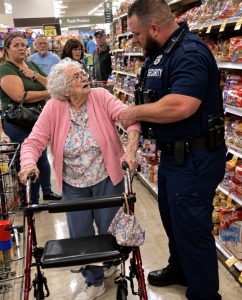
Part 2 – The Shoplifting Accusation That Made a Security Guard Break Down
The object in my mother’s palm was so small that, for one absurd second, I could not understand how it had silenced an entire supermarket.
It was a whistle. Not the bright plastic kind coaches wore now, but an old brass one, dulled almost brown with age. A blue cord looped through the ring at its end, though half the cord had been blackened and curled by heat, its fibers fused together in places like burned hair. Mom’s fingers trembled beneath it. Along one side of the metal, beneath soot that no amount of polishing had entirely erased, two tiny initials had been scratched by hand.
L.M.
The security guard stared at those letters as though my mother had opened her palm and revealed a beating heart.
His grip had disappeared from her wrist, but angry red marks remained where his fingers had been. I saw them before I saw anything else. Four blotches against paper-thin skin, already darkening at the edges. My own pulse began hammering so hard that I could feel it behind my eyes.
“What did you do to her?” I demanded.
He did not seem to hear me.
“Where did you get that?” he whispered again.
The booming certainty had gone out of his voice. Seconds earlier he had been loud enough to draw people from three aisles away, puffed up with the authority of his uniform and the attention of strangers. Now he looked smaller inside his navy security shirt. His broad shoulders had slumped. His mouth worked once without producing any sound.
Mom closed her fingers around the whistle.
That brought him back to life.
“No.” He took half a step toward her, then stopped himself so abruptly that the rubber sole of his shoe squeaked against the tile. “No, please. Let me see it.”
I moved between them.
“You don’t get to ask her for anything.”
“Claire,” Mom murmured.
“No, Mom.”
The crowd around us had thickened into a loose ring. Shopping carts stood crooked between displays of oranges and discounted cereal. Somewhere behind me, a child was asking his father what was happening, and the father kept shushing him without actually leaving. The phone I had noticed before was still raised. Its owner, a woman with a basket tucked against her hip, was recording everything.
Good, I thought.
Then, immediately: No. Not good.
A sick weight dropped through my stomach as I imagined the video already escaping the store, my eighty-five-year-old mother hunched beside her fallen walker while a security guard called her a thief. A caption. A hundred comments. A thousand strangers deciding what kind of person she was from twelve seconds of footage.
Mom had spent months learning how to leave the house again after Dad died.
Months.
At first, she would stand in her coat beside the front door and say she had forgotten something. Then she would take the coat off. Later, she managed the mailbox. Then the porch. Then my car. Today she had insisted on walking into the supermarket under her own power because she wanted apples.
And now half the town was watching her humiliation through a phone screen.
I wanted to tear the device out of the woman’s hand. I wanted to shout until every person there disappeared. I wanted to pick up Mom, carry her home, lock the door, and protect her from the world.
Instead, I bent to retrieve her walker.
One of its front wheels was still spinning.
That nearly undid me.
Mom touched my shoulder before I could straighten. Her fingertips were light but insistent.
“Set it upright, sweetheart.”
Her voice had changed.
She was shaken—I knew her too well not to hear it—but beneath the tremor was the tone she had used throughout my childhood whenever panic threatened to make a situation worse. The teacher’s voice. Quiet enough that everyone else had to become quiet to hear it.
I unfolded the walker fully and locked the crossbar.
The guard still had not taken his eyes off Mom’s fist.
“Please,” he said.
I turned on him. “You were hurting her ten seconds ago.”
“I know.”
“You accused her of stealing in front of half the store.”
“I know.”
“You called her a thief.”
His face twisted.
“I know.”
The answer was so different from the man who had been shouting at us that I faltered.
Before I could decide what to do with that, a sharp voice cut through the crowd.
“What is going on here?”
A woman in a dark green store blazer pushed through the spectators. She wore a rectangular name badge that read RUTH ALVAREZ — STORE MANAGER, and she moved with the brisk, controlled irritation of someone expecting to find a spilled display or an argument over coupons.
Then she saw Mom’s wrist.
Her expression changed.
She looked at the guard.
“Daniel.”
So that was his name.
Daniel Mercer.
He did not turn toward her.
Ruth’s eyes moved from him to my mother, then to the walker on the floor beside my leg, then to the ring of customers and the raised phone. Her lips tightened.
“Everybody, please give us some space,” she said. “This is a private matter.”
The woman recording lowered her phone by perhaps two inches.
Mom spoke before anyone could obey.
“No.”
Ruth looked at her.
My mother opened her fingers again.
The brass whistle lay against her palm.
“No,” Mom repeated. “I don’t believe this is private anymore.”
Daniel made a sound in his throat.
Ruth glanced toward him sharply.
He looked as though the floor had shifted beneath him.
Mom lifted the whistle just enough for the blue cord to hang.
Daniel’s eyes followed it.
“Where did you get that knot?” he asked.
Mom’s gaze flickered down.
“What?”
“The cord.” His breathing had become shallow. “That knot.”
I looked closer. Near the whistle’s ring, where the cord had escaped the worst of the scorching, two loops crossed over each other in an odd, compact pattern. It was not a standard knot. Even I could see that much. One loop was larger than the other, tucked underneath and doubled back.
Mom curled her fingers around the cord.
“You recognize it.”
Daniel’s face went gray.
Ruth looked from one of them to the other. “Daniel, do you know this woman?”
He laughed once.
There was no humor in it.
“Do I know her?”
“Answer me.”
He finally looked at the manager, and something in his eyes made Ruth’s posture stiffen.
“That whistle belonged to my sister.”
A murmur moved through the crowd.
I stared at him.
Mom closed her eyes.
Not in surprise.
That was what frightened me.
She closed them like someone hearing a name she had expected for years.
Daniel pointed at the whistle, but his hand shook so badly that his finger wandered in the air.
“Her initials are on the side,” he said. “L.M. Lily Mercer. My father scratched them in with a nail because she kept losing things. He put her initials on her lunch box, her jacket tag, her stupid little pencil case, everything.”
His voice cracked on the last word.
Mom opened her eyes.
“Daniel Mercer,” she said.
It was not a question.
He flinched.
I looked at her. “Mom?”
She did not answer me.
Daniel wiped his mouth with the heel of his hand, as if something bitter had risen into it.
“You remember me.”
“You were twelve.”
His jaw hardened.
“Don’t.”
“I remember you.”
“Don’t say it like that.”
“Like what?”
“Like you have the right.”
His grief vanished beneath anger so quickly that it frightened me. His shoulders lifted again. His hands clenched beside his thighs. The man who had grabbed my mother was reassembling himself out of the wreckage.
I stepped closer to Mom.
Ruth did the same from the other side, though I could not tell whether she meant to protect my mother or Daniel.
“Daniel,” she said, low and firm, “back away.”
He ignored her.
“You kept it?”
Mom’s fingers tightened around the whistle.
“Yes.”
“For thirty-seven years?”
“Yes.”
He stared at her.
“Why?”
Mom’s chin quivered once.
Then stopped.
“Because it mattered.”
Daniel recoiled as though she had slapped him.
“Mattered?”
“Daniel—”
“Mattered to who?”
His voice rose, and shoppers at the edge of the crowd began whispering again.
Ruth stepped directly in front of him.
“Enough.”
“No, it isn’t enough.” He looked over her shoulder at Mom. “Not even close.”
Ruth planted a hand against his chest, not forcefully, but with finality. “You are an employee of this store. You have already put your hands on a customer. Whatever this is, you will not make it worse.”
Daniel looked down at her hand.
For the first time since she had arrived, Ruth seemed aware that people were recording.
Her face went carefully blank.
She removed her hand.
Then she turned to the crowd.
“Please continue your shopping. We are handling the situation.”
Nobody moved.
Ruth’s jaw flexed.
“I’m asking you to give this family some privacy.”
A cart rolled away somewhere behind us. Then another. The ring loosened, though not by much. People drifted toward nearby displays and pretended to inspect produce while watching from the corners of their eyes.
The woman with the phone stayed where she was.
Ruth noticed.
Her expression told me she wanted to object.
She didn’t.
That told me something too.
I placed one hand on Mom’s walker.
“Mom, we’re leaving.”
“No.”
I turned.
She had slipped the whistle’s cord over two fingers. The burned metal rested against her palm, and her eyes were fixed on Daniel.
“Mom.”
“We are not leaving yet.”
“Your wrist is bruising.”
“I know.”
“He assaulted you.”
Daniel’s face tightened.
Ruth said, “Ma’am, if you need medical attention—”
“I don’t.”
“Mom, you don’t know that.”
“Claire.”
There it was again.
That classroom tone.
It irritated me now.
“Don’t Claire me.”
One corner of her mouth moved, not quite a smile. “That sentence sounded exactly the same when you were fourteen.”
“This isn’t funny.”
“No.” She looked back at Daniel. “It certainly isn’t.”
He had been staring at us with an expression I could not read.
Then his eyes sharpened.
“Claire.”
I faced him.
He looked at me as if fitting an old memory against my face.
“You’re Claire Hart.”
The way he said my last name chilled me.
“Yes.”
“Mrs. Hart’s daughter.”
“My mother has a first name.”
Mom touched my arm.
Daniel swallowed.
“Margaret.”
She gave the smallest nod.
He looked suddenly furious again.
“You don’t get to stand there pretending this is some reunion.”
“I am not pretending anything.”
“You knew who I was.”
“Not at first.”
“But once you heard my name.”
“Yes.”
“And you still didn’t say anything.”
Mom looked at the red marks around her wrist.
“No,” she said. “You had not given me much reason to believe you were prepared to listen.”
His face flushed.
Ruth’s eyes dropped briefly toward Mom’s bruises.
I saw guilt there.
Not Daniel’s guilt.
Something else.
A recognition that this was not entirely surprising.
I filed that away without knowing why.
Daniel rubbed both hands over his face. When he lowered them, tears had gathered in his eyes again, but anger held them there.
“Why do you have Lily’s whistle?”
Mom breathed in slowly.
The supermarket seemed to shrink around us.
A refrigerated case hummed behind the apples. The overhead lights buzzed faintly. Somewhere near the bakery, a timer began beeping, shrill and repetitive, until someone silenced it.
My mother stared at the whistle.
“The last time I saw Lily alive,” she said, “she was wearing it.”
Daniel’s head jerked back.
Ruth inhaled.
I stopped breathing.
Mom’s thumb moved over the scorched initials.
“She loved that thing.”
“Stop.”
“She would blow it indoors when she knew she wasn’t supposed to.”
“Stop talking about her.”
“Daniel.”
“Don’t say my name.”
Mom’s gaze lifted.
“You asked me why I have it.”
“I asked where you got it.”
“Those are not different questions.”
“They are to me.”
His voice had gone low.
Dangerously low.
Ruth heard it too.
“Daniel, take two steps back.”
He didn’t move.
Ruth turned fully toward him.
“Now.”
He stared at her, breathing through his nose.
Then, with visible effort, he stepped backward once.
Only once.
Ruth accepted it for the moment.
Mom rested more of her weight on the walker. I saw her knuckles whiten around the handle. Whatever strength she was projecting, the strain of standing was catching up with her.
I moved beside her.
“Sit down.”
“There isn’t a chair.”
“I’ll find one.”
“I don’t need—”
“You’re eighty-five, not indestructible.”
Her eyes flicked toward me.
“For goodness’ sake, Claire.”
“Yes, for goodness’ sake.”
Ruth looked toward the end of the produce aisle. “There’s a bench near customer service.”
“No,” Mom said.
Ruth hesitated.
Mom drew herself straighter.
“I will not be moved somewhere private so this can become a misunderstanding everyone politely forgets.”
Ruth’s cheeks colored.
“That isn’t what I meant.”
“Isn’t it?”
“No.”
Mom held her gaze.
Ruth was the first to look away.
Something passed between them that I did not understand then.
Daniel laughed again, bitterly.
“That’s rich.”
Ruth turned on him. “You are in no position to comment.”
“No? She gets to talk about forgetting?”
“Daniel.”
He pointed toward Mom.
“My family didn’t forget.”
Mom’s face lost what little color it had.
“Neither did I.”
“You don’t know what my family did.”
“No.”
“You don’t know what happened after.”
“No.”
“You don’t know what my mother was like.”
Mom swallowed.
“No.”
Each answer seemed to anger him more.
He took another step back of his own accord, then leaned against a display of bagged oranges as if his legs had weakened.
“My mother stopped sleeping,” he said.
Ruth opened her mouth.
Daniel cut her off.
“No. You wanted to know if I know her? Fine. Everybody wants to stand around and stare? Fine. Let them hear it.”
His eyes swept the aisle.
The few shoppers who had begun pretending not to listen stopped pretending.
I hated them.
I hated all of them.
But I also wanted to hear every word.
Daniel looked at Mom again.
“I was twelve years old when my sister died.”
Mom’s hand closed around the whistle.
“I know.”
“No, you don’t.”
“I taught both of you.”
“That doesn’t mean you knew me.”
“I knew enough.”
“You knew I was twelve. Congratulations.”
His mouth twisted. “I knew Lily was nine. I knew she was scared of thunderstorms. I knew she cheated at cards and always denied it. I knew she cried when my dad killed a spider. I knew she wanted to be an astronaut for three months and a veterinarian for four years.”
His voice broke.
He looked away.
Nobody spoke.
Even the woman recording lowered her phone slightly.
Daniel blinked hard and went on.
“And then one afternoon, a policeman came to our house.”
Mom closed her eyes again.
“No,” Daniel snapped. “Look at me.”
She did.
He nodded once, as though that mattered.
“He didn’t know what to say. My father kept asking him which hospital. That was all he wanted. Which hospital. He asked it maybe six times before the policeman finally told him there was no hospital.”
My throat tightened.
Mom’s breathing had changed.
Shallower.
I touched her back.
She did not react.
Daniel stared somewhere past us now, seeing another room.
“My mother screamed so loud the neighbors came running. I remember that part better than the funeral. Isn’t that funny?”
Nobody answered.
He rubbed his palms together.
“She kept asking where Lily’s teacher had been.”
Mom flinched.
Daniel saw it.
His eyes sharpened.
“There. You remember that.”
“I remember many things.”
“Then remember this one.”
“I do.”
“Do you?”
He pushed himself away from the orange display.
Ruth started forward, but he lifted his hands.
“I’m not touching anybody.”
“See that you don’t,” Ruth said.
Daniel’s jaw tightened at the rebuke. For a second I thought he might turn his anger on her.
Instead, he looked at my mother.
“The school gave us a report.”
Mom’s lips parted.
He nodded grimly.
“Yes.”
Her eyes changed.
It was subtle, but I saw it.
Something like dread.
“What report?” I asked.
Neither of them looked at me.
Daniel said, “The fire report.”
Mom’s thumb stopped moving over the whistle.
“A preliminary report,” she said.
“Funny how you remember that part.”
“Because it matters.”
“It mattered to my parents too.”
“It was incomplete.”
“It was what we were given.”
“It was not the full account.”
“It was signed.”
“Daniel—”
“It was signed.”
The word cracked across the aisle.
A jar fell somewhere nearby and shattered.
The sound made Mom jerk so violently that I grabbed her elbow.
Daniel froze too.
For one second, everyone’s eyes turned toward the noise.
A store employee at the far end of the aisle stared at the broken jar near his shoes, then quickly bent to clean it up.
Mom’s face had gone distant.
I knew that look.
I had seen it after Dad died, when some harmless sound—a spoon dropped in the sink, a door clicking shut—sent her someplace I could not follow.
“Mom.”
Her eyes found mine.
“I’m here,” she said.
It was meant to reassure me.
That made it worse.
I leaned closer. “We can go.”
She shook her head.
“No.”
Daniel watched us.
His expression shifted, just for a moment.
Then the old anger returned.
“The report said the class was evacuated through the east corridor.”
Mom straightened.
“Most of them.”
“It said the teacher led the surviving students outside.”
“I did.”
“It said Lily was not accounted for until afterward.”
Mom’s grip tightened on the walker.
“That wording was wrong.”
“That wording was all we had.”
“It should never have been the final record.”
“But it was.”
Ruth looked between them.
“Daniel, are you saying Mrs. Hart was Lily’s teacher?”
“Yes.”
The word came like a blade.
Ruth glanced at Mom.
“And the fire—”
“November 1989.”
Mom said the date quietly.
Daniel’s eyes snapped toward her.
“You remember the date.”
“I remember the hour.”
His face hardened.
“You remember the hour.”
“Yes.”
“And you kept her whistle.”
“Yes.”
“And you never came to our house.”
Mom’s eyes filled.
“I tried.”
He gave a short, disbelieving laugh.
“You tried.”
“Yes.”
“My parents sat in that house for four months.”
“I know.”
“No, you don’t.”
“I went there.”
Silence fell.
Daniel stared at her.
“What?”
Mom’s chin trembled.
“Twice.”
“That’s a lie.”
“No.”
“I would remember you.”
“You had already left.”
“We didn’t leave until spring.”
“I went later.”
His nostrils flared.
“That doesn’t make sense.”
“I know.”
“No, you don’t get to say that.”
“I know that it doesn’t make sense from where you were standing.”
“You weren’t there.”
“I was.”
“Not at our house.”
“No.”
He threw up his hands.
“Exactly.”
Mom’s voice became softer.
“I meant the school.”
Daniel stopped moving.
The anger in his face seemed to drain toward something colder.
I looked at my mother.
She had always been careful about the fire.
Too careful, I realized.
Growing up, I knew there had been a fire at the elementary school where she taught. I knew a child had died. I knew Mom hated the smell of smoke and would not light candles. I knew she stopped using the old metal whistle she had once carried on playground duty.
But I had never known the child’s name.
Lily Mercer.
I had never known Daniel.
I had never known that a family blamed her.
“Mom,” I said carefully, “what happened?”
She looked at me.
The pain in her face frightened me more than Daniel’s rage.
“Not here,” she whispered.
Daniel barked out a laugh.
“Oh, now it’s private?”
I turned on him.
“She has already been publicly accused of stealing, physically restrained, and called a thief in front of strangers. You don’t get to mock her for wanting privacy.”
“You think this is about groceries?”
“It started because you grabbed her.”
“It started thirty-seven years ago.”
“No. Whatever happened thirty-seven years ago did not make you put your hands on an eighty-five-year-old woman today.”
His eyes flashed.
I stepped closer.
“You saw her put something in her pocket and decided she was guilty. You didn’t ask. You didn’t check. You grabbed her hard enough to bruise her.”
“I saw concealment.”
“You saw what you wanted to see.”
His mouth opened.
Nothing came out.
For one brief second, I had struck something true.
Then his gaze slid toward the whistle.
“No,” he said. “I saw someone hiding something.”
Mom’s shoulders sagged.
I wished he had shouted instead.
Ruth moved between us again.
“That’s enough about the shoplifting accusation for the moment.”
“For the moment?” I repeated.
Her expression tightened.
“I mean that we need to handle this one issue at a time.”
“My mother is not an issue.”
“I did not say she was.”
“That’s how you’re talking.”
Ruth took a breath.
“Mrs. Hart, I apologize for the way this has unfolded. I need to establish what happened in the store, and I will. But right now, Daniel is clearly not in a condition to continue his duties.”
Daniel stared at her.
“You’re suspending me?”
“I’m telling you to step away.”
“You think I’m unstable.”
“I think you are crying in the produce department while confronting the former teacher of your dead sister.”
He recoiled.
Ruth’s face softened, but her voice did not.
“Go to the office.”
“No.”
“Daniel.”
“I said no.”
The authority in her expression met something equally stubborn in his.
Then Mom spoke.
“Let him stay.”
I swung toward her.
“Mom.”
“He asked me a question.”
“He has asked you about twenty questions.”
“One of them matters.”
Daniel’s face had gone still.
Mom let go of the walker with one hand and held the whistle out again.
The scorched cord swayed.
“Look at me, Daniel.”
He did.
“I did not leave Lily.”
His eyes narrowed.
I felt Ruth become very still beside me.
Mom’s voice remained quiet.
“I did not evacuate the class and decide she was someone else’s problem. I did not stand outside while your sister was inside that building.”
Daniel’s breathing deepened.
“Stop.”
“I went back.”
The words seemed to strike him physically.
He shook his head.
“No.”
“I went back into the school.”
“No.”
“I found her.”
“Shut up.”
“Daniel,” Ruth warned.
He pointed at Mom.
“She is lying.”
Mom did not move.
“I am not.”
“The report said—”
“The report was wrong.”
“My father read that report until the folds split.”
“I am sorry.”
“Don’t.”
“I am.”
“Do not say you’re sorry.”
Mom’s hand began trembling harder.
The whistle rattled softly against her wedding ring.
Daniel heard it.
His eyes dropped.
For a moment, the rage in his face cracked open again and something younger looked out.
Not forty-nine.
Twelve.
I could almost see the boy beneath the security uniform, standing in a doorway while adults told him something he could not survive hearing.
Then he saw the red marks on Mom’s wrist.
His expression changed.
He stared at them.
Mom followed his gaze.
Neither spoke.
Daniel’s mouth tightened.
“I didn’t mean to grip you that hard.”
I nearly laughed from sheer disbelief.
“You didn’t mean to?”
“Claire,” Mom said.
“No. I’m sorry, but no. He doesn’t get to soften it into an accident. He held you while you told him he was hurting you.”
Daniel looked at me.
There was shame in his eyes now.
I was too angry to care.
“I heard her,” he said.
“Yes. You did.”
“I thought she was trying to distract me.”
“You thought an eighty-five-year-old woman with a walker was running a con in the apple section?”
His face reddened.
“That’s not what I said.”
“It is exactly what you acted like.”
Ruth closed her eyes briefly.
When she opened them, she looked at Daniel with something weary in her face.
“Claire is right.”
He stared at her.
Ruth went on. “Whatever else is happening here, you used force when there was no immediate threat.”
“No immediate threat.”
He repeated the phrase as though it disgusted him.
“Is that how you write it up?”
“If I have to.”
His eyes narrowed.
Something unspoken passed between them.
I noticed it.
So did Mom.
Ruth noticed us noticing.
Her professional mask slipped.
Only for a second.
Then it was back.
“Daniel,” she said, “this is not the time.”
His laugh was brittle.
“Of course not.”
“What does that mean?” I asked.
Ruth turned toward me.
“Nothing relevant to your mother.”
“Then I’ll decide that after you tell me.”
“Claire,” Mom murmured again.
I looked at her.
She shook her head.
Not now.
I understood.
Barely.
Daniel sank onto the edge of a low produce display, elbows on his knees. He looked exhausted now, as though anger had been the only thing holding him upright and it had finally burned through its fuel.
He stared at the tile.
“When I was a kid,” he said, “every adult kept telling me there had been confusion.”
Mom’s eyes stayed on him.
“I believe that.”
“They said smoke causes confusion. Panic causes confusion. Reports get written before all the facts are known.” He rubbed his hands together slowly. “Do you know what a twelve-year-old hears when adults keep using the word confusion?”
Mom did not answer.
“He hears that nobody knows what happened to his sister.”
Daniel looked up.
“So he finds the one piece of paper that sounds certain.”
Mom’s mouth tightened.
“The preliminary report.”
“Yes.”
“And you kept it.”
“My father did.”
Daniel swallowed.
“When he died, I took the box.”
Mom lowered the whistle.
“Daniel—”
“No. Let me finish.”
Her fingers closed around the brass.
He stared at her.
“That report said the teacher evacuated the room. It said the surviving pupils were accounted for outside. It said one pupil, Lily Mercer, was discovered later.”
“Discovered,” Mom repeated softly.
“That’s the word.”
Her face crumpled for a fraction of a second.
I reached for her.
She pulled herself straight before I touched her.
Daniel saw that too.
“The way it was written,” he said, “there was only one thing to believe.”
Mom’s eyes shone.
“That I left her.”
He stood again.
The grief in his face had sharpened into accusation.
“That you got everyone you could get and left my sister behind.”
Mom’s voice was barely audible.
“No.”
“You want me to believe a piece of paper was wrong because you say so?”
“No.”
“Then what?”
She opened her fist.
The whistle lay there between them.
Daniel stared at it.
“This proves you had something that belonged to her.”
“Yes.”
“It doesn’t prove how you got it.”
“No.”
“It doesn’t prove you went back.”
“No.”
“It doesn’t prove she was alive when you found her.”
Mom inhaled sharply.
My whole body tensed.
Ruth whispered, “Daniel.”
But he kept going.
“It doesn’t prove anything except that for thirty-seven years, you had something my family should have had.”
Mom looked down at the whistle.
The accusation landed differently from the shoplifting charge.
I could see that.
When he had called her a thief, she had been humiliated.
Now she looked wounded.
Her thumb brushed the burned cord.
“I kept it because I did not know how to give it back.”
“You knew our name.”
“I did.”
“You knew where we lived.”
“For a time.”
“You could have found us.”
“I tried.”
“You could have tried harder.”
My mother’s face went white.
I stepped between them.
“That is enough.”
Daniel’s eyes moved to me.
“No, it isn’t.”
“Yes, it is.”
“You weren’t there.”
“Neither were you.”
His expression hardened.
I regretted the words the instant they left my mouth.
Not because they were untrue.
Because I saw what they did to him.
His whole face seemed to cave inward.
“I know.”
The anger vanished.
Just like that.
“I wasn’t there.”
He looked at Mom over my shoulder.
“I was twelve years old. I was at home because middle school got out earlier that day. Lily was the one who was there.”
His lips trembled.
“And for thirty-seven years, I have had to imagine it.”
Mom closed her eyes.
He continued anyway.
“I imagined the smoke. I imagined her calling for someone. I imagined every kid running past her. I imagined her wondering why nobody came back.”
“Daniel,” Mom whispered.
“I imagined you outside.”
Her eyes opened.
Tears slipped down her cheeks.
He looked at them and began crying too.
“I imagined you counting heads.”
Mom’s lips parted.
“I imagined you realizing she was gone.”
He wiped at his face angrily.
“And I imagined you deciding it was too late.”
“No.”
The word came from Mom with sudden force.
Daniel froze.
She gripped the walker and straightened until her back was almost painfully rigid.
“No.”
Her voice shook now, but not from weakness.
“I will let you accuse me of failing to save her. I have accused myself of that every day since 1989. I will let you hate me if that is what you need. I will let you say I should have been faster, stronger, smarter, younger, braver—anything you like.”
Her chest rose and fell.
“But do not tell me I decided not to go back.”
Daniel stared at her.
Mom lifted the whistle between them.
“I went back.”
His mouth trembled.
“I went back into that school.”
The brass shook in her hand.
“I found Lily.”
Daniel covered his mouth.
Ruth turned her face away, eyes wet.
I could not move.
Mom’s voice softened again.
“I carried your sister toward the people waiting outside.”
A strangled sound escaped Daniel.
He shook his head.
“No.”
“Yes.”
“No.”
“Yes.”
“The report—”
“Did not tell you everything.”
“You expect me to believe that?”
“I expect nothing from you.”
He stared at her through his tears.
Mom lowered the whistle.
Daniel’s shoulders shook once. He wiped his face, but there was no hiding anything anymore. Not the grief. Not the fury. Not the boy who had grown into a man around a single terrible version of the truth.
When he spoke, his voice was almost a whisper.
“I spent thirty-seven years believing you left my little sister to die. Why should I believe you now?”