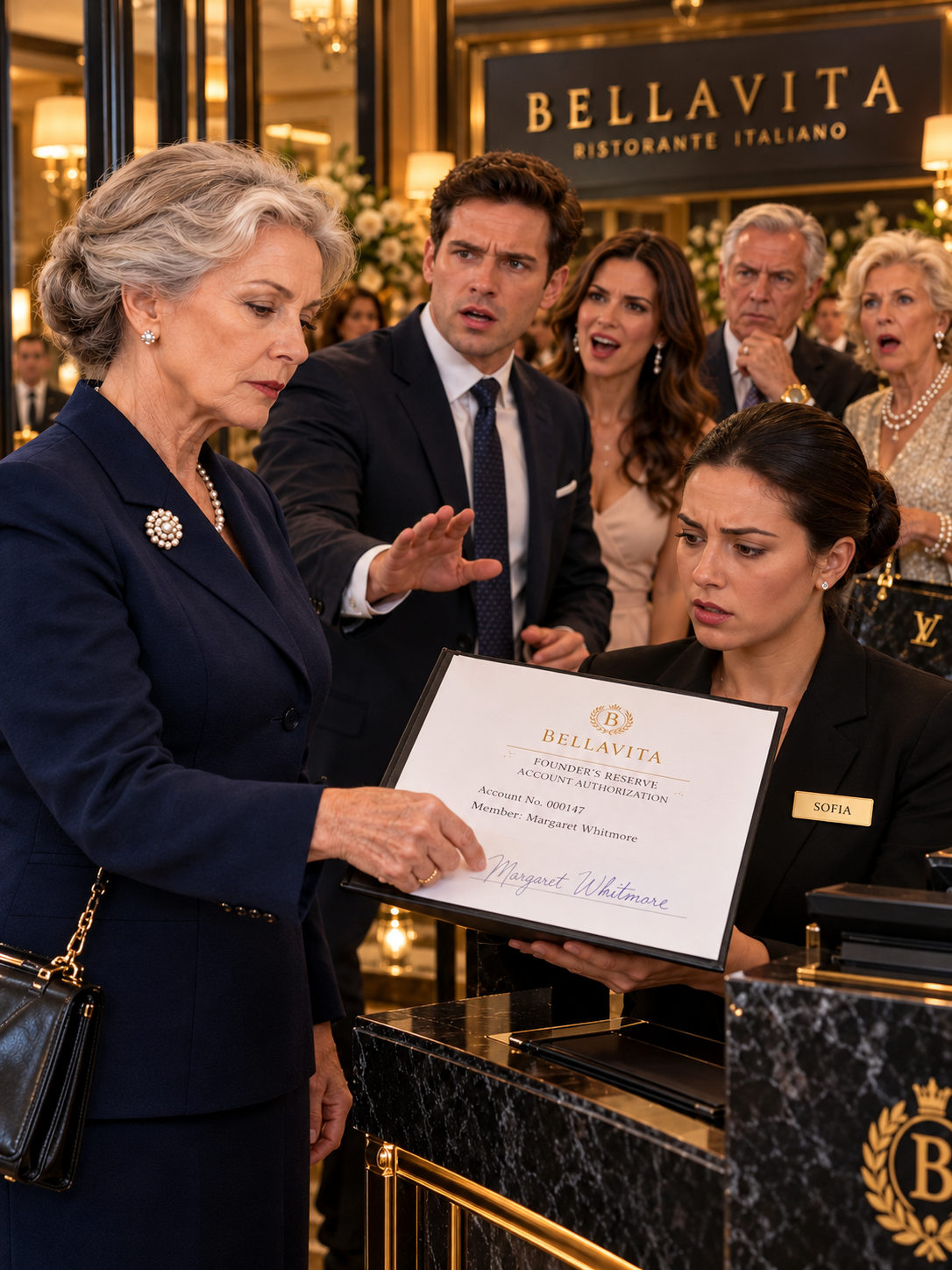
” On mother’s day, I went to dinner
alone at an Italian restaurant.
I ran into my son
and his wife’s family
just as I’d finished paying my check.
Then I heard him reading out
my membership number to the manager.
And what I did next…
made every one of them go pale.
》
My son was stealing from me
on Mother’s Day,
and he was stupid enough to do it
while I stood six feet behind him.
What he didn’t know was that
the membership number he was reading aloud
belonged to the woman
who controlled the entire restaurant.
My name is Margaret Whitmore.
I’m sixty-eight years old, a widow,
and apparently an embarrassment
to the son I spent thirty-five years raising.
That Sunday, I sat alone at Bellavita,
an elegant Italian restaurant in downtown Boston.
Around me, families laughed,
champagne glasses clinked,
and mothers received flowers.
My table had one chair occupied.
My son, Adam, hadn’t called.
Three weeks earlier, I’d invited him
and his wife, Vanessa,
to Mother’s Day dinner.
Vanessa answered his phone.
“”””We’re celebrating with my parents, Margaret.
It’s really a family occasion.””””
I remembered staring at my telephone.
“”””Am I not family?””””
She laughed.
“”””Don’t be dramatic.””””
So I dressed in my favorite navy suit,
pinned my late husband’s pearl brooch
to my lapel,
and took myself to dinner.
After finishing my pasta,
I paid my $86 bill
and prepared to leave.
That’s when I saw them.
Adam stood beside the entrance
with Vanessa, her parents,
and six other relatives.
His father-in-law, Graham Price, wore a Rolex.
His mother-in-law, Celeste,
carried a handbag worth more than my first car.
Adam noticed me.
His smile vanished.
“”””Mom? What are you doing here?””””
“”””Having dinner, sweetheart.””””
Vanessa looked at my empty table.
“”””Alone? How depressing.””””
Celeste exchanged an amused glance
with her husband.
“”””Some mothers really can’t let go.””””
I swallowed the humiliation.
“”””Enjoy your evening.””””
I turned toward the exit.
Then I heard Adam speaking
to the restaurant manager.
“”””The membership number is 000147.
Margaret Whitmore.
Just charge everything to her account.””””
My feet stopped.
The manager, a young woman named Sofia,
frowned.
“”””Sir, this is a Founder’s Reserve account.
Authorization is required.””””
Adam pulled a folded document
from his jacket.
“”””I’m her son. I have authorization.””””
Vanessa laughed.
“”””Mother’s getting forgetful.
She doesn’t understand financial arrangements anymore.””””
Graham leaned toward the manager.
“”””We’re booking a private reception.
Thirty-eight thousand dollars.
Her membership covers it.””””
Thirty-eight thousand dollars.
My son had deliberately excluded me
from Mother’s Day,
then brought his wife’s entire family
to spend my money.
Please type “OK” if you’re ready
for the next part
and I’ll send it right away.
But what caught my attention
wasn’t the amount.
It was the signature on the document.
My signature.
Perfectly copied.
Completely forged.
I quietly returned to the hostess stand.
“”””Sofia,”””” I said,
“”””before you process anything,
may I see that authorization?””””
Adam rolled his eyes.
“”””Mom, don’t make a scene.””””
I smiled.
“”””Oh, sweetheart. I haven’t even started…..Facebook limits
post length—don’t forget to switch
from “Most Relevant””
Sofia held the document between trembling fingers.
For several seconds, nobody moved.
The restaurant continued around us.
Silverware touched porcelain.
Someone laughed near the windows.
A waiter carried a birthday cake
toward a table of smiling strangers.
And my son stood there,
waiting for me to surrender.
I extended my hand.
“May I?”
Sofia glanced at Adam.
Then she looked directly at me.
“Of course, Mrs. Whitmore.”
She handed me the document.
Adam immediately reached for it.
“Mom, that’s private.”
I moved it beyond his fingers.
“Apparently, not private enough.”
Vanessa stepped closer.
“Margaret, you’re embarrassing everyone.”
I studied the first page.
It was professionally formatted.
My full legal name appeared at the top.
My address was correct.
So was my date of birth.
The authorization supposedly permitted Adam
to approve entertainment expenses
through my Founder’s Reserve membership.
It included a photocopy of my identification.
And beneath the final paragraph
sat a signature I recognized.
I recognized it
because I knew exactly where it came from.
Six years earlier,
after my husband Henry died,
I had sent Adam a handwritten letter.
It was written on cream stationery.
I had been unable to speak
about Henry without crying.
So I wrote instead.
At the bottom,
my fountain pen had leaked slightly.
A tiny dark mark appeared
beneath the final letter of Whitmore.
That same accidental mark
appeared on this document.
They hadn’t merely imitated my signature.
They had copied it.
From a letter
I had written to my own son.
I felt something inside me change.
Not anger.
Not yet.
Something colder.
Something that made my thoughts suddenly clear.
“Sofia, please preserve this.”
Adam laughed nervously.
“Preserve what?”
“Evidence.”
His expression tightened.
“Mom, you’re being ridiculous.”
I looked at him.
“Did you sign my name?”
He glanced at Vanessa.
It was a small movement.
Barely noticeable.
But mothers notice those things.
We notice when our children lie.
We notice when they’re frightened.
And sometimes,
we notice that they’ve already chosen sides.
Vanessa folded her arms.
“She’s confused. We expected this.”
“Did you sign my name?”
I repeated the question.
Adam’s jaw worked.
“Vanessa handled the paperwork.”
There it was.
Not a denial.
An explanation.
Vanessa’s face flushed.
“Don’t put this on me.”
Graham cleared his throat.
“Perhaps we should discuss this privately.”
I turned toward him.
“What an excellent suggestion.”
Then I addressed Sofia.
“Would you contact Lena Ortiz, please?”
Sofia blinked.
“Our director of operations?”
“Yes.”
“She’s not working tonight.”
“She’ll answer.”
Graham smiled condescendingly.
“Madam, this is becoming unnecessary.”
I returned his smile.
“Mr. Price, you have absolutely no idea.”
He adjusted his expensive watch.
“I know how business works.”
“I’m sure you do.”
I paused.
“Let’s see whether you understand this business.”
Sofia had already reached for her telephone.
She spoke quietly.
Then her posture changed.
“Mrs. Whitmore?”
“Yes, dear?”
“Ms. Ortiz says she’ll be here shortly.”
“Thank you.”
Adam looked between us.
“Why would the director come for you?”
“Because I asked her.”
“Mom, don’t pretend you’re someone important.”
That sentence landed harder than the theft.
Not because it surprised me.
Because he sounded so certain.
As if my importance
had always been determined by his approval.
I lowered the forged document.
“Adam, who do you think I am?”
He frowned.
“You’re my mother.”
“And?”
He hesitated.
“A retired woman.”
Vanessa supplied the rest.
“Living comfortably because your husband provided.”
I stared at her.
For years,
I had allowed that misunderstanding to survive.
It was easier than explaining my finances.
Easier than listening
to relatives calculate what they might inherit.
And perhaps,
some foolish part of me had hoped
Adam would love me
without knowing what I possessed.
Now I understood something painful.
He had never needed to know my wealth
to feel entitled to it.
He only needed to believe
that my boundaries didn’t matter.
“There’s something you should understand.”
Before I could continue,
a familiar voice interrupted.
“Margaret?”
Lena Ortiz approached from the corridor.
She was fifty-two,
with dark hair swept into a neat bun,
a tailored black jacket,
and the unhurried confidence
of someone accustomed to solving emergencies.
She saw my face.
Then the document.
Her expression hardened immediately.
“What happened?”
I handed her the authorization.
“My son attempted to charge thirty-eight thousand dollars
to my personal Founder’s Reserve account.”
Lena examined the paper.
“He presented this?”
“Yes.”
“And you authorized nothing?”
“Nothing.”
She turned toward Sofia.
“Has anything been processed?”
“No, ma’am.”
“Excellent.”
Lena faced the gathering.
“This transaction is denied.”
Graham’s smile disappeared.
“On whose authority?”
Lena looked genuinely surprised.
“Mrs. Whitmore’s.”
He gave an impatient laugh.
“She’s merely the account holder.”
“No, Mr. Price.”
Lena’s voice remained perfectly calm.
“Mrs. Whitmore is our controlling shareholder.”
Silence.
Vanessa blinked.
“Your what?”
Lena straightened.
“Whitmore Hospitality Holdings owns Bellavita.”
She glanced toward me.
“Mrs. Whitmore controls seventy-four percent
of that company.”
Adam stared at her.
Then at me.
Then at the elegant dining room.
The chandeliers.
The marble floor.
The polished brass railings.
His mouth opened.
Nothing emerged.
Graham looked toward the restaurant’s entrance,
as though the building itself
might contradict what he had heard.
Celeste clutched her handbag.
“You own this place?”
I shook my head slightly.
“Not all of it.”
For one hopeful second,
Vanessa seemed to relax.
Then I continued.
“Just the controlling interest.”
No one laughed.
I looked at Adam.
“Your father and I invested
when Bellavita was nearly bankrupt.”
I remembered that first visit.
The leaking ceiling.
The mismatched dining chairs.
The exhausted chef
who refused to abandon his restaurant.
Anton Bellini had been fifty-three then.
He had spent everything
keeping his family’s business alive.
Henry loved his cooking.
I loved his determination.
We had offered him a partnership.
The agreement protected Anton’s creative control
and gave us majority ownership.
Over the following years,
I helped expand the business.
Three restaurants became seven.
Seven became eleven.
We purchased our own catering kitchens.
Then a small hospitality property outside Boston.
Henry handled operations in the beginning.
I managed financing, property acquisitions,
and long-term investments.
When Henry died,
I became chair of the holding company.
I stopped attending every board meeting.
But I never surrendered control.
And I never needed Adam’s permission.
“Your father was proud of this company.”
My voice softened.
“He was especially proud of its people.”
Adam whispered,
“Why didn’t you tell me?”
I studied him.
“Would it have changed how you treated me?”
He said nothing.
I gestured toward the forged document.
“Because this answers that question.”
Vanessa recovered first.
“This is absurd.”
She looked around.
“Even if she owns the restaurant,
she still promised to help us.”
I turned toward her.
“When?”
“At Christmas.”
“With what?”
“Family expenses.”
I waited.
“Which expenses, Vanessa?”
Her lips tightened.
“You know exactly what I mean.”
“No.”
My voice remained steady.
“I know what thirty-eight thousand dollars means.”
I held up the paper.
“I know what forgery means.”
“And I know what deliberate exclusion means.”
Graham moved toward Lena.
“We have an agreement with your events department.”
Lena checked her tablet.
“You have an inquiry.”
He frowned.
“The reception is scheduled.”
“A provisional reservation.”
“People have already been invited.”
“Then you’ll need alternative arrangements.”
Graham’s face reddened.
“I’ll take this to the owner.”
Lena looked directly at me.
“She’s standing beside you.”
For the first time that evening,
I saw genuine fear cross Vanessa’s face.
Not embarrassment.
Not irritation.
Fear.
Because she finally understood
that the woman she had mocked
could not be dismissed as easily
as an unwanted Mother’s Day guest.
But the revelation changed nothing
about the document in my hand.
And it changed nothing
about the years that came before it.
I turned to Lena.
“Please preserve the original authorization,
the reservation correspondence,
and tonight’s security footage.”
“Of course.”
“And contact our legal counsel.”
Adam took a sharp breath.
“You’re calling lawyers on your own son?”
I looked at him.
“You brought a forged authorization
to a business I own.”
He shook his head.
“Mom, we can work this out.”
“Perhaps.”
Hope briefly appeared in his eyes.
Then I finished.
“But not by pretending it never happened.”
Vanessa stepped forward.
“Margaret, let’s be reasonable.”
I faced her.
“You told the manager I was forgetful.”
She glanced away.
“You misunderstood.”
“No.”
I remembered every word.
“You said I didn’t understand financial arrangements.”
“That was just an explanation.”
“Of what?”
Vanessa’s silence answered me.
I moved closer.
“Of why you could steal from me?”
“Nobody stole anything!”
She nearly shouted it.
Several diners turned.
Lena gently gestured toward a nearby corridor.
“Would everyone prefer a private room?”
I considered the crowded restaurant.
A young couple had stopped eating.
An elderly woman watched from across the aisle.
Three servers stood uneasily near the kitchen.
None of them deserved this disruption.
“Yes.”
I handed Lena the document.
“Please secure that first.”
She placed it inside a protective folder.
Then we entered Bellavita’s Blue Room.
It was a private dining space
with deep blue walls,
a walnut table,
and tall windows overlooking Boston’s evening traffic.
I had helped choose those curtains.
Henry had hated their color.
He always claimed they made the room
look like a banker’s office.
I smiled at the memory.
Then I turned.
Adam was watching me.
His eyes were red.
“Mom, please.”
“Sit down.”
He obeyed.
Vanessa sat beside him.
Graham remained standing.
Celeste took a chair near the door.
The other relatives had stayed outside.
One of them, Vanessa’s aunt Ruth,
looked deeply uncomfortable.
She had quietly followed us.
Lena remained beside the table.
Sofia stood near the doorway.
I noticed her pale face.
“Sofia, you did everything correctly.”
She swallowed.
“Thank you, Mrs. Whitmore.”
“Please don’t worry about your position.”
Her shoulders relaxed slightly.
I turned back toward my family.
“Now.”
I placed both hands on the table.
“Who created that authorization?”
Nobody answered.
I waited.
Adam stared at his wedding ring.
Vanessa inspected her fingernails.
Finally Graham spoke.
“It’s a family matter.”
“No.”
I shook my head.
“It’s a forged financial document.”
He leaned forward.
“You’re making an accusation.”
“Then answer the question.”
His jaw tightened.
Vanessa said,
“Adam believed he had permission.”
I looked at my son.
“Did you?”
His shoulders slumped.
“Not exactly.”
A dull ache spread through my chest.
“What does that mean?”
He rubbed his forehead.
“Vanessa said you wouldn’t mind.”
“And you believed her?”
He did not answer.
I waited.
“Adam.”
His eyes lifted.
“Did you know that signature wasn’t mine?”
He looked toward his wife.
Then he nodded.
Very slightly.
But enough.
For a moment,
I couldn’t feel my fingers.
It was not the confession
of a confused man.
It was the admission
of someone who understood his wrongdoing
and expected his mother to absorb it.
“Why?”
The word barely escaped me.
Adam covered his face.
“We needed the reception.”
“For what?”
Graham interrupted.
“That’s none of your concern.”
I turned sharply.
“You’re asking me to pay for it.”
He closed his mouth.
Vanessa spoke instead.
“My father’s charitable foundation
is hosting a donor event.”
I looked at Graham.
“What foundation?”
“The Price Family Legacy Foundation.”
“What does it support?”
“Community development.”
“Which communities?”
He glared at me.
“Are you interrogating me?”
“I’m asking about my proposed donation.”
His face darkened.
“We have important guests coming.”
“Then they deserve a truthful invitation.”
Celeste suddenly stood.
“Margaret, you’re enjoying this.”
I stared at her.
“Enjoying what?”
“Humiliating my family.”
I felt an unexpected sadness.
“Celeste, your daughter humiliated me
before I even knew about the document.”
She looked away.
“She called my dinner depressing.”
I glanced at Adam.
“She told me to stay away.”
Then I looked back at Celeste.
“And all of you laughed.”
Nobody contradicted me.
I continued.
“Do you know why I came tonight?”
Vanessa rolled her eyes.
“Because you couldn’t spend one evening alone?”
I ignored her.
“I came because I missed my husband.”
That silenced the room.
“Henry loved Bellavita.”
I touched my pearl brooch.
“He proposed our anniversary dinners here.”
“Every Mother’s Day,
he insisted we celebrate together.”
I swallowed.
“After he died,
I hoped my son might continue
one small piece of that tradition.”
Adam’s expression crumpled.
But I wasn’t finished.
“Instead, you told me I wasn’t family.”
Vanessa opened her mouth.
I raised one hand.
“Please don’t.”
She stopped.
I looked at the forged document.
“And then you tried to spend
more than thirty-eight thousand dollars
using my name.”
Adam whispered,
“I’m sorry.”
I watched him carefully.
“Are you sorry you did it?”
He began crying.
“Or sorry that I caught you?”
His crying stopped.
Because he didn’t know what to say.
That answer hurt most of all.
Lena’s telephone vibrated.
She glanced down.
“Margaret, our legal department is available.”
“Good.”
I stood.
“Please arrange for a formal incident report.”
Graham made a disgusted sound.
“You’re destroying a family over dinner.”
I looked at him.
“No.”
I collected my purse.
“Your family tried to finance a celebration
with a crime.”
Then I turned toward Adam.
“And mine forgot I was worth inviting.”
I walked toward the door.
Adam hurried after me.
“Mom!”
I stopped.
He stood just behind me.
“Please don’t leave like this.”
I glanced back.
“How would you prefer I leave?”
He searched for an answer.
“Can’t we just go home?”
The word home nearly broke me.
For thirty-five years,
my home had been his refuge.
When he scraped his knees,
when school became difficult,
when his first girlfriend broke his heart,
when he lost his first job,
he came home.
And I was there.
Always.
But somewhere along the way,
he had mistaken my presence
for an obligation without limits.
“You can go home, Adam.”
I touched his arm.
“But not with my money.”
He began crying again.
This time,
I did not comfort him.
I opened the door
and walked into the corridor.
Sofia waited beside the hostess stand.
“Mrs. Whitmore?”
“Yes?”
“Would you like your car brought around?”
“Thank you, but I drove myself.”
She nodded.
Then she hesitated.
“May I say something?”
“Of course.”
Her eyes shimmered.
“My mother worked two jobs.”
I listened.
“Sometimes she celebrated Mother’s Day alone
because I was working or studying.”
She drew a careful breath.
“I regret every one of those evenings.”
I felt my throat tighten.
“She’s still with you?”
Sofia nodded.
“Yes.”
“Then call her.”
She gave a watery smile.
“I will.”
“Tonight.”
“I promise.”
I squeezed her hand.
Then I left.
Outside, Boston was turning golden.
Late sunlight reflected from office windows.
The air smelled faintly of rain.
Couples walked past carrying flowers.
A little boy ran toward his mother,
holding a crooked handmade card.
She knelt to embrace him.
I stood beside my car
and finally let myself cry.
Not because of thirty-eight thousand dollars.
That money mattered.
But it was replaceable.
I cried because my son
had looked directly at me
and chosen convenience over honesty.
I cried because he had watched
his wife insult me
and offered no defense.
And I cried because,
for a terrible moment,
I wondered whether I had raised him
to believe love meant unlimited access.
I sat inside my car.
I turned the engine on.
Then I turned it off again.
I couldn’t drive yet.
My hands were shaking.
My telephone rang.
Adam.
I watched his name illuminate the screen.
Then disappear.
It rang again.
And again.
On the fifth call,
I switched the telephone to silent.
For years,
I had answered every call from him.
Even during board meetings.
Even during holidays.
Even when I knew
he only wanted something.
That night,
I needed to answer myself first.
I drove home slowly.
My house stood on a quiet street
near Boston’s western suburbs.
It was a modest brick colonial
with climbing roses,
a narrow porch,
and a white front door.
Henry and I had bought it
when Adam was four.
We could have moved many times.
But Henry loved the garden.
I loved the morning light.
And Adam had carved his initials
beneath the back porch railing.
There were memories everywhere.
Not all of them painful.
That made everything harder.
I entered the kitchen.
The clock read seven twenty-three.
A bouquet of white tulips
stood beside the sink.
I had bought them for myself.
I filled the kettle.
Then I opened the kitchen drawer
where Henry kept his handwritten recipes.
Beneath the recipe cards
was a faded photograph.
Adam, age eight,
stood between us at Bellavita.
He was missing a front tooth.
I wore a red dress.
Henry had one arm around us both.
On the back,
he had written a sentence.
“Our greatest investment is each other.”
I sat at the kitchen table
holding that photograph.
And for the first time,
I allowed myself to consider
that love without boundaries
could become something unrecognizable.
My telephone vibrated.
A message from Vanessa.
You are making a terrible mistake.
Another followed.
Adam is devastated.
Then another.
You owe your family an explanation.
I stared at the words.
An explanation.
As though the forged signature
required interpretation.
I turned off my telephone.
Then I drank my tea alone.
But this time,
the silence felt different.
It wasn’t abandonment.
It was a decision.
The following morning,
I called Clara Greene,
my attorney of nineteen years.
She arrived shortly after ten.
Clara was sixty-one,
with silver-framed glasses
and an extraordinary ability
to remain calm while delivering terrible news.
She read the incident report.
Then examined the scanned authorization.
Her expression grew increasingly serious.
“Margaret, this wasn’t an impulsive mistake.”
“I know.”
“No.”
She lowered the papers.
“I mean this was carefully planned.”
She pointed to the authorization.
“The language resembles an estate-planning document.”
I frowned.
“Whose document?”
“That’s what we’re going to determine.”
She opened her laptop.
“Have you given Adam access
to your financial files recently?”
“Not deliberately.”
“Think carefully.”
I closed my eyes.
At Christmas,
Adam and Vanessa had visited.
It was their first overnight stay
in almost two years.
Vanessa had offered to help
organize Henry’s old paperwork.
I had been touched.
She rarely volunteered
to do anything in my home.
For three hours,
she remained in the upstairs study.
Later,
I noticed one filing cabinet
had been left slightly open.
I hadn’t thought much of it.
Now,
the memory felt like a warning.
“Christmas,” I whispered.
Clara looked up.
“What happened at Christmas?”
I told her.
She asked several questions.
Then she called my accountant.
By noon,
we had begun reviewing every account
that Adam might reasonably know existed.
Clara arranged additional authentication protections.
My bank was notified.
My membership credentials were suspended
pending replacement.
The hospitality company’s legal team
preserved the restaurant records.
And I authorized a police report.
That final decision required the most courage.
Clara noticed my hesitation.
“You don’t have to decide
how you feel about your son today.”
I looked at her.
“But I should report what he did.”
“Yes.”
She paused.
“And remember something important.”
I waited.
“Reporting wrongdoing isn’t the same
as wishing suffering upon the person responsible.”
I nodded.
But my heart was heavy.
By afternoon,
the investigation uncovered something worse.
Three weeks before Mother’s Day,
someone had contacted my bank,
claiming to act as my financial representative.
The caller had requested information
about account access
and procedures for submitting authorization documents.
The bank had provided general instructions
but released no private financial information.
A week later,
a document arrived through an online portal.
It purported to grant Adam
limited financial authority.
The bank’s verification team rejected it.
They couldn’t establish my consent.
Nobody had informed me
because the request had been treated
as unsuccessful suspected impersonation
and referred for review.
Clara looked at the scanned paperwork.
“This signature matches the restaurant document.”
I leaned forward.
At the bottom,
beneath the name Margaret Whitmore,
was that tiny ink mark.
The same mark.
From Henry’s condolence letter.
I could almost hear my son’s voice
from the day he received it.
“Mom, I’ll always be here.”
He had hugged me
while I cried against his shoulder.
Now that same letter
had become a tool against me.
Clara touched my hand.
“Margaret?”
I realized I was crying.
“I’m all right.”
She waited.
“No,” I admitted.
“I’m not.”
She closed the laptop.
“Then we stop for today.”
I shook my head.
“Not yet.”
My voice was quiet.
“I want to know everything.”
And over the next two weeks,
we learned more
than I had ever wanted to know.
The Price Family Legacy Foundation
wasn’t what Graham claimed.
It existed as a privately organized project,
but had no established charitable track record.
Its promotional materials described programs
that had never actually operated.
The planned Bellavita reception
was supposed to attract wealthy contributors.
Graham had advertised an exclusive event
with prestigious catering
and prominent Boston business leaders.
He had already approached several prospective donors.
Some had expressed interest.
At least two had sent money
toward a separate fundraising initiative.
The reception was meant to demonstrate prosperity.
But Graham couldn’t afford it.
His consulting business was failing.
Several large contracts had collapsed.
His expensive house carried substantial debt.
The luxury cars were leased.
And the watch
he displayed so proudly
had been purchased on credit.
None of that excused the fraud.
But it explained his desperation.
He had built a life
that depended on appearing richer
than he truly was.
And my son had married into it.
I learned that Adam knew
about some of Graham’s financial problems.
He had been helping with expenses.
At first,
they were modest loans.
Then they grew.
Vanessa convinced him
that the foundation’s reception
would attract investors and rescue her father.
When Adam hesitated over the cost,
Vanessa suggested using my Founder’s Reserve account.
She had discovered its number
among the papers in my study.
Adam told her
the account was probably insignificant.
A family privilege.
Something Henry had arranged years earlier.
Vanessa researched it.
Then she discovered
that Founder’s Reserve members
could request significant hospitality services.
She knew my account carried unusual privileges.
What she didn’t understand
was why those privileges existed.
Or who authorized them.
When the events department requested my consent,
she produced a document.
And my son presented it.
Clara called me
the afternoon the forensic review
identified the matching signature source.
She spoke gently.
“Margaret, the evidence supports
a deliberate reproduction of your signature.”
I stood beside my kitchen window.
Outside,
a robin hopped across the garden path.
“Is there any uncertainty?”
“Some details still need investigation.”
“But it wasn’t accidental.”
“No.”
I closed my eyes.
“Thank you.”
Then I ended the call.
For several minutes,
I stood completely still.
Eventually,
I went upstairs.
I opened the closet
where Henry’s old coat still hung.
I hadn’t moved it.
It was a dark wool coat
with a torn inner pocket.
He had worn it every winter
until illness made the cold unbearable.
I pressed my face into the fabric.
It no longer smelled like him.
That hurt in a different way.
“Henry,” I whispered,
“what happened to our boy?”
The closet offered no answer.
Neither did the photograph on the dresser.
But I remembered something Henry once said.
Adam was sixteen.
He had damaged a neighbor’s fence
while driving without permission.
I wanted to pay for everything.
Henry stopped me.
“If we fix every consequence,
he’ll never learn what responsibility costs.”
At the time,
I thought Henry was being too severe.
Now,
I wondered how often
I had confused protection with rescue.
I sat on the edge
of our old bed.
And I made another decision.
I would not rescue Adam
from the consequences of his choices.
Not this time.
Three days later,
Vanessa appeared at my front door.
She arrived without warning.
I saw her through the window.
She wore a cream-colored coat
and enormous sunglasses.
Her hair was perfectly arranged.
She carried no flowers.
No apology.
Only a leather handbag
and an expression of controlled irritation.
I opened the door halfway.
“Hello, Vanessa.”
She removed her sunglasses.
“Can we talk?”
“About what?”
“Everything.”
I studied her.
“Is Adam with you?”
“No.”
“Does he know you’re here?”
She hesitated.
“That doesn’t matter.”
“It matters to me.”
She glanced over her shoulder.
“Are you going to invite me inside?”
I considered it.
Then shook my head.
“We can speak here.”
Her jaw tightened.
“Margaret, please don’t be childish.”
I almost laughed.
That word again.
Childish.
Dramatic.
Forgetful.
So many convenient descriptions
for a woman refusing obedience.
“What did you come to say?”
Vanessa lowered her voice.
“My father has made some mistakes.”
“Yes.”
“He trusted the wrong people.”
“Did he?”
“His business partners.”
I waited.
“Things got complicated.”
“Financially?”
“Yes.”
“And you decided I should pay?”
Her cheeks colored.
“We weren’t stealing.”
I looked directly into her eyes.
“Then why did you copy my signature?”
She looked away.
That was answer enough.
“I thought you’d understand.”
“Understand what?”
“That family helps family.”
I felt my patience disappearing.
“Vanessa, you excluded me
from a dinner celebrating mothers.”
She made an impatient gesture.
“That was just one evening.”
“Then you attempted to spend my money.”
“You have plenty.”
Her reply came instantly.
She realized her mistake too late.
I stared at her.
“So that’s your justification?”
She folded her arms.
“You’ll never miss thirty-eight thousand dollars.”
“Perhaps not financially.”
I stepped onto the porch.
“But I would miss the truth.”
She looked annoyed.
“You’re making this personal.”
“It is personal.”
My voice remained low.
“You used my dead husband’s letter.”
Her face changed.
I saw recognition.
Then alarm.
“To forge my signature.”
She swallowed.
“Adam gave me that letter.”
I felt something twist inside me.
“Did he?”
“He said we could use it.”
For a moment,
the morning seemed unnaturally quiet.
A breeze moved through the roses.
Somewhere,
a dog barked.
I remembered my son
holding that letter against his chest.
I had believed he treasured it.
Maybe he had.
Once.
I took a careful breath.
“Did you make the document yourself?”
Vanessa straightened.
“I’m not answering legal questions.”
“That’s sensible.”
She blinked.
“Excuse me?”
“You should probably speak with your lawyer.”
She stepped forward.
“Margaret, if this becomes public,
you’ll destroy Adam’s reputation.”
I looked at her.
“Did either of you consider that
before using my name?”
She said nothing.
I continued.
“Your father can explain his foundation.”
“You can explain the signature.”
“And Adam can explain his participation.”
Vanessa’s eyes narrowed.
“You’re willing to lose your son?”
The question struck exactly where she intended.
But I had already cried enough
to recognize manipulation.
“I’m not choosing to lose him.”
I stepped backward.
“I’m choosing not to lose myself.”
Her expression hardened completely.
“You’ll regret this.”
I nodded slowly.
“I already regret many things.”
Then I closed the door.
I stood there listening
until her car pulled away.
Only afterward did I realize
that my knees were trembling.
Strength doesn’t always feel powerful.
Sometimes,
it feels like leaning against a door
because you’re afraid you’ll fall.
That evening,
Adam left a message.
“Mom, Vanessa told me what happened.”
His voice sounded exhausted.
“I don’t know how we got here.”
A pause.
“Please call me.”
I listened twice.
Then deleted nothing.
I was learning
that preserving evidence
sometimes meant preserving painful things.
A week later,
I met Vanessa’s aunt Ruth.
She called unexpectedly
and asked whether we could speak privately.
Ruth Price was sixty-four,
a retired schoolteacher
with soft gray curls
and a straightforward manner.
I remembered her from Adam’s wedding.
She was the only person
who had helped me gather decorations
after the reception ended.
We met at a small café
far from Bellavita.
Ruth arrived carrying a folder.
She looked troubled.
“Margaret, I owe you an apology.”
I shook my head.
“You didn’t create that document.”
“No.”
She sat opposite me.
“But I believed things
I should have questioned.”
She opened the folder.
Inside were copies of invitations
and several email messages.
One invitation announced
the Price Family Legacy Foundation’s reception.
At the bottom,
beneath the event details,
was a sentence that stopped me.
“Hosted through the generosity of Margaret Whitmore.”
I stared at it.
“Hosted?”
Ruth nodded.
“That’s what we were told.”
“Who told you?”
“Vanessa.”
My hands tightened around the page.
“She said you insisted on paying.”
I looked up.
Ruth’s eyes were wet.
“She also said you couldn’t attend.”
“Why?”
“Because you were experiencing memory problems.”
I felt sick.
“She said you found gatherings overwhelming.”
Ruth continued softly.
“And that you wanted
to support the family from a distance.”
I looked at the invitation again.
My name had been used
not just as a payment method,
but as a public endorsement.
Vanessa had transformed my absence
into an imaginary act of generosity.
That explained the careful exclusion.
They didn’t merely want me elsewhere.
They needed me unavailable.
Because if donors met me,
the lie might collapse.
Ruth turned another page.
“There’s something else.”
She showed me an email.
It was from Graham.
He had urged several relatives
to contribute toward the foundation
before the reception.
Ruth had sent five thousand dollars.
Her savings.
Money she intended to use
for a family reunion.
“I thought the foundation was real.”
Her voice broke.
“I thought we were helping people.”