Here’s Part 2 and the Full Ending:
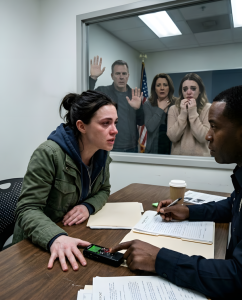
Detective Morris turned the phone toward the recorder on the table.
The first voice that came out of the speaker was my father’s, calm and clear.
“Nobody leaves this room until we get our story straight.”
The recording crackled softly.
Mom asked whether the police could prove who was driving.
Raven started crying.
Then Dad spoke again.
“Listen to me. Emma wasn’t there. But she’s always been difficult. If she says she borrowed the car earlier, that’s enough confusion. We just need time.”
The room went completely silent.
Behind the glass, my mother’s face drained of color.
Raven’s hands flew to her mouth.
Detective Morris didn’t interrupt. He simply let the recording continue.
Every lie.
Every plan.
Every attempt to make me the scapegoat.
It was all there.
The sound of Dad instructing Raven what to tell officers.
Mom reminding everyone to delete messages.
Raven begging them to stop.
Then the final sentence.
The sentence that ended everything.
“Emma owes this family. It’s her turn.”
Detective Morris pressed pause.
Nobody moved.
Nobody spoke.
For years, those words had governed my life.
Emma owes this family.
When Raven failed a class, I was expected to tutor her.
When Mom forgot a bill, I paid it.
When Dad needed help, I canceled plans.
Whenever something went wrong, I somehow became responsible.
But this time there was a recording.
This time there was evidence.
This time there was nowhere for the truth to hide.
Three hours later, I walked out of the station.
No handcuffs.
No accusations.
No suspicion.
Just exhaustion.
The summer air felt strange against my skin.
For the first time in twenty-seven years, I wasn’t carrying my family’s secrets.
I was carrying my own freedom.
Inside the station, things were moving quickly.
Traffic cameras had already confirmed the vehicle’s route.
Cell phone location data placed me across town at the time of the crash.
Witness statements contradicted every version of the story my parents had tried to create.
The recording was simply the final nail.
Raven eventually admitted everything.
She had been driving.
She had run a red light.
She had hit another vehicle.
Nobody died, but two people were injured.
Terrified, she called our parents.
And instead of helping her tell the truth, they tried to find someone else to sacrifice.
Me.
The legal consequences arrived over the following months.
Raven faced charges related to the accident.
My parents faced much worse.
Witness tampering.
Obstruction.
Providing false statements.
Attempting to interfere with an investigation.
Every court appearance seemed to age them another year.
They kept looking at me as though I had betrayed them.
The irony never escaped me.
I hadn’t betrayed anyone.
I simply refused to volunteer as the victim.
Raven contacted me six months later.
Not to ask for help.
Not to ask for forgiveness.
To apologize.
Really apologize.
For the first time in our lives, there was nobody else in the room telling her what to think.
She admitted she had known our parents would choose me.
Because they always had.
She admitted she stayed silent because she was scared.
And she admitted that hearing Dad say “It’s her turn” had finally broken something inside her.
We met for coffee.
Then again a month later.
Slowly, carefully, we built something neither of us had ever been allowed to have.
A relationship without our parents controlling it.
I never fully reconciled with Mom and Dad.
Some wounds don’t close because the people who caused them still insist they did nothing wrong.
The last letter they sent arrived two years later.
It wasn’t an apology.
It was another attempt to explain.
Another attempt to justify.
Another attempt to make themselves the victims.
I threw it away unread.
Because healing isn’t understanding why someone hurt you.
Sometimes healing is accepting that they did.
And deciding you won’t carry it anymore.
Years later, Detective Morris retired.
On his last day, he mailed me a short note.
It contained only one sentence.
“The truth usually arrives late, but it arrives.”
I framed it.
Not because of the case.
Not because of the investigation.
But because of what it taught me.
For most of my life, I thought survival meant enduring.
Keeping quiet.
Keeping peace.
Keeping everyone else comfortable.
I was wrong.
Sometimes survival means pressing record.
Sometimes it means telling the truth out loud.
And sometimes the bravest thing you’ll ever say is the simplest:
“I was not in the car.”
Everything changed after that. And for the first time, the change was in my favor.