My Husband Called Our 15-Year-Old Daughter an Attention Seeker Every Time She Complained of Pain—Then a Doctor Found a Medical Record He Had Hidden From Me for Five Weeks
My daughter was fifteen when she finally looked at me and whispered, “I stopped telling Dad when it hurts. He says I’m just doing it for attention.”
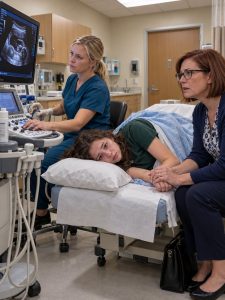
The next afternoon, I signed her out of school and took her to the hospital without telling my husband. Halfway through the scan, the technician suddenly went silent.
Then the doctor walked in, closed the examination room door, and asked me one question that made my blood run cold: “How long has her father known about this?”
The room smelled sharply of sanitizer, and the paper beneath my daughter crackled every time she shifted. I stared at the doctor because his question made no sense.
“He doesn’t know,” I said. “I didn’t tell him we were coming.”
The doctor glanced at my daughter, then back at me.
“I’m not asking about today.”
He turned the monitor toward me and opened an older entry in her medical chart. Five weeks earlier, my daughter had been evaluated for exactly the same pain.
Her father was listed as the parent who brought her in. The note stated that additional imaging had been recommended because her symptoms required further investigation.
I hadn’t known there had been a first visit.
My daughter pulled the sleeves of her gray hoodie over her hands and stared at the edge of the examination bed.
“Did Dad take you?” I asked.
She nodded.
The doctor kept his voice even. What they were seeing now needed prompt attention and more testing. He wasn’t accusing anyone. He was trying to understand why the recommended follow-up had never happened.
So was I.
My name is Rebecca Mitchell. I’m forty-one years old, and until that afternoon, I believed my husband and I shared every important decision concerning our daughter.
Our daughter, Grace, had always been a cheerful, hardworking teenager who loved drawing, playing volleyball, and spending Saturday afternoons baking chocolate-chip cookies with me.
She wasn’t the kind of child who complained easily. Even when she broke her wrist falling off a bicycle at eleven, she apologized for interrupting our dinner.
So when she began mentioning persistent pain in her lower abdomen, I knew something wasn’t right.
At first, the discomfort came and went.
Grace described it as a dull ache on her right side, occasionally spreading toward her back. Sometimes it became sharp enough to interrupt her concentration.
I suggested making a doctor’s appointment.
My husband, Daniel, immediately dismissed the idea.
“She’s fifteen, Rebecca. Teenagers get stomachaches. Stop teaching her to panic over every little discomfort.”
Daniel worked as a senior sales executive for a regional construction company. He was confident, outspoken, and accustomed to having the final word.
During our seventeen years of marriage, I had gradually learned that disagreeing with him often resulted in hours of arguments and uncomfortable silence.
He wasn’t always unkind.
He could be affectionate and generous, especially when other people were watching. But at home, he had little patience for anything that disrupted his plans.
When Grace became ill, his impatience grew worse.
One evening, she came downstairs holding her side.
“Dad, it really hurts tonight.”
Daniel barely looked away from the television.
“Then stop eating junk food.”
“I haven’t eaten anything unusual.”
He sighed loudly.
“Grace, not everything needs to become a medical emergency. You’re always looking for attention lately.”
She went silent.
I remember the way her shoulders dropped before she turned and walked upstairs.
I followed her, but she insisted she was fine.
Now I understand why.
She had learned that admitting pain meant risking another argument.
Over the following weeks, Grace became increasingly withdrawn. She stopped attending volleyball practice and began spending most evenings curled up on her bed.
Her appetite decreased.
She lost weight.
Sometimes, when I checked on her at night, I found her awake, pressing a heating pad against her abdomen.
I asked Daniel again to help arrange an appointment.
He told me he had already handled it.
“I took her to a clinic while you were working,” he said. “They said it was probably nothing serious.”
I was relieved.
“What did they recommend?”
“Rest. Better eating habits. The usual.”
“Did they prescribe anything?”
“No.”
I asked whether there was paperwork.
Daniel became irritated.
“Rebecca, do you need a written report every time I do something for our daughter?”
I backed away from the conversation.
That decision would haunt me later.
Because Daniel had taken Grace to a hospital.
And the doctors had not told him everything was fine.
Five weeks before our second hospital visit, Grace had experienced severe pain during school. The nurse called Daniel because I was attending an out-of-town conference.
He collected her and brought her to the emergency department.
The physician examined Grace, ordered initial tests, and identified an abnormal finding that required additional imaging and specialist follow-up.
But Daniel didn’t arrange the appointment.
Instead, he brought her home and told her that the doctors believed she was exaggerating her symptoms.
Grace believed him.
Why wouldn’t she?
He was her father.
She trusted him to tell her the truth about her own health.
The first time I realized how frightened she had become was on a Tuesday evening, when I found her sitting on the bathroom floor.
Her face was pale.
She had one arm wrapped around her stomach.
“Grace?”
She looked up quickly.
“I’m okay, Mom.”
I knelt beside her.
“You don’t look okay.”
She tried to smile.
“It’s just the same pain.”
I touched her forehead.
“Sweetheart, why didn’t you tell me it was getting worse?”
Her eyes filled with tears.
Then she whispered the words I will never forget.
“I stopped telling Dad when it hurts. He says I’m just doing it for attention.”
Something inside me changed.
I had spent months trying to keep peace between my husband and daughter, believing his harshness was simply frustration.
But looking at Grace, I finally understood that our silence was costing her something much more important than peace.
It was costing her the confidence to ask for help.
I held her face gently between my hands.
“Listen to me, sweetheart. Pain is not something you have to earn permission to talk about.”
She began crying.
“I don’t want Dad to be mad.”
“He doesn’t have to agree with us for you to see a doctor.”
The following afternoon, I signed Grace out of school and drove directly to the hospital.
I didn’t call Daniel.
I didn’t ask his permission.
I simply told my daughter that we were going to find out what was happening.
At the hospital, Grace underwent blood tests and an ultrasound examination. The technician carefully moved the probe across her abdomen while watching the monitor.
For several minutes, everything seemed routine.
Then the technician became unusually quiet.
She adjusted the machine, took additional images, and asked Grace to remain still.
I noticed her expression change.
“Is something wrong?” I asked.
She explained that the radiologist would review the images and that a physician would discuss the findings with us.
Twenty minutes later, Dr. Andrew Collins entered the examination room.
He closed the door.
Then he asked about Daniel.
When he showed me the earlier medical record, I felt as though the floor had disappeared beneath my feet.
Five weeks.
For five weeks, my husband had known doctors wanted further investigation.
For five weeks, he had told our daughter she was seeking attention.
And for five weeks, he had allowed me to believe that a medical professional had already ruled out anything serious.
“What are you seeing now?” I asked.
Dr. Collins pulled up the latest images.
“There appears to be a sizable mass near your daughter’s right ovary. We need further imaging and specialist evaluation to understand exactly what it is.”
My heart began pounding.
“A mass?”
He nodded.
“Many ovarian masses in adolescents are benign, but this one requires prompt assessment, especially because of her worsening pain.”
Grace stared at the monitor.
“Do I have cancer?” she whispered.
The doctor turned toward her.
“We don’t know that, Grace. And I don’t want you to assume the worst. We’re going to investigate carefully and explain each step.”
I reached for her hand.
It was cold.