Dr. Robert Wright had delivered thousands of babies.
He had seen the first seconds of life in every form—furious cries, trembling limbs, tiny fists clenched against the brightness of the world. He had stood beside mothers who laughed, mothers who screamed, mothers who whispered prayers, mothers who looked too stunned to believe that pain could turn into a person.
But he had never looked into a newborn’s face and felt the floor vanish beneath him.
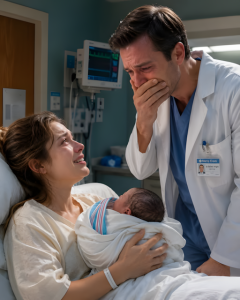
The baby’s eyes were still squeezed shut. His skin was flushed from birth, his mouth open in protest as the nurse rubbed him clean. A dark patch of hair clung damply to his head.
And on the left side of his chest, just beneath the collarbone, was a small birthmark.
A crescent shape.
Robert’s hand went to his own chest as if someone had struck him there.
“Doctor?” the nurse asked carefully.
Joanna, exhausted and pale against the pillows, lifted her head. “What is it? Is something wrong with him?”
Robert tried to answer, but his voice had disappeared. He stared at the baby, then at Joanna’s chart again.
Patient name: Joanna Miller.
Infant: male.
Father listed: Logan Wright.
The letters blurred.
Logan.
His son.
The son he had not spoken to in nearly eight years.
Robert turned toward Joanna with a face that no longer belonged to the calm doctor everyone knew. It was the face of a man seeing a ghost.
“Did you say the father’s name is Logan Wright?” he asked.
Joanna’s expression changed instantly. The relief in her eyes dimmed, replaced by caution. “Yes.”
Robert swallowed. “Logan… Andrew Wright?”
Her fingers tightened around the hospital blanket. “How do you know his middle name?”
The room fell silent except for the baby’s cries.
Robert stepped back as though the question had physically pushed him. His eyes shone with tears he could not control.
“Because,” he whispered, “Logan is my son.”
Joanna stared at him.
For a moment, she thought she had misunderstood. Maybe the exhaustion had finally overtaken her. Maybe the twelve hours of pain, the fear, the loneliness, and the sudden appearance of this shaken man had tangled into some impossible mistake.
But Robert Wright did not look confused.
He looked devastated.
The nurse shifted uneasily, the newborn still bundled in her arms. “Dr. Wright…”
Robert blinked, remembering where he was. Remembering the mother in the bed. The baby waiting to be held.
He forced himself to move closer, though every step seemed difficult.
“I’m sorry,” he said, his voice rough. “I didn’t mean to frighten you. Your son is healthy. He’s breathing well. Strong cry. Good color.”
Joanna’s eyes flicked to the nurse. “Can I hold him?”
“Of course,” the nurse said softly.
She placed the baby against Joanna’s chest, and the instant his cheek touched her skin, his cries began to quiet. Joanna closed both arms around him, bending over him with a tenderness so fierce it seemed to close the rest of the room away.
“My baby,” she whispered. “My beautiful boy.”
Robert watched them, and tears slipped down his face.
He had spent years teaching himself not to think of Logan too deeply. Not because he did not love him, but because love had become a room full of broken glass. Every memory cut.
Logan at five, running down the hallway in mismatched socks.
Logan at twelve, refusing to cry when his mother died.
Logan at twenty-one, standing in Robert’s kitchen with anger burning in his eyes, saying, “You don’t get to decide my life just because you lost yours.”
Then the silence.
Eight years of unanswered calls.
Eight years of birthdays marked by unsent messages.
Eight years of wondering whether his son was alive, happy, lost, married, alone.
And now—here was Logan’s child.
Born in Robert’s hospital.
Delivered into his hands.
The crescent birthmark had been the final blow. It was the same mark Logan had been born with. The same mark Robert’s late wife, Elaine, had once kissed and called “the moon’s fingerprint.”
Joanna looked up at him, wary and confused. “Where is he?”
Robert did not answer immediately.
The question was too small for the truth behind it.
“I don’t know,” he said at last.
Joanna gave a bitter, tired laugh. “That makes two of us.”
The nurse quietly checked Joanna’s vitals, sensing the heaviness in the room. “We’ll give you a few minutes,” she said, though she cast Robert a look before leaving—a look that said he needed to regain himself.
The door closed.
Joanna held her son tighter.
Robert stood at the foot of the bed, no longer the physician in charge, but an old man trembling beneath the weight of an accident that felt too precise to be random.
“When did Logan leave?” he asked.
Joanna’s mouth tightened. “Seven months ago.”
Robert closed his eyes.
Seven months.
So Logan had known.
“He knew about the baby?”
“Yes.”
“And he left anyway?”
Joanna looked down at the newborn. “He said he needed air. Said he had to think. He packed one bag.” Her voice remained calm, but it was a calm built from exhaustion and old pain. “I waited that night. Then the next. Then a week. He never came back.”
Robert’s face hardened with an anguish that looked almost like shame. “I’m sorry.”
“You don’t have to apologize for him.”
“Yes,” Robert said. “I do.”
Joanna studied him then. There was something in his voice that made her pause. This was not the apology of a stranger embarrassed by another man’s cruelty. This was older. Deeper.
“What happened between you two?” she asked.
Robert looked at the window. Gray winter light pressed against the glass.
“His mother died when he was twelve,” he said. “Elaine. She was… everything soft in our home. After she was gone, I tried to keep the house standing by making rules. By controlling everything. What he ate. What grades he got. Who he saw. Where he went. I told myself I was protecting him.”
He took a breath.
“But grief doesn’t become love just because you call it protection.”
Joanna said nothing.
Robert’s gaze returned to the baby. “Logan grew up under my fear. He learned to escape before anyone could leave him. When he was angry, he vanished. When he was hurt, he vanished. When he was loved too much, he vanished.”
A small tremor passed over Joanna’s face.
Yes.
That was Logan.
The man who could be gentle one minute and unreachable the next. The man who kissed her forehead like she was precious, then disappeared inside himself when she asked where his sadness came from. The man who had listened to the news of her pregnancy in silence, his eyes going strangely empty.
“What happened eight years ago?” she asked.
Robert’s jaw tightened. “I gave him an ultimatum. Medical school or nothing. He wanted to be a photographer. Said he wanted to travel. Said hospitals made him feel like death was waiting behind every door.” Robert gave a broken smile. “I told him he was wasting his life. He told me I had already wasted mine.”
The words hung in the air.
“He walked out that night,” Robert continued. “I thought he’d come back after a few days. Pride is a foolish thing. Mine lasted longer than his absence should have.”
Joanna looked down at her son. His tiny fingers had curled around nothing. His mouth moved in little searching motions, alive and innocent, untouched by the wounds already gathering around his name.
“What am I supposed to do with this?” she whispered.
Robert had no answer.
Then the baby opened his eyes.
It was only a brief flutter, unfocused and cloudy with newness, but Robert’s breath caught. For one impossible second, he saw Elaine’s eyes.
Not Logan’s.
Elaine’s.
Soft gray. Almost silver in the light.
Robert turned away, pressing a hand to his mouth.
Joanna saw it.
“You loved her very much,” she said quietly.
Robert nodded. “More than I knew how to survive.”
The baby made a small sound against Joanna’s chest. She looked at him, and something inside her shifted—not softened exactly, but made room for another truth. Her anger at Logan remained. Her hurt remained. But this man standing before her had lost things too.
“What was she like?” Joanna asked.
Robert looked startled.
“Elaine?”
Joanna nodded. “If this is his family… I should know something.”
Robert’s eyes filled again, but this time he smiled.
“She sang badly,” he said. “Confidently, but badly. She burned toast almost every morning and blamed the toaster for five years. She remembered everyone’s birthday. Even people she barely knew. She used to leave notes in Logan’s lunchbox shaped like stars.”
Joanna’s throat tightened.
“She sounds kind.”
“She was.” Robert looked at the baby. “And stubborn. If she were here, she would already be furious with me for standing so far away from my grandson.”
The word landed between them.
Grandson.
Joanna lowered her eyes to the child.
“I haven’t named him yet,” she said.
Robert froze. “You haven’t?”
“No.” Her voice turned fragile. “I thought… maybe when I saw him, I’d know. But all I could think was that I didn’t want him carrying anyone’s abandonment.”
Robert understood.
A Wright name could feel like a stone.
“I won’t ask you to name him after anyone,” he said. “That’s yours to decide.”
Joanna appreciated that more than she expected.
For the next hour, Robert moved between doctor and grandfather with visible difficulty. He checked the baby’s reflexes, examined his breathing, monitored Joanna’s recovery, and all the while seemed to be holding himself back from asking too much. He did not reach for the child again without permission. He did not press Joanna for forgiveness she did not owe him. He did not defend Logan.
When the nurses returned, whispers followed them down the corridor.
Dr. Wright has a grandson.
No one said it aloud to Joanna, but she felt the hospital changing around her. The room that had been empty now seemed full of questions.
By evening, snow began to fall.
Joanna lay in bed with her son sleeping in the crook of her arm. The hospital lights had dimmed. A paper cup of untouched broth sat on the side table. Her body ached. Her heart felt swollen and bruised.
A quiet knock came at the door.
Robert entered holding a small blue blanket.
“I’m off duty,” he said, as though explaining why he no longer wore his white coat. “I brought this from my office.”
Joanna eyed the blanket.
“It was Logan’s,” Robert said. “Elaine kept it. I’ve had it in a box for years.”
Joanna’s first instinct was to refuse.
Anything of Logan’s felt dangerous.
But then she looked at the faded fabric in Robert’s hands. It was old, soft at the edges, with tiny embroidered moons stitched along one corner. This was not Logan leaving. This was someone loving him before he knew how to run.
She nodded.
Robert approached slowly and laid the blanket at the foot of the bed.
“I don’t want to intrude,” he said. “But I also don’t want you leaving here thinking you are alone.”
Joanna laughed softly, without humor. “I came in alone.”
“I know.”
“I’ve been alone for months.”
His face tightened. “I know.”
“You don’t.”
The words came sharper than she intended. Her son stirred, and she lowered her voice.
“You have a house. A career. People who know your name. I had a diner uniform that barely fit by the end and a landlord who pretended not to notice when I paid rent two days late.” Her eyes burned. “Every appointment, I sat beside women with husbands holding their hands. Every night I wondered what I would do if something went wrong. So don’t say you know.”
Robert accepted the blow.
“You’re right,” he said. “I don’t know what that felt like.”
That answer disarmed her.
He took the chair beside the bed, but only after she did not object.
“May I ask where you plan to go when you’re discharged?”
Joanna looked away. “Back to my room.”
“With the baby?”
“Yes.”
“Is it warm enough?”
Her silence answered him.
Robert’s hands folded tightly. “Joanna.”
“No,” she said immediately.
“I haven’t offered anything yet.”
“You were about to.”
“I was.”
“I don’t want charity.”
“It wouldn’t be charity.”
“What would it be?”
He looked at the child sleeping between them. “Family trying not to fail twice.”
The sentence struck somewhere deep.
Joanna hated that it did.