The envelopes were tucked under the Easter plates. One at every place setting. Each with a name written on it in my mother-in-law’s round schoolteacher handwriting.
Kim opened hers first.
She’s the oldest. Divorced two years. Raising two boys in a rented trailer behind the grain elevator. She looked at what was inside the envelope and put her hand flat over her mouth.
Then Jeff opened his. He’d been laid off from the Caterpillar plant in the fall. He was driving a propane truck part-time now. He read his, and he looked up at his father, and he couldn’t get a single word out.
Then Stacy. The baby of the family. Twenty-six years old, with her nursing school loans. She started crying into her napkin.
“Twenty thousand dollars each,” Ron said from the head of the table.
He had his hand resting on the back of Judy’s chair.
“Toward a house. Your mother and I sold the forty acres down by the creek. We want to see you kids settled while we’re still alive to see it.”
Everybody was up out of their chairs and hugging. The ham was getting cold. Kim’s boys wanted to know what was happening, and Kim couldn’t even tell them.
Nate and I had one envelope between us.
I slid my thumb under the flap.
It was a greeting card. It had a bluebird on the front.
Inside, Judy had written:
You two have always been so capable. We never worry about you. Love, Mom and Dad.
There was nothing else in the envelope.
I looked. I’m a hospital billing clerk. I check things twice for a living. So I checked twice.
I passed the card to Nate under the edge of the tablecloth.
He read it. He read it a second time, slower. Then he folded it once and put it in his shirt pocket.
And his ears went red. The way they do when a bolt shears off in his hand, or a customer calls him son.
Ron lifted his coffee cup toward us across the table.
“That’s the truth, you two,” he said. “That’s a compliment. You never gave us one day’s worry. Either one of you.”
Judy was beaming at me.
She meant it. That was the thing I understood, sitting there in the smell of ham and scalloped potatoes and Easter lilies. She’d picked that card out special. She really thought she was handing us the best thing in the room.
“Thank you,” I said. “It’s a lovely card.”
I could’ve asked why. The question was right there in my mouth.
But you can’t ask for a gift. A gift is the one thing in this world you’re never allowed to ask for. And it was Easter Sunday. And that woman had been on her feet since five in the morning cooking for all of us.
So I thanked her. And I passed the rolls to Kim.
And I was glad for Kim. I want that written down. I was glad for all three of them. Kim’s two boys were sleeping in one bed.
My name is Emily Schafer. I was thirty-three that Easter. Nate was thirty-four.
Nate didn’t say one word against his parents at that table.
He ate his dinner. He helped his father carry the folding chairs back down to the basement. He kissed his mother on the cheek at the door on our way out.
He didn’t say anything in the truck either. Not until we were past the city limits sign and the fields opened up black on both sides of the road. Freshly worked. Waiting on corn.
“How much have we got?” he said.
“Six thousand two hundred,” I said.
I didn’t have to look it up.
“What’s rent again?”
“Seven twenty-five.”
He drove a while without talking.
Nate is a diesel mechanic. He thinks the way he works. You find out what’s actually wrong before you ever pick up a wrench.
“I’m not mad at Kim,” he said.
“I know.”
“I’m not even mad at them. They think they said something nice.”
“They did say something nice.”
“Yeah.”
He took the card out of his shirt pocket and set it on the dashboard. Bluebird side up.
“I’d just like to be worried about one time,” he said. “Just to see what it’s like.”
I laughed.
And then I wasn’t laughing anymore. And I looked out my window so he wouldn’t have to watch me.
“Then we need second jobs,” he said. “I’ll take harvest calls. Field service. Guys will pay cash to get a combine running at ten o’clock at night.”
“I’ll take the diner,” I said. “Patty’s been after me for a year to wait tables out at the truck stop.”
“You’re on your feet all week.”
“I sit all week,” I said. “That’s the trouble with billing.”
That was the whole meeting.
We never had another one.
So for two years, I billed insurance companies at the hospital from seven-thirty to four o’clock, Monday through Friday.
And on Friday nights, Saturday nights, and Sunday mornings, I carried plates at the truck stop out on the highway.
I learned to carry four dinners up one arm. I learned which of the seed corn salesmen tipped well, and which ones left a religious tract instead. I learned that a tired woman can actually sleep standing up next to the pie case for about forty seconds. If she hooks one elbow over the top of it.
Nate worked his regular shift at the truck shop.
And then, from September to Thanksgiving, he drove out to whatever field somebody’s combine was broke down in.
He replaced a feeder house chain by flashlight in a sleet storm. He rebuilt an injection pump on the tailgate of his truck at midnight.
One night he came home at two in the morning with three hundred dollars cash in his coverall pocket. And a whole pumpkin pie a farm wife had made him take.
He ate half of it standing at the kitchen sink.
We ate a great many eggs those two years.
Nate sold his bass boat.
He didn’t ask me first. He didn’t make a big speech about it.
One Saturday the boat was sitting in our yard on its trailer. The next Saturday, there was a rectangle of dead grass where the trailer used to sit. And thirty-six hundred dollars more in our savings account.
He loved that boat.
And we went to every single Sunday dinner at Ron and Judy’s that my shift schedule allowed. And we didn’t tell anybody what we were doing.
That was Nate’s rule. I came to agree with it.
If we told them we were saving for a house, it would sound like a hint. It would sound like a bill sent two years late.
And neither one of us wanted one single dollar that had to be asked for.
Kim bought a little ranch house on Maple Street with a fenced backyard. Jeff and his wife put their money down on a place in the new subdivision. Stacy kept hers in the bank until she finished nursing school.
We went to both housewarming parties.
I brought a casserole to each one. And I meant every noodle of it.
At Jeff’s housewarming, Judy came up and squeezed my arm.
“You two will be next,” she said. “You’re so good with money.”
“We’re working on it,” I said.
The second spring, in March, I was eating my sandwich at my desk at the hospital with the county newspaper open to the legal notices.
That’s where a billing clerk’s eye goes, whether she wants it to or not.
The county trustee was auctioning off its surplus property list. Those are the properties where nobody paid the taxes. And nobody redeemed them. Year after year. Until the county ended up holding them.
Most of the list was empty lots and a burned-out filling station.
One line was a house and two point three acres on the county road north of town.
Everybody knew it as the Miller place.
Old Dale Miller had died in that house. His children lived in Arizona and Oregon and had stopped answering the tax bills. The house had been standing empty for six years.
You could see it from the blacktop as you drove by. A tall white farmhouse going gray. With a front porch that sagged in the middle like a tired horse.
I drove Nate out there that evening.
You weren’t allowed to go inside before a county sale. You bought what you could see from the yard. You bought it as it stood.
The weeds came up to my hip. There was an old cistern with a concrete lid. And right beside it, one stubborn clump of something red, just breaking ground.
Nate walked all the way around the house once. Slowly.
He got down on his belly and went under the porch with a flashlight. He stood back by the road and looked at the roofline for a long time with his head tilted. The way he sights down a driveshaft.
“Ridge is straight,” he said. “Foundation’s limestone, and it hasn’t moved. The porch is shot. And I bet the wiring’s older than Dad.”
He rubbed his jaw.
“Good bones, Em.”
“What would it go for?”
“What have we got?”
“Forty-two thousand and some change.”
“Then that’s what it’d go for,” he said. “Or it goes to somebody else.”
The sale was on a Thursday morning in April. Ten o’clock. On the courthouse steps.
They’ve held the county sales on those steps for as long as anybody can remember.
The auctioneer was a man named Dobbs. Sixty or so. Tan windbreaker. A clipboard. And a voice that carried all the way across the square to the bank.
There were maybe twenty people. Most of them were there for the empty lots.
A landlord from over in the next county was standing near the front in a quilted vest with his hands in his pockets. I knew he was a landlord by his boots. They’d never been in a field.
I’d taken a vacation day from the hospital. Nate came straight from a job with grease up to his elbows.
The terms were printed on a sheet. Payment in full on the day of the sale. Certified funds. No warranty of any kind. A county deed, mailed when it was recorded.
I had a cashier’s check in my purse for forty thousand dollars.
And underneath it, a bank envelope with two thousand dollars in cash. Because the rest of what we had was tip money. And I’d never gotten it all turned into anything bigger than twenties.
Dobbs read off the parcel number.
“House and two and three-tenths acres. Known locally as the Miller farm. Who’ll give me twenty thousand?”
The quilted vest lifted one finger.
“Twenty-five,” Nate said.
It went up by thousands. Thirty. Thirty-five.
At thirty-eight, the man in the vest stopped lifting his finger. He started saying the numbers out loud. I took that to mean he was thinking hard about each one.
“Forty,” Nate said.
“Forty-one,” said the vest.
Nate looked at me.
I’d told him forty-two was the bottom of the jar. Past forty-two, there was nothing. Not a furnace filter. Not a gallon of paint.
“Forty-one five,” Nate said.
Dobbs looked at the vest.
The vest looked down at his sheet.
And I watched that man decide that a sagging porch wasn’t worth five hundred dollars more to him.
He shook his head.
“Sold,” Dobbs said. “Forty-one thousand five hundred. Your name, sir?”
“Schafer,” Nate said. “Nathan and Emily. Both names.”
Inside at the county clerk’s counter, I handed over the cashier’s check.
Then I counted out fifteen hundred dollars from the bank envelope. Mostly twenties. With a layer of fives and ones at the bottom that still smelled a little bit like the fryer.
The deputy clerk counted it twice without one single remark. Bless her. And she wrote me a receipt.
“The deed will come in the mail in six or eight weeks,” she said. “But the sheriff’s office had the keys from when they boarded up the back door.”
She slid a manila envelope across the counter.
“Nobody’s going to mind if you start mowing.”
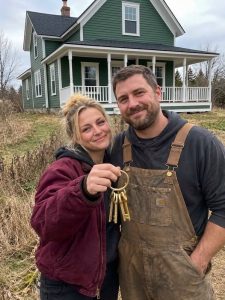
It was a ring of seven old keys. Two of them were skeleton keys. Not one of them was marked.
We drove out there with the windows rolled down.
We stood at the foot of those porch steps holding that ring of keys between us. Nate’s hand was shaking. So was mine.
“Capable,” he said.
“Don’t,” I said.
And then we both started laughing so hard I had to sit down on the bottom porch step.
It held.
We still didn’t tell anybody.
By then it wasn’t a rule so much as a habit. And there was a little pride in it too. I’ll own that.
I wanted to hand them a finished thing. I wanted to say, come to dinner. And give them an address.
It was a long, long way from finished.
The fourth key opened the front door.
Inside, it smelled like mice and wet plaster and somebody’s old pipe tobacco. There was a calendar from a seed company still hanging on the kitchen wall. Turned to a July six years gone.
The wallpaper in the front room was coming down in long sheets all by itself.
The fuse box was in the cellar stairwell. Sixty amps for the whole house.
When Nate unscrewed the first fuse, there was a penny jammed in behind it.
“Well,” he said. “That’s one way.”