Account Number 0001
I went to the bank in my gardening clothes.
That was my first mistake, I suppose.
It was a Tuesday in June. Hot already by ten in the morning. The kind of hot that comes up out of the ground in Millbrook and sits on your shoulders like a wet towel.
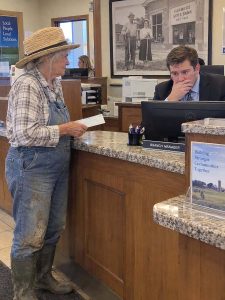
I’d been in the tomatoes all morning. Tying up the Better Boys and pinching the suckers off the Romas. Dirt on my knees. Dirt under my fingernails. Dirt, probably, on the end of my nose.
I had on George’s old straw hat. The one with the frayed brim and the sweat stain around the band that’s been there since the Carter administration. My blue work shirt with the patches on the elbows. My good rubber boots. The green ones.
Ezoic
The check was from the Methodist church.
Forty dollars. For four rhubarb pies for the bake sale. Reverend Collins had brought it by the house himself on Sunday afternoon and stood on my porch insisting I take it.
“Dot, you’ve been giving us pies for free for forty years,” he said. “Let us pay you once.”
So I took it. And Tuesday morning, after the tomatoes, I walked the four blocks down Main Street to cash it.
Ezoic
I’ve been banking at Farmers & Merchants in Millbrook for fifty-eight years.
I didn’t think twice.
The bank is a little red brick building on the corner of Main and Second. Two stories. White columns out front that George always said were too fancy for a town of four thousand people. A brass plaque by the door that says FARMERS & MERCHANTS BANK — EST. 1968.
Inside, it smells like old carpet and new money and the peppermints they keep in a glass bowl on the counter.
Ezoic
It’s cool in there. That was the first thing I noticed. The air conditioning was blasting. My sweat went cold on my neck.
Shelly usually works the window.
Shelly Haskins. Fifty-four years old. She’s been at that window since her kids were little. Since 1998. She knew George. She came to his funeral. She brought a casserole and cried harder than some of his own cousins.
She always asks about my roses.
“How are the Peace roses this year, Dot?”
“Blooming like crazy, Shelly. I’ll bring you some.”
And I always do. A big bunch, wrapped in wet newspaper. She keeps them in a coffee can on the counter by her window until they drop their petals.
Ezoic
Shelly wasn’t there.
There was a young man in a blue suit behind the counter instead. Thirty, maybe. Thin. Very clean. His hair was cut short and combed with something shiny. He had on a white shirt so starched it could have stood up by itself, and a tie the color of a robin’s egg.
His name tag said BRANDON PIERCE, BRANCH MANAGER.
I’d heard about him.
Everybody in Millbrook had heard about him. He’d been transferred in from the city in April. The corporate office sent him. Heartland Bancorp, out of Des Moines, who bought most of Farmers & Merchants back in 2015.
He’d only been here two months. But people talked.
He’d taken the peppermint bowl off the counter. Said it wasn’t hygienic. Ruth Abernathy at the beauty shop said he’d made her fill out a form to deposit her Social Security check. Earl Lindquist said Brandon had asked him if he was “sure” he wanted to withdraw two hundred dollars from his own savings.
Ezoic
“Like I was a child,” Earl said at the diner. “Like I didn’t know my own mind.”
I’d thought they were exaggerating.
I slid the check under the glass.
“Good morning,” I said. “I’d like to cash this, please.”
He looked at the check.
Then he looked at my boots.
Then he looked at George’s hat. At the dirt on my knees. At my hands on the counter, the knuckles big and knotted from arthritis, the fingernails black from the tomato bed.
Ezoic
I watched him look at all of it.
Then he leaned toward the glass and talked very loud and very slow.
“MA’AM. DO YOU HAVE AN ACCOUNT WITH US?”
He said it like I was a foreigner. Or a child. Or someone who’d wandered in off the highway by mistake.
“I do,” I said.
“I’LL NEED TO SEE SOME IDENTIFICATION.”
I’m seventy-nine.
My hearing is better than his manners.
I didn’t say that. I just reached into the front pocket of my work shirt, where I keep my license in a little plastic sleeve, and I handed it to him under the glass.
Ezoic
He took it. He held it up to the light. He turned it over. He looked at the picture. He looked at me. He looked at the picture again.
The picture was from three years ago. I’d had my hair done for it. I was wearing my blue church dress and my pearls. I looked like a nice old lady.
Now I looked like a nice old lady who’d been rolling around in a garden. Which I was.
Ezoic
“I’ll need two more forms,” he said.
“Two more? For forty dollars?”
“A utility bill. A passport. Something with your address.”
“Young man, I live four blocks from here. On Elm Street. The yellow house with the roses.”
He set my license down on his side of the glass.
He didn’t slide it back.
“Ma’am,” he said. “We have to be careful with people like you.”
Ezoic
The bank got quiet.
It’s a small bank. One big room. Four teller windows, though only one was open. Two desks along the side wall for loans. A little waiting area with three chairs and a rack of brochures nobody reads.
There were maybe six people in there. And every one of them heard it.
Behind me in line, a young woman with a toddler stopped bouncing him on her hip. I knew her. Kayla Brandt. Her grandmother and I were in the Garden Club together for thirty years. The little boy was named Wyatt. He had a drool bib with a duck on it.
Ezoic
At the loan desk, old Harvey Kessler, who’s been a loan officer at Farmers & Merchants since 1979, set down his pen.
The security guard, a big gentle boy named Tommy Ruiz whose mother I taught in Sunday School, looked at the floor.
People like you.
I wanted to ask what kind of people he meant.
Ezoic
Old people? Dirty people? Widows in dead men’s hats?
I didn’t.
George used to say a raised voice only proves the other fellow’s point.
He said it to me a thousand times over fifty-one years of marriage. Usually when I was about to give somebody a piece of my mind. Usually at a church council meeting.
“Dot,” he’d say, putting his hand on my knee under the table. “Let ’em talk. Let ’em show you who they are. Then you’ll know what to do.”
Ezoic
So I let him talk.
And I looked at the wall.
There’s a photograph on the wall by the door in that bank lobby.
Black and white, in a cheap gold frame. The glass is a little dusty. It’s hung a little crooked. It’s been hanging there so long the wallpaper around it is a different color than the rest of the wall.
It’s from 1968.
A young man and a young woman in their church clothes, each holding a shovel, standing in an empty lot. The young man has dark hair slicked back and a narrow tie and a grin like he’s just gotten away with something. The young woman is wearing a white dress with little blue flowers on it and a pillbox hat, and she’s holding her shovel like she isn’t quite sure which end goes in the ground.
Ezoic
Behind them, there’s nothing but dirt. And a hand-painted sign on a wooden stake.
FUTURE HOME OF FARMERS & MERCHANTS BANK.
Nobody ever looks at it.
People walk past it every day. They come in out of the rain and stamp their feet on the mat right under it. They wait in line with their backs to it. Nobody ever looks.
I looked at it then.
The young woman in the picture was smiling so big.
Ezoic
She had no idea what was coming.
The loans for farmers in the bad years. The fights in the back room. The bank examiners from Des Moines with their briefcases and their frowns. The winter of 1985, when half the farms in the county were going under, and the big banks were calling in every note, and George came home at two in the morning and sat on the edge of our bed in the dark.
“Dot,” he said. “I think we’re going to lose it.”
We didn’t lose it.
But it was close. Lord, it was close.
I turned back to the glass.
The young man was watching me. Waiting. I think he expected me to argue. Or cry. Or march home in a huff and never come back. I think that’s what usually happened with “people like me.”
Ezoic
“I appreciate careful,” I said.
He looked surprised.
“You do?”
“I do. Careful is how you keep a bank alive.” I folded my hands on the counter. “Would you do one thing for me before I go home for the rest of my papers?”
He sighed. A long, put-upon sigh.
“What?”
“Would you look up account number 0001?”
“Ma’am, I can’t just—”
“It’s my account,” I said. “You have my license right there.”
He rolled his eyes. Right at Tommy Ruiz, the security guard. A little look that said can you believe this?
Ezoic
Tommy didn’t look back at him.
Brandon turned to his computer. He typed with two fingers, fast and hard, the way young people do.
Zero. Zero. Zero. One.
He pressed enter.
He stopped typing.
He looked at the screen for a long time.
He scrolled down.
Then up again.
He leaned closer to the monitor. He squinted. He read something. I watched his lips move.
He looked at me.
Then at the screen.
Then, slowly, past me, at the old photograph by the door.
Ezoic
At the young woman in the white dress with the little blue flowers. Holding a shovel. Smiling so big.
His face went the color of skim milk.
He picked up the phone on his desk.
His hand was shaking so badly he had to dial twice.
I’m going to tell you what was on that screen. But first I have to tell you how it got there.
Ezoic
Because it took fifty-eight years. And a lot of pie.
I was born Dorothy Mae Lund in 1947, on a dairy farm three miles south of Millbrook. The youngest of six. My father milked forty Holsteins twice a day for thirty years and never took a vacation. My mother kept chickens and a garden and canned enough tomatoes every August to feed a small army.
I met George Whitaker at the county fair in 1964.
Ezoic
He was showing a Hereford steer. I was showing a rhubarb pie.
His steer got reserve champion. My pie got blue ribbon. He came over to the pie tent afterward with his ribbon pinned to his shirt and said, “I hear yours beat mine.”
“Pies and steers aren’t in the same category,” I said.
Ezoic
“Everything’s in the same category if you look at it right,” he said.
I didn’t know what that meant. I still don’t, entirely. But I married him two years later.
George’s family farmed too. Two hundred acres of corn and beans west of town. But George had been to Korea, and then to college on the GI Bill. He came home with a degree in economics from Iowa State and a head full of ideas.
Ezoic
He got a job at First National, the big bank in the county seat. Twenty miles away. He wore a suit every day and drove a used Ford.
He hated it.
“They don’t understand farming, Dot,” he’d say at the dinner table. “They look at a farmer and see a risk. They see dirt and old boots and a pickup truck with rust on the fenders. They don’t see the man who’s been feeding this country for three generations.”
He watched First National turn down loan after loan. Good farmers. Honest men. Men whose fathers and grandfathers had worked the same land for a hundred years. They’d come in with their hats in their hands and their best shirts on, and some young man in a suit would look at their boots and their hands and say no.
Ezoic
One afternoon in 1967, my own father went in for a loan.
He needed eight thousand dollars to replace his milking equipment. The old system had broken down. Without new equipment, he’d have to sell the herd. Forty cows. Thirty years.
The loan officer at First National was twenty-six years old. He’d never been on a farm. He looked at my father’s work clothes and his chapped red hands and his old Chevy truck parked outside.
Ezoic
And he said no.
My father came home and sat at the kitchen table and didn’t say anything for an hour.
George was there. We’d come for Sunday dinner.
He watched my father sit there. Then he got up and went outside and stood in the barnyard for a long time, looking at the cows.
When he came back in, he said, “Dot. We’re going to start a bank.”
Ezoic
Everybody thought he was crazy.
We were twenty-one and twenty-three years old. We had eleven hundred dollars in savings. We lived in a three-room apartment over the hardware store.
But George had a plan. He’d been thinking about it for years. He went to every farmer in the county. Every shopkeeper. Every widow with a little nest egg in a coffee can.
“Put your money in a bank that knows you,” he told them. “A bank that’s owned by people like you.”
Ezoic
People like you.
That’s what he said. That’s exactly what he said. In kitchens and barns and church basements all over the county.
It took a year and a half. But they came.
Farmers put in five hundred dollars. A thousand. Two thousand. Old Mrs. Jorgensen, who’d been widowed in the war, put in her entire savings. Six thousand dollars, in cash, in a cardboard box tied with string.
Ezoic
“George Whitaker,” she said, setting the box on our kitchen table, “if you lose this, I will haunt you.”
He didn’t lose it.
In August of 1968, we broke ground on the empty lot at the corner of Main and Second. The newspaper sent a photographer. George and I put on our church clothes and stood in the dirt holding shovels.
That’s the picture on the wall.
And in October, when the doors opened, the very first account at Farmers & Merchants Bank belonged to George and Dorothy Whitaker.
Ezoic
We put in a hundred and twelve dollars. All the money we had left from our wedding.
Account number 0001.
The second account belonged to my father.
Account 0002. Arvid Lund.
The first loan Farmers & Merchants ever made was eight thousand dollars to Arvid Lund, for milking equipment.
He paid it back in four years. Every cent. Early.
Ezoic
For the next fifty years, George ran that bank.
He was president for thirty-two years. Then chairman of the board. He knew every customer by name. He knew their kids’ names. He knew which farmers had a bad year and which ones needed a little extra time.
He made loans the big banks wouldn’t make. To farmers with dirt under their nails. To young couples with no credit history. To widows starting little businesses. To a Mexican family who wanted to open a restaurant in 1981, when half the town thought that was a terrible idea. Casa Ruiz is still on Main Street. Tommy Ruiz, the security guard, is the owner’s grandson.
George was careful. Lord, he was careful. He read every loan application three times. He drove out to every farm. He walked the fields. He looked at the cows.
Ezoic
But he was careful about the right things.
He never once looked at somebody’s boots.
I worked there too, at the beginning.
I was a teller for eleven years. I sat at the window where Shelly sits now. I counted money and stamped deposit slips and handed out peppermints from a glass bowl.
The peppermint bowl was my idea.
“People get nervous at banks,” I told George. “Give them something sweet.”
After Sarah was born, our only child, I stayed home. But I never really left. I baked pies for every bank event. I knew every customer. I sat in on board meetings when George wanted a second opinion.
Ezoic
And I was there in 1985.
The farm crisis.
If you didn’t live through it, you can’t understand it. Interest rates went through the roof. Land prices crashed. Farmers who’d borrowed money in the good years couldn’t pay it back. All over Iowa, all over the Midwest, banks were calling in loans. Foreclosing on farms that had been in families for a hundred years.
Men were losing everything. Some of them couldn’t take it. That winter, three farmers in our county took their own lives. I went to all three funerals.
The big banks were foreclosing as fast as they could.
Ezoic
George refused.
He sat in the back room of Farmers & Merchants with the board of directors, night after night, fighting. The other directors wanted to call in the loans. The bank examiners from Des Moines wanted him to call in the loans. Everybody said if he didn’t call in the loans, the bank would go under.
“If I call in those loans,” George said, “half this county loses its farms. And then who are we a bank for?”
They fought for weeks. I heard them through the wall sometimes, when I brought coffee. Shouting. Pounding on the table.
Ezoic
In the end, George did something I’ll never forget.
He mortgaged our house.
Our little yellow house on Elm Street. The one with the roses. He took out a mortgage on it and put the money into the bank’s reserves. Then he mortgaged his father’s farm. Two hundred acres. He put that money in too.
He told the board that if the bank went under, he’d go under with it.
“I’m not asking any farmer to risk more than I’m risking,” he said.
Ezoic
That night, he came home and sat on the edge of our bed in the dark.
“Dot,” he said. “I think we’re going to lose it.”
I held his hand.
“Then we’ll lose it together,” I said.
We didn’t lose it.
The next spring, the rains came. The crops were good. The farmers paid what they could. Some of them paid late. Some of them paid in installments for ten years. A few never paid at all.
Ezoic
But they kept their farms.
And Farmers & Merchants survived.
Every year after that, at Christmas, our porch was covered with gifts. Hams and pies and jars of honey and handmade quilts. From farmers who’d kept their land because George Whitaker wouldn’t call in their loans. Nobody ever signed a card. They didn’t have to.
George died in 2017.
Heart failure. He was seventy-two. He went in his sleep, in our bed, in the yellow house on Elm Street that we almost lost in 1985.
Two years before that, in 2015, something happened that broke his heart.
Ezoic
Small banks were dying. All over the country. The regulations got so complicated and so expensive that little banks like ours couldn’t keep up. We needed compliance officers and computer systems and lawyers. We couldn’t afford them.
George got an offer from Heartland Bancorp. A big regional bank in Des Moines. They wanted to buy Farmers & Merchants.
George didn’t want to sell.
But he was seventy. He was tired. His heart was already starting to go. And if we didn’t sell, the bank would fail within five years. The lawyers said so. The accountants said so.
Ezoic
So George sold. Sixty percent. Heartland Bancorp bought sixty percent of Farmers & Merchants, and we kept forty.
But George was careful.
He made them sign something first.
I remember the night he did it.
He sat at our kitchen table with the merger papers spread out in front of him. Two hundred pages. Lawyers’ language. He read every word. Three times.
Then he called our lawyer, an old friend named Walt Brennan, and talked to him for two hours.
Ezoic
When he hung up, he turned to me.
“Dot,” he said. “I want to put something in the agreement. Something they won’t notice until they need to.”
“What?”
“A covenant,” he said. “A promise. That Millbrook gets its bank. Forever. No matter who owns it.”
“Will they agree to that?”
“Not if I ask for it straight out,” George said. “They’ll say no. They’ll want the right to close branches. Cut staff. Consolidate. That’s what big banks do.” He tapped the papers. “So I’m not going to ask for it straight out. I’m going to tie it to something they’ll think is just sentimental.”
Ezoic
“What?”
He smiled. That same grin from the photograph.
“Account number 0001,” he said.
Here’s what George put in the merger agreement.
Section 14.3. Page 147. Buried between a paragraph about computer systems and a paragraph about parking lot maintenance.