The knock didn’t come politely.
It came as a single, heavy strike—authoritative enough to rattle the glass and shatter the illusion that this was still a private family moment.
“Police. Open the door.”
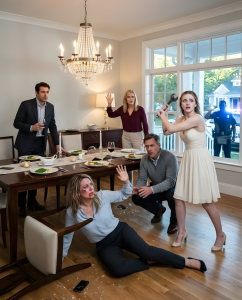
Madison’s fingers loosened around the wrench. It clanged to the floor beside my head, rolling until it tapped against the leg of the table.
For the first time all night, my father moved too fast.
“I’ll handle it,” he said, already halfway to the door, voice sharp with a panic he’d never allowed himself to show around me before.
“Don’t,” Travis said quietly.
Everyone turned to him.
He was standing now. Pale. Very still. His eyes weren’t on me—they were on the blood soaking into Eleanor’s linen rug.
“There are cameras,” Travis continued. “On the street. On the neighbor’s porch. And I called it in.”
Madison stared at him. “You—what?”
“I didn’t think you’d go that far,” he said. His voice was flat, stripped of amusement. “But once you did… I wasn’t going to be part of this.”
Another knock. Louder.
“Open the door. Now.”
My father froze.
My mother’s mouth opened, then closed again. For the first time in my life, she looked unsure.
The room smelled like iron and candle smoke and fear.
When the door finally opened, the night rushed in with flashing blue lights and crisp voices that didn’t belong to our family hierarchy.
“Ma’am,” an officer said sharply, eyes immediately locking on me. “Don’t move. Medical is on the way.”
Someone knelt beside me. Gloved hands. Calm instructions. A flashlight beam across my pupils.
Eleanor started talking all at once.
“She fell—she’s always clumsy—she provoked Madison—this is a misunderstanding—”
“Step away from her,” another officer ordered.
Madison was crying now. Loud, panicked sobs that sounded nothing like laughter.
My father backed up, hands raised.
Travis said nothing. He just watched as the truth finally walked into the room wearing a badge.
I woke up in a hospital room with a fractured cheekbone, a concussion, and stitches that pulled every time I breathed too deeply.
But I was alive.
And for the first time, I wasn’t alone.
A detective sat with me the next morning while a nurse adjusted my IV. He didn’t rush me. He didn’t interrupt. He didn’t ask what I’d done to “cause” it.
He just listened.
I told him everything.
Not just about the wrench—but about the years. The patterns. The jokes that landed like blades. The way my pain had always been the family’s entertainment.
When I finished, he nodded once and closed his notebook.
“You did nothing wrong,” he said.
That sentence rewired something in my chest.
Eleanor and Madison were arrested that night. Assault with a deadly weapon. Aggravated battery. My father was charged for restraining me and failing to intervene. His calm voice on the floor became evidence.
The photos did the rest.
Blood on the wrench. Blood on the floor. Blood on Eleanor’s hands.
Madison tried to call me from jail.
I didn’t answer.
My mother sent a message through a lawyer saying she hoped we could “heal as a family.”
I never responded.
Travis testified. Not out of heroism—out of fear. He admitted he stayed silent because he thought this was “just how they were.” That he laughed because laughing was safer than objecting.
The court didn’t care why he stayed.
Only that he finally spoke.
I moved apartments after my release. New locks. New walls. New silence.
At work, I went back slowly. The sixteen-year-old girl I’d helped weeks earlier wrote me a note in shaky handwriting.
You didn’t give up on me. I hope you don’t give up on yourself.
I didn’t.
The last time I saw my family was in a courtroom. Eleanor wouldn’t look at me. Madison did—but her eyes were empty now. Not cruel. Not bright.
Just small.
They lost their smiles the moment the world stopped laughing with them.
And here is the truth I carry forward, stitched into bone and memory:
They broke my face.
They did not break me.
I walked out of that courthouse alone—
and for the first time in my life,
that felt like freedom.