PART 3 — The Price of a Child
Camila’s voice floated through the phone like silk dragged across broken glass.
“Now that you have the key,” she said, “let’s talk about what your daughter is really worth.”
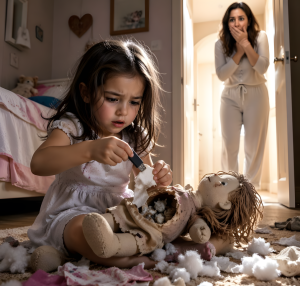
I stood on the sidewalk in front of my ruined apartment building, clutching the filthy doll in one hand and the tiny silver key in the other. Around me, neighbors whispered. Police lights painted the brick walls red and blue. But none of it felt real.
Only Sophie’s sobbing on the other end of the line was real.
“Mommy,” she cried. “I want to go home.”
My knees almost gave out.
“Baby, listen to me,” I said, forcing my voice not to break. “I’m coming.”
Camila sighed, almost bored. “How touching. But no, Elena. You are not coming anywhere unless I allow it.”
“Touch her,” I whispered, “and I swear—”
“You swear what?” Camila laughed softly. “You’ll call the police? Run to the news? Wave your little USB drive around like a sword?”
My mouth went dry.
She knew.
Of course she knew.
“You have Alexander’s little confession,” she continued. “You have a dead woman’s key. And now I have the only thing you truly love.”
The only thing I truly loved.
The words hit exactly where she meant them to.
Then Sophie’s voice came again, smaller this time.
“Mommy, there’s a lady here. She said I have to be good.”
I closed my eyes. “You are good, baby. You are so good.”
Camila’s voice returned.
“Bring the key to Whitmore House. Alone. No Detective Graves. No Alexander. No neighbors with bats. No heroics.” Her tone sharpened. “And Elena? If I see one police car, one reporter, one wrong face… Sophie disappears into a country that doesn’t ask questions.”
The call ended.
For one second, I just stared at the phone.
Then I screamed.
Not like a woman afraid.
Like something ancient had torn itself loose inside me.
Mrs. Chen grabbed my shoulders. “Elena! Look at me.”
I looked at her.
“My daughter,” I gasped. “She has my daughter.”
Mrs. Chen’s wrinkled face hardened. “Then we get her back.”
I almost laughed at the absurdity of it. An eighty-two-year-old woman in a purple robe had more courage than half the city.
The burner phone rang again.
This time it was Graves.
“Elena,” she said. “Do not go to Whitmore House.”
“She has Sophie.”
“I know.”
“You know?” My voice cracked into fury. “Then why are you still at the carousel?”
“Because I found what was under it.”
I froze.
“What?”
Graves breathed hard, as if running. “Not the second drive. Something else. A lockbox. Empty. But there was blood on the floorboards and a strand of hair caught in one of the hinges.”
“Whose?”
“I don’t know yet. But Elena…” Her voice dropped. “There were children’s names scratched inside the box.”
My hand tightened around the key.
“One of them was Sophie.”
The sidewalk tilted.
“That’s impossible.”
“It was carved recently.”
The world narrowed to a single thought.
This had never been just about money.
Graves continued, “Whitmore House has security, private guards, and at least two cops on Camila’s payroll. Walking in alone is suicide.”
“She said she’ll hurt Sophie.”
“She will hurt Sophie either way if she gets what she wants.”
“What does she want?”
“The trust transfer. The key isn’t for the carousel anymore. It’s ceremonial. Whitmore family tradition. The heir opens the old vault before a transfer of bloodline authority.”
I gripped the key until the metal bit my palm.
“She wants Sophie to inherit.”
“No,” Graves said. “She wants Sophie to inherit under her control.”
I looked down the street, where Camila’s car had vanished.
“My daughter is five.”
“And that makes her easier to own.”
A cold calm moved into me then. It frightened me more than panic.
“Tell Alexander,” I said, “that if he wants to make up for three years, he can start now.”
“Elena—”
“I’m going to Whitmore House.”
“Don’t.”
“I’m not going alone.”
Then I looked at Mrs. Chen.
She lifted her bat.
“Good,” she said. “I hate rich people with gates.”
Whitmore House stood behind iron gates in Tarrytown, overlooking the Hudson like a mansion that had learned to keep secrets.
It was not beautiful in the way magazine spreads made it look.
At night, it was monstrous.
Stone walls. Black windows. Ivy crawling over the sides like veins. Statues lined the driveway, their faces worn smooth by weather, each one holding a lantern that did not shine.
Graves drove. I sat beside her, the doll in my lap, the key hidden inside my sleeve. Mrs. Chen sat in the back with Alexander, who looked barely alive but refused to stay behind.
“You should have stayed at the clinic,” I told him for the fourth time.
He leaned his head against the window. “My daughter is in that house.”
I wanted to hate his answer.
I couldn’t.
Mrs. Alvarez had stayed hidden, but before we left she had grabbed my hand and whispered one last thing.
“Lucy always keeps trophies where the family prays.”
I didn’t know what it meant.
Not yet.
Graves parked half a mile from the estate. We approached through the trees, moving under a moon thin as a knife. My borrowed shoes sank into wet earth. Branches scratched my face. Every sound felt too loud.
At the edge of the property, Graves stopped.
“There are cameras on the front gate, back terrace, and east wall,” she whispered. “But the old chapel tunnel runs under the garden.”
“How do you know that?” I asked.
Alexander answered.
“Camila showed it to me once. She said all old families need escape routes.”
“And traps,” Mrs. Chen muttered.
The tunnel entrance was hidden behind a stone angel in the garden. Its face had been chipped away, leaving a blank oval where mercy should have been.
Alexander pushed against the base. Nothing happened. He pushed again, weaker this time.
I stepped forward and shoved with everything I had.
Stone groaned.
A narrow staircase opened beneath us, breathing out cold air and dust.
We descended.
The tunnel smelled of mold, old smoke, and something metallic. Graves held her gun low. Mrs. Chen held her bat like she had been born for war. Alexander limped behind me, one hand braced against the wall.
Halfway through, we heard singing.
A child’s voice.
Soft.
Trembling.
My heart stopped.
“Sophie,” I whispered.
I ran before anyone could stop me.
The tunnel opened beneath the house into a chapel lit by dozens of candles. Wooden pews sat in perfect rows. Portraits of dead Whitmores stared down from the walls, pale faces watching beneath gilded frames.
And at the altar stood Camila.
She wore white.
Not a wedding dress, but close enough to make my stomach turn.
Beside her stood Marcus Vale.
And in front of them, holding a stuffed rabbit and crying silently, was Sophie.
“Sophie!”
My daughter turned.
“Mommy!”
She tried to run to me, but Marcus grabbed her shoulder.
Alexander made a sound that was not human.
Camila smiled.
“There you are. I was beginning to think maternal instinct had failed you.”
Graves stepped out behind me, gun raised. “Let the girl go.”
Camila barely glanced at her.
“Detective Graves. Still pretending this is justice instead of obsession?”
“Lucy Hernandez,” Graves said.
The name struck the room like thunder.
Camila’s smile died.
For the first time, Sophie looked at her with pure fear.
“I told you not to call me that.”
“And I told you I’d bury you one day,” Graves replied.
Camila’s eyes slid to Alexander.
“My poor husband,” she said. “You look terrible. Did Elena forget to feed you?”
Alexander’s voice shook. “Take your hands off my daughter.”
“Your daughter?” Camila looked amused. “No, Alexander. She is the last clean Whitmore heir. You were useful only because you made her.”
I stepped forward. “You wanted me to bring the key. I’m here. Let Sophie go.”
Camila extended one perfect hand.
“The key first.”
“No.”
Her eyes narrowed.
“Careful.”
I pulled the key from my sleeve and held it up.
Candlelight flashed along the silver.
Sophie’s name gleamed.
Camila stared at it with something close to hunger.
Then from behind the altar came a weak voice.
“Don’t give it to her.”
Everyone froze.
A door hidden in the carved wood opened slowly.
An old woman stepped out.
Her hair was white, her body bent, her skin thin as paper. But her eyes were bright and furious.
Camila went completely still.
The old woman looked at me.
“My name,” she said, “is Camila Whitmore.”