That was the only reason my son survived that Tuesday.
Rain had followed me inside, soaking through my canvas flats and dripping from the hem of my jeans onto the hardwood floor.
The school fundraiser envelopes I had been carrying were damp enough that the red ink had started smearing onto my fingers.
The house smelled like lemon floor cleaner and boiled chicken.
Those were Marjorie Hayes’s smells.
She believed lemon meant clean, boiled chicken meant respectable, and a quiet woman meant a manageable one.
The refrigerator hummed in the kitchen.
My umbrella ticked water into the ceramic stand by the door.
On the side table sat my son’s blue lunchbox, the one with the tiny astronaut patch sewn crookedly on the front.
I had stitched that patch myself after Ollie cried because the original one peeled off in the wash.
He was five.
To everyone else he was Oliver, but to me he was Ollie when he was sleepy, Ollie when he had syrup on his chin, Ollie when he put his whole hand in mine because crosswalks made him nervous.
Marjorie never called him that.
She said Oliver sounded stronger.
She was in the kitchen with her back to me, phone pressed to her ear.
I almost called out to tell her I was home.
Then she said, “The allergic reaction will look natural.”
My hand tightened around the wet mail.
She spoke softly, but the hallway in that house carried sound the way church foyers carry whispers after service.
“I put peanut oil in his lunch,” she continued.
I stopped breathing.
“In the chicken salad, under the crackers, even on the rim of the juice straw,” she said. “By the time anyone notices, they’ll think he grabbed something at preschool.”
The mail bent in my hand until paper pulp squeezed between my fingers.
Ollie’s peanut allergy was not mild.
It was not the kind people dismiss with a joke about picky parenting.
At 2:18 p.m. on a Saturday two years earlier, one smear of peanut butter on a playground swing sent him to the ER.
His lips turned blue before the ambulance reached us.
His little sneakers kicked under the blanket while I tried to keep my voice steady enough that he would not hear terror in it.
At the hospital intake desk, a nurse cut through his dinosaur shirt.
A doctor looked at me and Caleb and said, “The next exposure could kill him faster.”
Marjorie had been there.
She had seen the monitor.
She had watched me sign the hospital intake form with a hand that would not stop shaking.
She had heard the doctor.
Afterward, she brought Caleb coffee and told him I had become too emotional to process medical information.
That was Marjorie’s gift.
She could wrap cruelty in concern so neatly that people thanked her for the ribbon.
Then she laughed into the phone.
Not loudly.
Worse.
With relief.
“Claire is dramatic,” she said. “Everyone knows that. Caleb will believe she forgot to check a label before he believes his own mother did anything wrong.”
My husband’s name hit me like a second injury.
Caleb was a good father in the ways people could see.
He went to preschool open houses.
He tightened car seat straps.
He knew which stuffed bear Ollie needed when he had a fever.
But when it came to Marjorie, Caleb had a blindness that had been trained into him since childhood.
She cried, and he apologized.
She accused, and he explained.
She hinted that I was controlling, and he asked me to be patient because she was lonely.
I wanted to scream.
I wanted to run into that kitchen, rip the phone from her hand, and ask what kind of grandmother oils a child’s lunch like a trap.
For one ugly heartbeat, I pictured the chicken salad dumped down her beige sweater.
I pictured the ceramic bowl breaking at her feet.
I pictured her finally looking as frightened as she had made me feel.
Instead, I stepped backward.
One inch.
Then another.
There was an old floorboard near the coat closet that creaked if you touched it wrong.
I knew that floorboard because I had lived in that house for seven years.
Marjorie had lived in it for nine months too many.
She moved in after a blood pressure scare that somehow required my guest room, my kitchen, my routines, and eventually my silence.
She said she was helping.
She reorganized my pantry.
She corrected my laundry.
She told Caleb I was exhausted and needed guidance.
Guidance meant she made herself the judge of my home.
On the side table were three lunch containers.
Ollie’s blue astronaut lunchbox.
Sabrina’s black insulated lunch bag with the gold zipper.
Marjorie’s floral tote, packed for her church committee meeting.
Sabrina was Caleb’s sister.
She had moved in temporarily after her divorce, though temporary had stretched long enough that her shampoo was in the shower and her mail came to our address.
She worked part-time at a boutique and let Marjorie pack her lunches because, at thirty-one, she said chopping vegetables made her anxious.
Marjorie loved doing it.
Not because she was kind.
Because feeding people gave her control over what they owed her.
I looked at the three bags.
My hands had gone numb, but my mind became very clear.
If I grabbed Ollie’s lunch and ran, Marjorie would know immediately.
She would destroy whatever was left.
She would cry.
She would call Caleb.
She would say grief over my father’s death had made me unstable, or motherhood had made me paranoid, or maybe that I had misunderstood a private conversation.
She always had a lie ready.
The mistake people make about panic is thinking it always looks loud.
Sometimes panic becomes arithmetic.
At 11:43 a.m., while Marjorie was still on the phone, I lifted Ollie’s lunchbox and slipped it into Sabrina’s black bag.
Then I put Sabrina’s lunch into Ollie’s blue lunchbox.
I moved the astronaut keychain too.
My fingers shook so badly that the metal charm clicked against the zipper like teeth.
I took one picture of the side table.
Three lunch containers.
The blue one.
The black one.
The floral tote.
Then I sent myself a blank email with the photo attached so the timestamp would live somewhere Marjorie could not rinse down a sink.
Not revenge.
Not panic.
Evidence.
At 12:07 p.m., I photographed the chicken salad bowl in the sink.
There was an oily shine on the rim.
I photographed the juice straw.
I photographed the grocery receipt tucked under Marjorie’s purse, where peanut oil sat halfway down the list like a normal errand.
I did not touch anything twice.
I did not breathe loudly.
I did not give her a reason to watch me.
When she ended the call, I wiped my face with the back of my sleeve and walked into the kitchen.
“Lunch smells good,” I said.
For half a second, fear flashed across her face.
Then she recovered.
Marjorie smiled.
“For Oliver,” she said. “I made it special.”
The cruelty was not only in what she had done.
It was in how easily she could say his name afterward.
I picked Ollie up from preschool myself that afternoon.
I told the teacher I had forgotten something at home and needed to change his lunch plan.
That was not entirely a lie.
I signed the school office pickup sheet at 12:41 p.m.
I kept my hand on Ollie’s shoulder while he showed me a sticker shaped like a frog.
He was alive.
That fact kept moving through me like a prayer I was afraid to say out loud.
At home, I made him buttered noodles in a clean pan.
I used a sealed package.
I used a clean fork.
I watched him eat three bites before I let myself blink.
He asked why Grandma’s chicken salad smelled funny.
I told him grown-up recipes were sometimes weird.
He laughed.
That nearly broke me.
Dinner came with the kind of ordinary details that make terrible nights feel even stranger.
Rain tapped the windows.
The small American flag on the front porch snapped against its pole.
Caleb loosened his tie and checked his phone beside his water glass.
Marjorie ladled soup as if she had not tried to turn my son’s lunch into a medical emergency.
Sabrina’s chair was empty.
She had taken her black bag to work earlier, kissed the air beside Marjorie’s cheek, and promised to be home by dinner.
At the table, Ollie sat beside me eating the noodles I had packed for him after pickup.
His sneakers swung under the chair.
Every few seconds I pressed my knee against his chair leg, just to feel the tiny motion of him.
Alive.
Warm.
There.
Marjorie watched me watching him.
“Claire,” she said, “you’re hovering.”
Caleb gave me the tired look he used when he wanted peace more than truth.
“Maybe let him eat,” he said.
I smiled.
“I am.”
Nobody understands restraint until rage has to sit across a dinner table and pass the salt.
I passed the salt.
Marjorie smiled back.
Three hours after that phone call, the ambulance arrived.
It screamed into our driveway so hard the sound seemed to split the house open.
Red light washed over the rain-slick front windows.
Marjorie’s spoon stopped in midair.
Caleb stood.
Ollie’s eyes went wide, and I put a hand on his shoulder.
“It’s okay,” I whispered.
I did not know if that was true.
I only knew he was breathing.
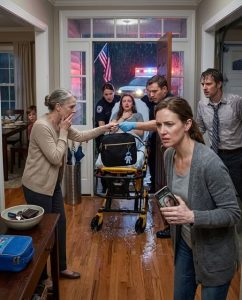
The front door burst open.
Paramedics came in first, wet boots squeaking on the hardwood.
Then the stretcher crossed the threshold.
Sabrina was on it.
She was still wearing her boutique name tag.
Her coral lipstick was smeared across her chin.
Her face was swollen in a way that made Caleb make a sound I had never heard from him before.
One hand clawed at her throat.
The other gripped the stretcher rail so hard her pink acrylic nails clicked against the metal.
“Peanuts,” one paramedic barked. “Known allergy?”
Marjorie covered her mouth with both hands.
She did not rush to Sabrina.
She looked at the black lunch bag first.
That was the moment Caleb saw it too.
The gold zipper.
The side pocket.
The little blue astronaut keychain hanging from it.
“Claire,” he said slowly. “Why is Ollie’s keychain on Sabrina’s bag?”
The room seemed to tilt.
The paramedic called out the EpiPen time.
Another asked who had packed the lunch.
No one answered.
Marjorie’s eyes moved toward the kitchen sink.
Then toward me.
Then toward Caleb.
I took my phone from my cardigan pocket.
My thumb felt cold on the screen.
I opened the 11:43 a.m. photo and turned it toward my husband.
Three lunch containers on the side table.
Ollie’s blue lunchbox.
Sabrina’s black bag.
Marjorie’s floral tote.
Caleb stared at the image.
Then he looked at the keychain.
Then he looked at his mother.
His knees softened like someone had cut a wire inside him.
“Mom,” he whispered.
Marjorie shook her head.
One of the pins in her tight gray bun slipped loose.
“She switched them,” Marjorie said, pointing at me. “Claire did this.”
The old Caleb would have looked at me first.
The Caleb I had lived with for seven years would have searched my face for the version of events that caused the least damage to his mother.
But that night, his sister was on a stretcher.
His son was sitting behind my legs.
His mother was not crying for Sabrina.
She was watching the evidence.
I opened the second photo.
The chicken salad bowl.
Then the third.
The oily straw.
Then the email timestamp.
“I heard her,” I said.
My voice sounded calmer than I felt.
Marjorie lunged for my phone.
Caleb stepped between us.
It was not dramatic.
He did not shout.
He simply moved.
For the first time in our marriage, he put his body between his mother and the truth.
Marjorie stopped as if the floor had disappeared under her.
The paramedics worked on Sabrina in the entryway for another minute, then rolled her back toward the ambulance.
Caleb followed them to the porch, then stopped and turned around.
“Did you pack Ollie’s lunch?” he asked Marjorie.
She pressed a hand to her chest.
“After everything I’ve done for this family?”
“Answer me.”
Her face hardened.
That was the part of Marjorie people rarely saw.
The soft mother vanished.
The helpful widow vanished.
What remained was a woman furious that the stage had moved without her permission.
“She was turning you against me,” she said.
My stomach went cold.
Caleb’s voice dropped.
“Ollie is five.”
Marjorie looked past him at me.
“She would have blamed the preschool,” she said. “She blames everyone for everything. She would have survived the sympathy.”
The sentence hung in the room.
Even Marjorie heard what she had admitted too late.
Caleb’s face changed.
Not into rage.
Something quieter.
Something worse.
Disbelief becoming knowledge.
He took out his phone and called 911 again, this time not for medical help.
The police report later listed the call time as 6:36 p.m.
I remember because I stared at that number for weeks.
6:36 p.m.
That was the minute Caleb stopped asking me to be patient.
An officer arrived while the ambulance lights were still fading down the street.
I gave him the photos.
I gave him the email.
I told him what I heard.
I did not embellish.
I did not call Marjorie a monster, though the word sat behind my teeth.
I repeated her sentences exactly.
“The allergic reaction will look natural.”
“I put peanut oil in his lunch.”
“Caleb will believe she forgot to check a label.”
The officer wrote each line down.
Marjorie sat at the dining table with her purse in her lap, staring at a spot on the wall.
When the officer asked for her phone, she said she needed to call her doctor.
He told her she could make calls later.
Sabrina survived.
At the hospital, a doctor said the quick response saved her airway.
She had eaten enough of the chicken salad to react, but not enough to die before help reached her.
That sentence did something strange to me.
It made me grateful and sick at the same time.
Sabrina cried when she woke enough to speak.
Not pretty crying.
Real crying, with her swollen face and cracked voice and terror still moving through her body.
“She packed it,” Sabrina whispered to Caleb.
He nodded, but he could not look at her for long.
Guilt does that.
It makes people stare at tile floors because faces become too honest.
Ollie slept that night in my bed with one hand curled around the edge of my sleeve.
Every time he breathed heavily, I woke.
Every time he shifted, my whole body went alert.
Caleb sat in the chair by the door until dawn.
At 4:12 a.m., he said, “I should have believed you sooner.”
I did not tell him it was okay.
It was not okay.
There are apologies that matter and apologies that arrive after the house has already burned.
This one mattered.
But something had still burned.
In the weeks that followed, the house changed.
Marjorie did not come back to the guest room.
Her floral tote sat in an evidence bag for a while, along with the grocery receipt and the lunch containers.
The county clerk’s office became a place I knew too well.
There were statements, follow-up calls, a protective order filing, and a meeting in a family court hallway where Caleb looked like he had aged ten years in ten days.
We did not make big speeches.
We made changes.
New locks.
New emergency contacts.
New preschool pickup permissions.
A copy of Ollie’s allergy action plan taped inside the pantry door.
Caleb called the school office himself and removed Marjorie from every authorized list.
Then he came home and showed me the confirmation email without asking for praise.
That helped more than flowers would have.
Sabrina moved out after three months.
She moved into a small apartment with a laundromat downstairs and called me the first night because she did not know how to cook rice without Marjorie telling her she was doing it wrong.
We stayed on the phone while she burned the first pot.
Then she made another.
People think survival is one big moment.
Sometimes it is a second pot of rice.
Caleb and I did not heal quickly.
Trust does not return because someone finally sees the knife.
It returns, if it returns at all, through a hundred ordinary choices made after.
He went to counseling.
So did I.
He listened when I said his mother had not only tried to hurt our child.
She had counted on his loyalty as part of the plan.
That was the hardest sentence for him.
Not because it was complicated.
Because it was true.
Months later, Ollie found the blue astronaut lunchbox in the back of a cabinet.
I had hidden it there because I could not stand to throw it away.
He held it up and asked why I looked sad.
I sat on the kitchen floor with him and told him the smallest honest version.
I told him someone had made a dangerous choice.
I told him the grown-ups had stopped it.
I told him his job was not to carry fear.
His job was to tell us when something felt wrong.
He studied the crooked astronaut patch.
Then he said, “Can we put a rocket sticker on it too?”
I cried after he left the room.
Not because of the lunchbox.
Because he still believed broken things could be repaired with stickers.
The new patch is still crooked.
I left it that way.
Every morning when I pack his lunch, I check every label.
I check the seal.
I check the straw.
Then I put the lunchbox on the counter and breathe until my hands stop shaking.
The house does not smell like lemon floor cleaner anymore.
It smells like coffee, toast, crayons, raincoats, and sometimes noodles because Ollie still asks for them when he wants comfort.
The porch flag still snaps in the wind.
The refrigerator still hums.
And every time I hear a lunchbox zipper click, I remember the sound of that tiny astronaut keychain tapping like teeth in my hand.
That was the sound of me choosing silence for three hours so my son could have the rest of his life.