I used to think family cruelty announced itself before it arrived.
I thought there would be a warning in the room, a change in the air, some small mercy that gave a person time to protect herself.
I was wrong.
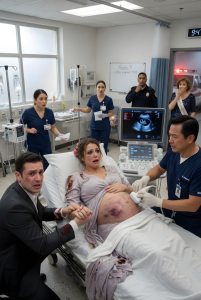
At my grandpa’s birthday, my father threw my 8-month pregnant body down a flight of granite stairs because I didn’t give my seat to my sister who had a cosmetic tummy-tuck.
As I lay in a pool of my blood, my mother screamed, “Stop faking it! You’re embarrassing us!”
Minutes later in the ER, when the doctor stared at the monitor, he whispered one sentence that shattered my world into pieces.
But the story did not begin on the stairs.
It began five years earlier in a fertility clinic waiting room with gray chairs, bad coffee, and a nurse who had learned how to say devastating things gently.
Mark and I had been trying to have a baby for so long that hope stopped feeling soft.
It became a discipline.
It became alarms at 6:00 a.m., injections in the bathroom, pharmacy receipts folded into envelopes, and calendar squares marked with bloodwork appointments instead of vacations.
There were months when I could not walk past the baby aisle without pretending I had forgotten something in another row.
There were baby showers where I smiled until my cheeks hurt, then cried in Mark’s truck while he held the steering wheel and said nothing because silence was kinder than advice.
My mother, Evelyn, knew all of it.
She knew the clinic name.
She knew the dosage changes.
She knew about the embryo transfer that failed two days before Thanksgiving and the chemical pregnancy I did not tell anyone about until she found me crying in her laundry room.
For a while, I mistook access for love.
I thought because she knew the tender things, she would guard them.
Instead, she saved them.
People like Evelyn do not forget your weak places.
They label them for later use.
My father had always been the kind of man who made rooms smaller just by entering them.
He was not loud all the time.
That was the trick.
He could laugh with neighbors, shake hands with pastors, and write generous checks at fundraisers.
Then he could turn in a hallway and make one of his daughters feel twelve years old with a single look.
Chloe, my younger sister, learned early that softness got rewarded when it was performed correctly.
She cried prettily.
She winced dramatically.
She let our parents believe she was fragile, and they paid her back for it with protection, money, and excuses.
I was the daughter expected to be useful.
I handled the travel arrangements for family events.
I remembered birthdays.
I sent flowers when my mother wanted credit for kindness she had not shown.
When Mark and I finally got pregnant after five years, I did not expect my family to transform overnight.
I only expected them to behave like the baby mattered.
Even that was too much.
My grandfather’s birthday gala was held at an old event hall with marble floors, granite stairs, velvet sofas, and chandeliers bright enough to make everyone look richer than they were.
My grandfather had turned eighty.
The invitation said black tie optional, which in my family meant mandatory if you did not want Evelyn commenting on your shoes.
I wore a pale silk maternity dress that Mark helped zip because I could not reach comfortably around my belly anymore.
He told me I looked beautiful.
I told him I looked like a cream-colored parade float.
He kissed my forehead and said, “Then you’re my favorite parade float.”
It was the kind of small joke that had carried us through years of medical disappointment.
By the time we arrived, my lower back already ached.
Eight months pregnant is not a glow.
It is pressure in the hips, heat under the skin, swollen feet, strange hunger, sudden fear, and love so enormous it makes the body feel breakable.
The foyer smelled like candle wax, perfume, and chilled champagne.
The marble floor was polished so brightly that the chandelier lights doubled beneath us.
Somewhere near the dining room, a string quartet played something elegant and distant.
I remember placing one hand under my belly as we greeted relatives.
I remember my grandfather touching my cheek and saying, “Almost time, sweetheart.”
I remember thinking that maybe the night would pass without a scene.
Then Chloe arrived.
She had recently had an expensive cosmetic tummy-tuck, paid for by my father, and she moved through the room as if she had survived battlefield surgery.
She pressed one hand to her abdomen.
She let people bring her water.
She leaned into every sympathetic question.
I did not begrudge her pain.
Pain is pain, even when it is chosen.
But I knew Chloe.
I knew the difference between discomfort and performance.
I had seen that performance get me punished since childhood.
After twenty minutes of standing, smiling, and pretending my spine was not on fire, I lowered myself onto a velvet sofa in the foyer.
The relief was immediate.
The fabric was cool beneath my palms.
My belly shifted forward as if the baby had also decided we were done pretending to be comfortable.
I was breathing slowly when I saw my mother cross the room.
My father walked beside her.
Chloe followed just behind them, eyes already wet.
Evelyn stopped in front of me.
“Get up,” she said.
There was no greeting.
No concern.
No question about how I felt.
Just the order.
I looked around at the room full of empty chairs.
There were chairs near the gift table.
Chairs lining the wall.
An entire sitting area visible through the archway.
“Your sister is recovering from major surgery,” my mother said coldly. “She needs to sit on this sofa.”
Mark was across the foyer speaking with my grandfather’s old business partner.
He turned when he heard her tone.
I kept my hand on my belly.
“I’m eight months pregnant, Mom,” I said. “I’m not moving.”
Chloe made a sound like she had been slapped.
My father’s jaw flexed.
My mother leaned closer.
“You always have to be so selfish,” she hissed. “Get off the sofa, Sarah. Now.”
There are moments when a lifetime compresses into one word.
All the apologies you were trained to give.
All the times you swallowed pain because peace mattered more than truth.
All the little ways you made yourself smaller so people who loved control could feel tall.
I was tired.
My back hurt.

My baby pressed against my ribs.
And I was done.
“No,” I said.
The foyer froze.
A fork paused in midair near the dining room entrance.
Someone’s champagne glass hovered inches from her lips.
My grandfather’s business partner stared into his whiskey instead of at us.
One cousin looked toward the quartet like music could save him from choosing a side.
The chandelier kept glittering.
The marble kept shining.
Nobody moved.
Except my father.
He stepped forward so fast that I did not have time to protect myself.
His hand closed around the shoulder of my maternity dress, bunching silk in his fist.
The seam bit into my skin.
“Don’t disrespect your mother,” he said.
Mark shouted, “Sarah!”
My father yanked.
My body rose wrong.
My balance disappeared.
Pregnancy had changed the map of me, shifted weight and instinct and motion, and for one terrible second I could not find the floor with my feet.
My bare soles slipped on polished marble.
My fingers clawed at the sofa arm.
I caught nothing.
Behind me were the granite stairs.
I remember the feeling of being weightless.
That is the part people do not understand.
Falling is not impact at first.
Falling is a moment where the body knows what is coming and the mind begs time to stop being time.
Then my lower back hit the edge of the first step.
The crack went through me like a sound made inside bone.
Pain exploded up my spine.
I tumbled, twisting instinctively around my belly, trying to make my own body into a shield.
My hip struck the next step.
My shoulder hit another.
The air left my lungs.
I landed on the granite landing curled around my stomach.
For a second, there was no sound.
Then I screamed.
Not from embarrassment.
Not from drama.
From the ancient, animal terror of a mother who knows something has gone wrong inside her body.
“My baby,” I gasped. “Mark, my baby.”
Mark dropped beside me.
His knees hit the stone hard enough that I heard it.
His hands hovered above my shoulders, shaking.
He wanted to lift me.
He knew he could not.
“Don’t move,” he said, voice breaking. “Sarah, don’t move. Somebody call 911!”
Then the warm rush came.
Fluid soaked through my dress.
It spread beneath me, too much and too fast.
When I saw the red in it, bright against the pale silk and cold granite, my mind went white.
“No,” I whispered. “No, no, no.”
My mother stepped to the edge of the landing.
She looked down at me.
I have replayed that moment more times than I can count.
I have searched her face in memory for shock, regret, fear, anything that might make her human to me again.
There was nothing.
Only fury.
“Are you happy now?!” she screamed. “Are you faking this just to ruin your grandfather’s party?! Get up, you’re embarrassing us!”
The room gasped.
Chloe did not kneel.
My father did not say my name.
One aunt covered her mouth, but her feet stayed planted.
That was the second injury.
The fall broke my body.
The silence showed me the family.
Mark looked up at my mother.
His face had changed.
Not loud rage.
Not reckless rage.
The cold, fixed kind that frightened me because it had a center.
“If my wife or my child dies,” he said, “I will kill you myself.”
Someone finally called 911.
The next fifteen minutes became fragments.
A man’s voice telling people to move back.
My grandfather crying somewhere above me.
Mark’s hand gripping mine.
A paramedic asking how far along I was.
“Eight months,” I said.
My voice did not sound like mine.
“Five years,” I kept adding, as if the years could count as a medical fact. “We waited five years.”
The paramedic wrote something down.
Later, in the ambulance report, the time of pickup was listed as 8:31 p.m.
Mechanism of injury: fall down granite stairs after alleged physical assault.
Patient: thirty-two-year-old pregnant female, approximately eight months gestation, vaginal bleeding, abdominal pain, possible placental trauma.
Those words looked so clean on paper.
They did not smell like blood.
They did not sound like Mark begging me to keep my eyes open.
At 8:47 p.m., the hospital intake form marked my arrival in the emergency trauma bay.