The police officer told my father they had found me unconscious beside the road, almost four miles from home, soaked through and dangerously cold. A driver had seen my body near the gravel shoulder and called 911. I was still holding the same school backpack I had carried out of the house.
Dad stopped speaking.
Then Officer Daniels asked the question that mattered more than anything Karen had said that night: why had his fifteen-year-old daughter been outside in an October storm without a coat, a phone, or money?
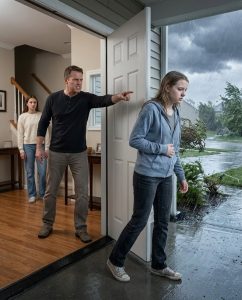
Dad tried to explain.
He mentioned the drugs again. He said there had been an argument. He said I had left the house after causing trouble, as if those words could turn a fifteen-year-old child into an adult responsible for surviving alone in freezing rain.
Officer Daniels listened without interrupting.
Then he said, “Sir, she was found unconscious.”
The room went silent.
Dad looked toward Karen.
For the first time since she had accused me, he wasn’t looking at her for reassurance. He was looking at her because he needed an answer.
“What exactly did you tell me?” he asked.
Karen’s face changed.
Until that moment, the lie had existed inside our family. Dad had heard it from her, believed it, and acted on it. But now someone outside the house had seen what that lie had led to.
Karen opened her mouth.
Nothing came out.
Officer Daniels still wasn’t finished.
He told Dad that I had been transported to the hospital because my condition was serious. The passing driver had found me barely responsive, and by the time emergency personnel arrived, I couldn’t tell them my name or explain why I was outside.
Dad’s hand tightened around the phone.
“Is she alive?” he finally asked.
“Yes,” Officer Daniels said. “But you need to come to the hospital.”
Dad didn’t ask another question.
He grabbed his keys.
Karen followed him toward the door.
He stopped.
“You’re staying here.”
She stared at him.
“What?”
“I said you’re staying here.”
It was the first time that night Dad had refused to let Karen control what happened next.
He drove to the hospital alone.
I don’t remember being carried into the ambulance. I don’t remember the siren. I don’t remember the paramedics cutting away my wet sweatshirt or asking me questions I couldn’t answer.
What I remember came in pieces.
Warmth.
Bright lights.
A ceiling moving above me.
Someone telling me to keep my eyes open.
Then nothing again.
When I finally woke for more than a few seconds, I was in a hospital bed with blankets layered over me. My clothes were gone. My hair was still damp. My cheek hurt where it had scraped against the gravel.
A nurse noticed my eyes opening.
“Hey,” she said softly. “You’re safe.”
I tried to speak.
My throat felt dry and raw.
“Dad?”
The nurse hesitated.
“He’s here.”
I turned my face toward the wall.
I didn’t know whether I wanted him there.
Part of me had spent the entire walk homeward imagining him coming after me. Another part of me had stopped believing he would ever come at all.
Now he was on the other side of the hospital door.
And I couldn’t decide which possibility hurt more.
A few minutes later, Dad was allowed inside.
He looked different.
Not older exactly.
Smaller.
His jacket was still wet from the weather, and his hair was disordered from running his hands through it. He stood beside the door instead of coming straight to my bed.
For several seconds, neither of us spoke.
Then he said my name.
I looked at him.
“I didn’t know,” he whispered.
My voice was barely there.
“You didn’t ask.”
He closed his eyes.
That answer landed harder than an accusation because there wasn’t anything he could argue with.
He had not searched my room.
He had not checked my backpack.
He had not called a neighbor.
He had not followed me outside.
He had believed Karen, pointed at the door, and locked it.
And now he was standing beside a hospital bed trying to understand how quickly one decision could become something irreversible.
“I thought you had drugs,” he said.
“I didn’t.”
“I know.”
The words came out immediately.
I stared at him.
“How do you know?”
Dad looked down.
“Officer Daniels told me what they found.”
My stomach tightened.
“What did they find?”
“Your backpack.”
He paused.
“Your schoolwork. Your clothes. Nothing else.”
I looked away.
The half-finished algebra worksheet was still there.
That tiny detail hurt more than I expected. It was proof that I had walked out of the house expecting my life to continue. I had been thinking about school. I had been carrying homework. I had not been preparing to disappear.