The doctor studied the scans, looked back at me, and told me the pattern in front of him was not something he could simply ignore. Then he picked up the phone.
I watched his hand close around it while my injured arm rested stiffly against me, my fingers still swollen and discolored, and for the first time that night I understood that what had happened at my parents’ dinner table was no longer going to stay inside our family.
Three hours earlier, I had still been worried about overcooking the roast.
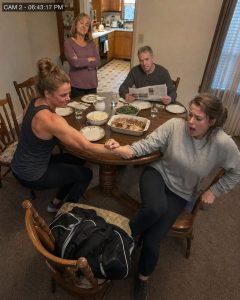
That was the kind of thing I worried about at Sunday dinner: whether Mom’s good china was set out correctly, whether the food was getting cold, whether Dad would complain that dinner was late, whether Sarah would arrive in one of her moods and somehow turn an ordinary evening into a competition nobody else had agreed to enter.
Sarah was thirty and strong enough that everyone knew it before she said a word about it.
She trained for competitions, collected medals, and carried herself through our parents’ house as if every room automatically belonged to her. She could drop a gym bag on a chair someone had just cleaned, interrupt a conversation, and make the entire family adjust around her without ever seeming to notice that anyone had moved.
I was twenty-eight, standing near the dining table when she came in, still thinking about serving dishes and dinner timing.
I congratulated her on her latest competition.
Sarah looked at my arm instead of answering normally.
Then she laughed and grabbed it.
She said it was time to settle the family joke once and for all.
Arm wrestling.
I laughed too, because laughing had become one of my safest habits around Sarah.
If I laughed, maybe she would think I was playing along. If I kept things light, maybe she would lose interest. If I did not challenge her, maybe the moment would pass without becoming one of those incidents everyone later insisted had been harmless.
I told her I needed to check dinner.
She pulled me into the chair anyway.
My elbow landed on the table, and she pinned my hand before I had decided whether I was participating.
For a moment, it looked like exactly what she claimed it was: two sisters messing around at Sunday dinner while the rest of the family carried on nearby.
Then her grip changed.
Her fingers slid away from my hand and closed around my wrist.
She started rotating it.
The pain was immediate enough to wipe every polite response out of my head.
I told her to stop.
She kept twisting.
I told her it hurt.
She tightened her grip.
I told her I was serious.
Sarah leaned toward me and said that everything hurt with me, that I had always been too sensitive, and that the real world was not going to coddle me.
Then something inside my arm cracked.
The sound was small compared with the pain that followed it, but it seemed to cut straight through the room.
My hand went loose.
Heat shot from my wrist toward my shoulder, and I screamed.
Sarah did not release me immediately.
That was the part I could not stop replaying later in the hospital.
She had heard the crack. She had heard me scream. She could see my face. And for several more seconds, she continued rotating my wrist while she watched me as though the expression on my face meant she had finally proven whatever she had been trying to prove.
When she let go, my arm dropped into my lap.
Mom came from the kitchen and looked at the swelling.
She told me I was being dramatic.
Dad lowered his newspaper long enough to ask whether I knew what an emergency room visit cost.
Sarah smiled.
Mom headed back toward the kitchen.
Dad raised his newspaper again.
Then came the part that should have shocked me most but somehow did not.
They told me to help serve dinner.
I looked down at my hand.
My fingers would not move correctly.
Purple was spreading beneath the skin, and the injured hand felt noticeably colder than the other one.
I knew enough to understand that something was badly wrong, but years inside that family had trained me to distrust my own reactions before I distrusted theirs.
Maybe I was exaggerating.
Maybe the swelling only looked terrible because I was scared.
Maybe it would settle down in a few minutes.
Maybe Sarah had not meant to hurt me.
Those thoughts did not appear because the injury was minor. They appeared because I had spent years being taught that whatever Sarah did was less important than how inconvenient my reaction became afterward.
I went to the bathroom and locked the door.
I did not want to hear them laughing anymore.
With my good hand, I opened the cabinet looking for old painkillers.
A box of bandages tipped over.
Behind it was a stack of medical paperwork.
The pages slid onto the tile.
My name was on every one.
I crouched awkwardly and started looking through them.
Fractured radius at sixteen.
Cracked ribs.
Severe bruising.
There were dates I had forgotten and injuries I had spent years pretending were unrelated.
Beside each one was an explanation written in the tidy language my family had always used when somebody outside the house asked what had happened.
Fell downstairs.
Slipped in the shower.
Walked into a door.
The explanations looked almost reasonable when reduced to a line on a page.
My memories did not.
I remembered Sarah’s martial arts phase and the chokeholds she treated like demonstrations even after I begged her to stop.
I remembered the pillowcase stuffed with books.
I remembered being hurt, then being told that I was clumsy, sensitive, dramatic, weak, or unable to take a joke.
Different years.
Different injuries.
Different excuses.
Sarah was the constant.
My hand kept getting colder while I sat there looking at the record of a childhood and young adulthood that had been rewritten one incident at a time.
The bathroom door opened suddenly.
Sarah stood there.
Her eyes dropped to the papers.
For one second, I thought she might finally understand what I was seeing.
She laughed instead.
She called the records my ‘victim trophies.’
Then she told me nobody would believe the whiny sister over the successful athlete.
That sentence landed differently from everything she had said at the dining table.
Until then, some part of me had still been trying to fit the evening into the same old explanation: Sarah got carried away, Sarah did not know her own strength, Sarah thought we were joking, Sarah had pushed too far.
But standing in the bathroom doorway, looking at years of medical records, she was not confused about what those pages represented.