Julian stayed planted on the dock, a drink in one hand and binoculars in the other, while the cutter carved down the strip of water separating him from us.
Victoria had finally killed her engine, but I was still strapped to the second jet ski with my wrists bound and blood running down my legs.
The water had gone strangely calm around me.
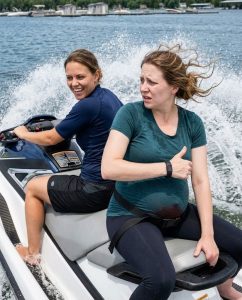
My body had not.
A sharp cramp folded through my abdomen, followed by another wave of pressure so strong that I bit the inside of my cheek to keep from screaming.
One of the helicopters banked above us while a rescue crew came alongside my jet ski.
A man in a life vest leaned across the gap and took one look at the canvas strap around my body.
His expression changed.
“Ma’am, don’t move.”
“I can’t,” I whispered.
He reached for the restraints while another crew member stabilized the jet ski.
I saw his eyes go to my wrists.
I saw his eyes go to my stomach.
I saw his eyes drop toward the blood in the water, and suddenly everyone around me started moving faster.
They cut the zip ties first.
The second my hands came free, I grabbed my stomach.
“My baby.”
“We’ve got you.”
Those three words nearly broke me.
Not because I believed everything was suddenly safe, but because they were the first words anyone had spoken to me that day without trying to manipulate, embarrass, drug, or frighten me.
Behind us, Victoria sat frozen on her jet ski.
She was no longer smiling.
A crew member ordered her to keep her hands visible while another secured the tow line and photographed the restraint system before removing it.
That mattered later.
At the time, all I cared about was getting off the machine without falling.
The moment they lifted the canvas strap away from my abdomen, another contraction hit.
I doubled forward.
One of the rescuers caught my shoulders.
“Easy.”
“No,” I gasped. “Something’s wrong.”
They transferred me onto the cutter, laid me flat, and began checking what they could while coordinating emergency medical care on shore.
I kept turning my head toward the dock.
Julian was still there.
He had lowered the binoculars.
He had put down his drink.
He had finally started moving.
But not toward me.
He was talking rapidly to two men from the retreat, pointing toward the water and then toward the hotel buildings behind him as if this were a public-relations problem he could still manage.
That was Julian’s gift.
When something terrible happened, his first instinct was never to ask who was hurt.
It was to ask who had seen it.
The cutter reached the dock, but the rescue team did not hand me back to my husband.
Julian tried anyway.
“Genevieve!”
I heard his shoes pounding across the boards as they carried me toward the waiting medical transport.
“Genevieve, thank God. Babe, listen to me. This got completely out of control.”
I turned my head toward him.
For years, I had mistaken his polished calm for competence.
Now I could finally see what it really was.
Control.
He needed to control the room, the story, the witnesses, the version of himself everyone remembered afterward.
“What did you give me?” I asked.
He stopped.
Only for half a second.
But I saw it.
“What?”
“The capsules.”
His face reset immediately.
“Your vitamins.”
“No.”
“Genevieve, you’re in shock.”
I almost laughed.
Even then, with my wrists raw from plastic ties and my clothes soaked in seawater, he was trying to explain my own memory to me.
A responder stepped between us.
Julian lifted both palms.
“I’m her husband.”
The responder did not move.
“She needs medical care.”
Julian’s eyes flicked past him toward the executives gathering near the dock.
There it was again.
The audience.
Victoria was brought in separately a few minutes later.
She kept saying the same thing.
“It was supposed to be a joke.”
Then she changed it.
“She agreed to ride.”
Then she changed it again.
“She panicked and made it dangerous.”
I listened from the stretcher while somebody covered me with a dry blanket.
Each version was a little more careful than the one before it.
None explained the zip ties.
None explained the strap.
None explained why I had awakened offshore with no memory of getting there.
And none explained my husband standing on the dock watching through binoculars.
At the hospital, the argument stopped mattering.
The doctors took one look at my condition and moved quickly.
The bleeding, the trauma, and the contractions had turned the rest of the night into a blur of clipped instructions, bright lights, signatures, monitors, and hands moving around me.
Someone asked whether Julian should be allowed into the treatment area.
“No.”
The answer came out before I had time to think about it.
It was the first decision I made as a woman who no longer had a husband she trusted.
They took blood for testing.
They documented the bruising beginning around my wrists and abdomen.
They recorded the abrasions left by the restraints.
And when the medical team told me the baby needed to be delivered immediately, I signed the consent forms myself.
I remember staring at my own hand afterward.
It was shaking so badly that my signature barely looked like mine.
My daughter was delivered that night.
She was small enough to terrify me and loud enough to make me cry the second I heard her.
That cry changed the entire shape of my fear.
Until then, part of me had still been trapped on the water, trying to survive the next jerk of the tow rope.
Then I heard my child, and the fear turned into something cleaner.
Purpose.
My father arrived before sunrise.
He did not arrive in uniform.