I did not tell him everything would be fine.
Children know when adults use those words because they are afraid to tell the truth.
Instead, I rested one hand beside my radio and said, “I can promise I will listen. I can promise I will not leave you alone while we figure out what keeps you safe.”
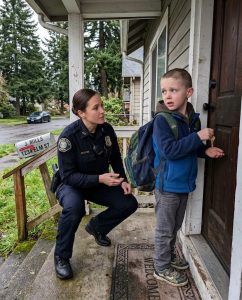
The boy searched my face for a loophole.
“Even if my dad says I’m lying?”
“Even then.”
His fingers closed around the key.
It took him three tries to guide it into the lock.
When the door opened, the first thing I noticed was the smell of bleach.
Not fresh laundry or a recently cleaned floor, but the sharp, throat-drying smell of a house scrubbed so often that nothing inside was allowed to leave a trace.
The second thing I noticed was the silence.
No television.
No refrigerator hum loud enough to cover a whisper.
No child calling from another room to ask who had come home.
The boy stepped inside and carefully placed his backpack against the wall, lining it up with two pairs of shoes already arranged beneath a narrow table.
Then he turned and raised one finger to his lips.
“He checks if things moved,” he whispered.
I stayed near the open doorway and called my supervisor, keeping my voice low while I explained that a child had invited me inside after reporting a possible safety issue.
The boy waited until I finished.
“Can I show you now?”
I nodded.
He led me past a small living room where the couch cushions sat perfectly square and every blind had been pulled to the same height.
A paper schedule was taped to the refrigerator in the kitchen.
It listed wake-up time, breakfast, school, chores, homework, quiet time, dinner, and sleep.
Nothing about the schedule looked alarming by itself.
Families used charts all the time.
Then I saw the handwritten marks beside the children’s names.
Each mark had a number beside it.
Fifteen.
Thirty.
Sixty.
The boy saw me reading.
“Those are minutes,” he said.
“Minutes for what?”
He looked toward the hallway.
“For the room.”
At the end of the hall stood a narrow door painted the same pale color as the walls.
It could have been a linen closet or a utility room.
A metal sliding latch had been screwed into the frame at an adult’s shoulder height.
The latch was on the outside.
The boy stopped several feet away.
His face had gone pale.
“She’s not supposed to answer if someone knocks,” he said. “But she knows my knock.”
He tapped twice, paused, and tapped once more.
Something shifted behind the door.
Then a little girl’s voice asked, “Is Dad back?”
The boy looked at me.
“No, Sophie. It’s me. I brought somebody.”
I moved the latch and opened the door.
The room was barely wider than the washer and dryer pushed against one wall.
A folded blanket lay on the floor beside a plastic cup and a workbook.
A little girl sat with her knees pulled against her chest, wearing a faded school sweatshirt and leggings.
She looked about six.
Her hair was tangled on one side, and the elastic around her wrist had left a deep pink line where she had twisted it over and over.
She was not bleeding.
I saw no obvious injury.
But when the door opened, she did not stand.
She looked first at her brother, then at me, and asked the question that changed the entire situation.
“Did I finish all my minutes?”
The boy dropped to his knees beside her.
“You’re done,” he said quickly. “You don’t have to do any more.”
She glanced past him at the open latch.
“Dad said you couldn’t decide that anymore.”
The boy’s shoulders folded inward.
Until that moment, I had assumed he was showing me something an adult did to him.
I had not understood that the adult had made him part of doing it to someone else.
I crouched outside the room and asked Sophie whether she wanted to come into the kitchen.
She did not move until her brother took her hand.
Even then, she stepped over the threshold like she expected an alarm to sound.
I asked how long she had been inside.
She looked at her brother because she believed he was supposed to answer for her.