The nurse had barely finished helping my five-year-old daughter settle after her stitches when my phone vibrated again.
I expected another explanation from my wife.
Instead, the message said: COME HOME. WE NEED TO GET OUR STORIES STRAIGHT BEFORE ANYONE STARTS ASKING QUESTIONS.
I read it twice.
My daughter was sitting beside my sister, wrapped in a paper blanket, one eye swollen around the fresh bandage. She was exhausted, frightened, and trying very hard not to cry again. The words on my screen suddenly made the room feel much smaller.
My wife wasn’t asking whether our daughter was okay.
She wasn’t asking how many stitches the doctor had used.
She wasn’t asking whether the bleeding had stopped.
She was asking me to get our stories straight.
And I had just watched the video that explained why.
A few minutes earlier, the neighbor whose security camera faced the side of our yard had sent me a clip. He had saved it before I even got home because he had heard my daughter screaming.
I watched it standing in the hallway outside the exam room.
The first time, I kept the sound low. I wanted to see the sequence without letting my anger fill in anything the camera hadn’t actually shown.
The second time, I used headphones.
There was no ambiguity about the part that mattered.
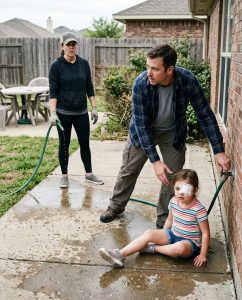
My daughter had been near the flower bed when my wife came through the patio door carrying the garden hose. The camera didn’t show what had happened inside the house before that. It didn’t show every word spoken between them. But it showed what happened after my wife turned the water on.
My daughter backed away.
The stream followed her.
She raised both arms over her face.
My wife kept the hose pointed toward her.
Then my daughter slipped.
Her head struck the edge of a low planter.
The hose didn’t stop immediately. It stopped after she was already on the ground.
For several seconds, my wife stood over her.
Then she went inside.
She came back carrying the gauze I had seen when I first stepped onto the patio.
I had spent the entire drive to urgent care trying to hold two thoughts at once: maybe there was an explanation I hadn’t heard, and my daughter was too frightened for me to ignore what she was saying.
Now I had something neither of those thoughts could explain away.
The video didn’t answer everything.
It did something more important.
It established a sequence.
My daughter had told me that the water made her move backward. The camera showed her moving backward while the stream followed her. She had told me the hose was pointed at her. The footage showed it. She had told me she fell after the spraying began. The footage showed that too.
But there was another detail.
Just before my wife went inside for the bandage, she lifted her phone and aimed it toward the patio.
My daughter had told me earlier that her stepmother took a picture before the fall.
I had almost dismissed that detail as something a frightened child might remember incorrectly.
I didn’t dismiss it anymore.
I saved the video in two places.
Then I forwarded a copy to my sister.
When I went back into the exam room, my daughter looked up at me.
“Daddy?”
“I’m here.”
“Are we going home?”
“Not tonight.”
She looked toward the door.
“Is she coming here?”
“No.”
My sister sat beside her and gently adjusted the paper blanket around her shoulders.
My daughter looked at me again.
“Don’t tell her I told you.”
That sentence had stayed with me since urgent care.
Not because a child had told me something difficult.
Because she was already thinking about protecting herself from the consequences of telling the truth.
I crouched beside the exam table.
“You’re not in trouble,” I told her. “You did the right thing by telling me.”