Six days after his funeral, a letter arrived in his shaky handwriting.
The first sentence was an apology I didn’t understand.
By the end of the page, I was on my way back to the courthouse where we had gotten married.
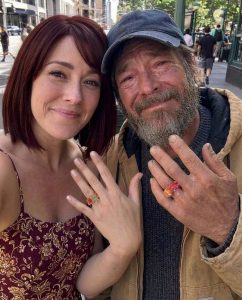
There, a clerk opened an old record book filled with Larry’s name and asked me a question I never expected.Which Larry had I married?
“Sarah, I need to apologize before I thank you.”
I read the opening line twice.
Larry’s letter had arrived less than a week after his funeral, sealed inside a thick white envelope.
The handwriting was unmistakable.
Uneven.
Shaky.
The same handwriting I had watched him use while completing forms at hospice.
The postmark was dated one day before he died.
When I first saw the envelope, I smiled.
I assumed Larry had written me a goodbye.
That would have been like him.
The man couldn’t accept a cup of coffee without thanking me three times.
Then I reached the next sentence.
“Nobody was going to bury me as a John Doe.”
My smile vanished.
I sat down.“No.”
Less than a month earlier, Larry had been sitting outside my usual subway station with a piece of cardboard resting across his knees.
Written across it in large black letters were the words:. I HAVE ONE MONTH LEFT TO LIVE.
I had known Larry for nearly two years.
Every weekday morning, I stopped at the coffee kiosk beside the station and bought two cups.
Mine had cream.
His was always black.
Larry never begged me for money.
Some mornings we talked about the weather.Other mornings he complained about the pigeons.
Once, he looked down at my office heels and told me they looked like they had been designed by “someone who hated human feet.”
Usually, I stayed for five minutes before rushing to work.
That Tuesday morning was different.
Larry looked terrible.
His skin had a yellow tint, and his hands shook when I passed him his coffee.
DiscoverCraft Roasts
I pointed at the cardboard sign.
“What is this?”
He looked down at it.
“The clinic says I probably have about a month.”
For a moment, the noise of traffic and commuters around us seemed to disappear.
“What?”
“Liver failure.”
I sat beside him on the freezing pavement.
“Larry, I’m so sorry.”
“Don’t make that face.”
AccessWriting Tools
“What face?”
“The face people make when they’re already standing at your funeral.”
Even then, he managed to make me laugh.
But I kept staring at the sign.
“Why marriage?”
Larry looked at his coffee.
“I don’t want to die belonging to nobody.”
“You don’t belong to nobody.”
“That’s a nice thing to say, Sarah.”
He looked toward the street.
“But it’s different when there’s paperwork.”
He explained that without legal family, strangers would eventually deal with his remains.
He didn’t want that.
“I just want one person who can say, ‘He’s mine. I’ll take care of him.’”
I was single.
Larry was dying.
And I had always been better at solving problems than walking away from them.
Two days later, we went to the courthouse.
Larry wore a clean blue shirt somebody at the shelter had given him.
I wore my navy work dress.
When the clerk asked whether we had rings, Larry checked his empty pockets dramatically.
“Knew I forgot something.”
I laughed.
Eleven minutes later, I became his wife.
Exactly three weeks after that, I sat beside his bed in a state hospice facility and held his hand while his breathing slowly stopped.
And now his letter was telling me that the reason I had married him wasn’t entirely true.
I forced myself to keep reading.
“The liver failure was real. The month was real. What I lied about was why I asked you to marry me.”
I lowered the letter.
Then immediately picked it up again.
“My arrangements were already taken care of. Hospice or the county would have handled the paperwork. I wasn’t going to disappear without a name.”
DownloadReference Apps
I stood so quickly my chair scraped across the floor.
“What did you do, Larry?”
There was nowhere for my anger to go.
He was dead.
I couldn’t call him.
I couldn’t demand an explanation.
I couldn’t even force him to sit across from me and watch the expression on my face.
I kept reading.
“If I gave you a problem you could solve, I knew you would solve it.”
That sentence hurt the most.
Because it was true.
For two years, I had constantly offered Larry things.
Coffee.
DiscoverCraft Roasts
Food.
Warm socks.
Shelter phone numbers.
Once, during a brutal cold spell, I spent half my lunch break calling shelters until I found an available bed.
Larry always thanked me.
But it had never occurred to me that during those two years, he had also learned something about me.
He had learned exactly how to ask me for help.
Near the bottom of the page, he had written:
“Before you decide what kind of jerk I was, go back to the courthouse where we got married. Ask for Margaret. Tell her you’re my wife.”
For a few minutes, I seriously considered throwing the letter away.
Instead, an hour later, I was standing inside the courthouse lobby.
Couples filled the plastic chairs.
ExploreSectional Sofas
A woman in a white jumpsuit adjusted her lipstick while her fiancé held a bouquet.
A toddler crawled beneath a row of seats while his father tried to catch him.
Three weeks earlier, Larry and I had sat in those same chairs.
I remembered him rubbing his palms against his trousers again and again.
“You’re shaking,” I had told him.
“I’m dying. I think I’m allowed to shake.”
At the time, I accepted that explanation.
Now I wondered how many things I had accepted simply because asking another question had seemed unnecessary.
At the records counter, someone pointed me toward an older woman wearing red glasses.
“Margaret?”
She looked up.
“Yes?”
“My name is Sarah.”
DownloadReference Apps
I hesitated.
“I’m Larry’s wife.”
Her hands froze above the keyboard.
“Larry?”
I nodded.
Her chair rolled backward.
“Oh, sweetheart.”
Before I understood what was happening, she walked around the counter and hugged me.
I stood stiffly in her arms.
When she stepped back, her eyes were wet.
“When did he pass?”
“A week ago.”
She looked away for a moment.
“I knew he was sick. I didn’t know it was that close.”
I stared at her.
“You knew Larry?”
Margaret frowned slightly.
“Of course I did.”
“How?”
She glanced around the courthouse.
“He worked here.”
I stared at her.
“Here?”
“For twenty-eight years.”
My mouth fell open.
“Then how did he end up homeless?”
Margaret’s expression softened.
“His health started failing after retirement. Medical expenses ate through his savings. Then he lost his apartment.”