My Parents Left Grandma at a Nursing Home and Disappeared Then She Told Me to Drive to the Courthouse
My parents told Grandma Eleanor they were taking her to lunch.
Three hours later, a nursing home in Ohio called me.
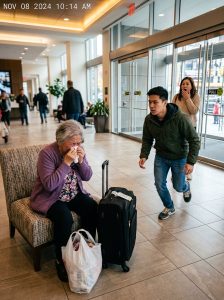
“Are you Daniel Mercer?” the woman asked. “Your grandmother listed you as an emergency contact. Her suitcase is in our lobby, but the family members who brought her left before admissions were completed.”
I was standing in my apartment kitchen in Indianapolis, holding a coffee I no longer wanted.
“What do you mean, left?”
The administrator hesitated. “They said they needed to get paperwork from the car. They never came back.”
I called my father. Straight to voicemail. My mother. Same.
I drove 190 miles with both hands locked around the steering wheel, but before I tell you what I found in that lobby, I need to back up, because none of what happened that day makes sense without understanding who my grandmother actually was, and who my father had quietly become over the years leading up to it.
My name is Daniel Mercer. I’m 34, and Eleanor Mercer, the woman everyone in the family just called Grandma, was my father’s mother, a widow for the past seven years since my grandfather Walter passed.
She’d lived on Maple Ridge Road for over four decades, in the same redbrick, single-story house where my father grew up, where I spent most of my own childhood summers shelling peas on the back porch and learning to drive a stick shift in the gravel lot behind the detached garage.
Grandma Eleanor was sharp in a way that people sometimes mistook for coldness until they got to know her better. She’d worked as a high school math teacher for thirty-one years before retiring, and she carried that same exacting, patient precision into everything else in her life, her garden, her
checkbook, the way she folded laundry into corners crisp enough to pass inspection. She loved fiercely but never performatively, the kind of love that showed up as a hot meal waiting when you were struggling rather than a hug you had to ask for.
My father, Richard, was her only child, and I think, looking back now with the clarity this whole ordeal eventually gave me, that being an only child of two exacting, hardworking parents shaped him in ways nobody in the family fully examined until it was almost too late.
Dad had always been the charming one, gifted with an easy, persuasive warmth that could talk a mechanic into extending a payment deadline, convince a hesitant customer to pay a deposit early, or smooth over a family argument with a joke and a refilled wine glass before anyone quite noticed the original problem had gone unresolved.
He started Mercer Renovations about fifteen years before all of this happened, a general contracting business that did decently for its first several years, enough for my parents to buy a nice house in a good school district, enough for my mother, Diane, to stop working and focus on what she called
“managing the household,” which mostly meant managing appearances. But somewhere around the time I finished college, the business started struggling in ways my parents never fully explained to me, competitive bids lost, a couple of projects that ran badly over budget, suppliers who apparently stopped extending the same easy credit they once had.
I didn’t know the full extent of it. Nobody in the family did, I think, except possibly my mother, and even she, it would later become clear, hadn’t grasped quite how deep the hole had gotten.
Grandpa Walter had a heart condition that finally took him seven years earlier, a sudden, fast decline that none of us were fully prepared for despite years of doctors’ warnings.
Grandma Eleanor handled his death the way she handled everything, with a controlled, private grief that she rarely let anyone else witness directly. She stayed in the house on Maple Ridge Road, kept up the garden he’d loved, and settled into a quiet, independent widowhood that seemed, from the outside, entirely stable.
About eight months before that terrible phone call from the nursing home, Grandma had a hip replacement surgery, routine enough as these things go, but it required a recovery period where she genuinely did need some help managing bills and appointments for a few weeks.
My father offered to step in, and Grandma, trusting her only son the way any mother might, signed a power of attorney document he brought to her hospital room, temporary, she believed, limited to helping her through the recovery period.
I want to be honest that I didn’t think much about any of this at the time. I called Grandma every couple of weeks, visited when I could make the four-hour round trip from Indianapolis, and generally assumed everything with my parents’ involvement in her recovery was exactly as innocent as it appeared. I had no reason yet to think otherwise.
Which brings me back to that Tuesday, standing in my kitchen with a cooling cup of coffee, my hands starting to shake as the nursing home administrator’s words settled in.
I drove those 190 miles faster than I should have, replaying every phone call with my parents over the previous months, searching for some detail I’d missed, some warning sign I’d been too distracted to catch.
When I arrived, Grandma was sitting beside one brown suitcase and a grocery bag full of medications. She wore her church coat even though the lobby was warm. Her gray hair was pinned neatly, and her face was calm in the way it always became when she was furious, a stillness I’d learned to recognize since childhood as considerably more dangerous than shouting would have been.
I knelt in front of her. “Grandma.”
She looked at me for several seconds. Then she stood. No tears. No questions. She walked to my car, got in, and buckled her seatbelt.
“Don’t call them,” she said.
I stared at her.
“I’ll tell you where to drive.”
“Where?”
“First, the county courthouse.”
That got my attention.
On the highway, she opened her purse and handed me a folded bank statement. Three withdrawals had been circled in red. Twelve thousand dollars. Eighteen thousand. Twenty-five thousand. All within six weeks.
“Your father has power of attorney,” she said. “Temporary. I signed it after my surgery because I trusted him.”
My stomach tightened.
“He told me I was becoming confused. He said I needed help with bills.” She looked out the window. “Then yesterday I found this.”
“Did you ask him?”
“I did.”
“And?”
“He told me the money was being used for my care.”
I glanced at the single suitcase in the back seat.
Grandma gave a dry laugh. “At lunch today, your mother said we were stopping somewhere with a garden. They walked me inside that place, signed nothing, and disappeared.”
My phone buzzed. Dad. Grandma reached over and turned it face down.
“Courthouse first,” she repeated. “Then the bank. Then one more place.”
“What place?”
She met my eyes. “My house.”
I swallowed. “Why?”
“Because if they’ve done what I think they’ve done, your parents didn’t abandon me today.”
She pulled a small envelope from inside her coat. On the front, in my grandfather’s handwriting, were two words: HOUSE DEED.
“I hid this before they picked me up,” she said. “I wanted to know whether they’d search for it.” Her voice dropped. “They were getting me out of the way.”
The county courthouse was ten minutes from closing when we arrived. Grandma moved faster than I expected, her cane clicking sharp and purposeful against the marble floor. At the clerk’s window, she asked for copies of every document recorded against her property during the previous ninety days.
The clerk searched by address. Then her expression changed.
“There’s a quitclaim deed recorded twelve days ago.”
Grandma gripped the counter. “To whom?”
The clerk turned the monitor slightly. My father’s name was there: Richard Mercer.
I felt heat rise into my face. Grandma did not react immediately. She simply asked for a certified copy.
In the parking lot, she read every line. Her signature appeared at the bottom.
“That is not my signature,” she said.
I looked closer. It resembled hers, but the final letters were wrong. Too smooth. Too careful.
“Can Dad transfer your house with power of attorney?”
“Not by forging my name.”
We went to her bank next. A branch manager named Claire Benton took us into a private office. Grandma showed identification, revoked my father’s access, changed every account password, and requested full transaction records.
Claire looked uncomfortable as the statements printed. There were more transfers than Grandma had known about. Not fifty-five thousand dollars. Eighty-three thousand. Most had gone to an account belonging to Mercer Renovations LLC, my father’s struggling contracting company. Another twenty thousand had been wired to a title company.
Grandma tapped that line. “That’s the house.”
Claire nodded carefully. “I can’t tell you what the title company used it for, but this transfer was initiated through online banking using authorized credentials.”
“His credentials,” Grandma said.
The manager did not answer.
Outside, I finally called my father. Grandma did not stop me. He answered on the second ring.
“Daniel, where is she?”
The question stunned me.
“You left her at a nursing home.”
“That wasn’t the plan.”
“What was the plan, Dad?”
Silence. Then my mother’s voice came faintly through the phone. “Tell him she needs supervision.”
Dad lowered his voice. “Your grandmother has been making unsafe decisions. We were trying to get her somewhere secure.”
“She passed a cognitive evaluation two months ago.”
Another silence. I had not known about the evaluation. Grandma had.
Dad changed tactics. “You don’t understand the financial situation.”
“I understand eighty-three thousand dollars is missing.”
He stopped breathing for half a second. Grandma watched my face and knew.
“Daniel,” Dad said, “do not take her back to that house.”
“Why?”
“Because it isn’t hers anymore.”
Grandma reached for the phone. I handed it to her.
“Richard,” she said, “you forged my name.”
His response came quickly. “You signed papers.”
“I signed a temporary power of attorney after surgery. I did not sign away my home.”
“You said you wanted to help the family.”
“I said I would help if I could. I did not say you could steal.”
My mother grabbed the phone on his end. “Eleanor, stop making this dramatic. Richard was protecting the property. His business is underwater. We were going to pay everything back.”
Grandma’s face hardened. “So you put me in a nursing home?”
“You need care.”
“No. You needed me unable to object.”
My mother said something I will never forget. “You are eighty-one years old. What exactly are you saving the house for?”
Grandma ended the call.
For a moment, neither of us spoke. Then she gave me the next address. Her house.
When we pulled onto Maple Ridge Road, two pickup trucks were parked in the driveway. The front door was open. A man I did not recognize was carrying Grandma’s dining chairs onto the porch.
I slammed on the brakes. Grandma stared through the windshield.