My Dad Handed My Lake Tahoe Home Over to My Sister Like It Was His, So I Made Sure Everyone Learned the Truth
My husband James used to say that the best military strategy was the one the other side never saw coming.
He said it the way he said most things, lightly, with the specific smile of someone who has learned that wisdom travels better without ceremony.
He was a Naval officer.
He had spent twenty-two years understanding that the moment your adversary believes they have you figured out is the moment your advantage begins.
He died four years ago.
Cardiac arrest.
He was fifty-one years old.
He was in excellent health by every standard we had, by every physical and every test, and then he was not, and then he was gone.
The speed of it was the thing I could not manage for the first year.
Not the grief itself.
The speed.
The way a morning could be entirely ordinary and a phone call could end it.
The way everything after that phone call was a different kind of life than the one you had been living forty minutes before.
James would have known what to do.
He always knew what to do.
He would have looked at the situation with my family and he would have smiled the specific smile and he would have said: you already know the answer.
He would have been right.
I did already know the answer.
I just needed to let the question develop before I gave it.
My name is Commander Catherine Holt, United States Navy.
I am forty-seven years old.
I have served for twenty-three years.
I have deployments behind me and a career record that reflects, if nothing else, the specific discipline of someone who has learned to make decisions under conditions that do not allow for hesitation.
I am not a person who hesitates.
I am sometimes a person who waits.
The difference is significant.
The Lake Tahoe villa belonged to James and me.
We bought it in the sixth year of our marriage, with money we had saved and with the specific intention of two people who had been stationed in too many different places to count and who wanted one location in the world that was unambiguously theirs.
The villa was that location.
Three bedrooms.
A kitchen with the view of the water that James had specified as non-negotiable.
A back porch where we sat in the evenings when we could manage to be there together.
He had chosen the furniture.
He had chosen the specific shade of gray for the walls in the living room, which he described as the color of the Pacific in November, which was his favorite month.
He had planted a juniper tree in the backyard, which had grown considerably.
He had put his hands on the porch railing and said: this is the place we come back to.
We came back to it when deployments ended.
We came back to it for anniversaries and for the weeks between assignments.
It was the only house that had ever felt like a house to me.
After James died, I kept it.
People said: you don’t need that much space.
People said: it must be hard to be there alone.
People said various things.
I kept it.
I kept it because it was the place James had put his hands on the railing and said: this is the place we come back to.
I was still coming back to it.
I was still the person who needed a place to come back to.
My family is my father, whose name is Richard Holt, sixty-eight years old, a man who has spent most of his adult life being managed by the women around him, first my mother before she died, then my stepmother Susan, then increasingly by my sister Olivia, who has always had his ear in a way I have not.
He is not a bad man.
I want to say this at the beginning, the way you have to say it at the beginning when the story involves your own family, because the easy reading of the story is the one where he is the villain, and the truth is more complicated.
He is a man who has always found money difficult, who has always found the distance between what he needed and what he had to be a source of ongoing anxiety, and who has, over the years, developed a specific habit of looking to me to close that distance.
I am the one who went away.
I am the one who made something.
I am therefore, in the logic of family systems that I did not choose but that I understand, the one who can afford to give.
I have given.
Over the years, over the specific accumulation of requests that began small and became larger, I have given more than a hundred and ten thousand dollars.
I bought Olivia the SUV she drives.
She needed reliable transportation, she said.
Her car had died.
She had two children.
She could not manage without something dependable.
I wired the money.
I wired money to my father when he told me creditors were coming.
When he told me the family home was facing foreclosure, I sent fifty thousand dollars.
This was two months after James’s funeral.
I was in the specific state of someone who is still understanding that the world has a different shape than it had before, and my father called, and I sent the money, because what else do you do.
What else do you do when you have just buried your husband and your father calls and says the family home might be lost.
You send the money.
You send it and you go back to the shape of the world that has changed.
Olivia never thanked me for the SUV.
Not the specific thank you that names the thing.
She said: thanks, Cat, the kids will be safer now.
Which was about the kids, not about me.
My father thanked me for the creditor money.
He thanked me the way he thanked me for things, with the specific gratitude of someone who expected the help and is appreciative but not surprised.
I did not give the money to be thanked.
I gave the money because they were my family.
But I want you to understand the accounting.
Not because the accounting justifies what came later.
Because it is part of understanding who knew what and who had decided what before the champagne cork hit the ceiling of my villa.
The naval exercises had been three weeks.
Not the worst three weeks I had experienced.
Not by a significant measure.
But three weeks of sustained work at sea has a quality of accumulated weight that lands on you when it ends, the specific fatigue that is not just physical but the fatigue of sustained attention, of being the person whose decisions matter in ways that cannot be undone.
I drove to Lake Tahoe from the point of debarkation.
I drove because I wanted to.
Because the drive along the coast and then through the mountains was a transition I needed.
The drive said: you are going to the place you come back to.
I arrived in the early evening.
The villa’s lights were on.
I thought: I left a timer running.
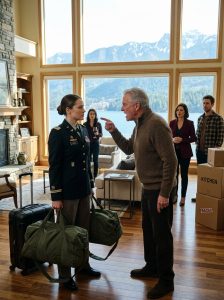
I parked and I took my duffel bag from the truck and I went to the front door and before I even had the key in the lock I heard the champagne cork.
The party was not loud.
It was an intimate gathering.
My father, my stepmother Susan, my sister Olivia, her husband David.
Moving boxes.
Suitcases.
Family photographs stacked near the living room.
A child’s bicycle leaning against the wall in the hallway.
They had not come to visit.
They were moving in.
My father looked at me the way you look at someone who has arrived at an inconvenient time.
He said: this house is far too big for one person. Olivia has a husband and children. They need it more than you do.
He said it with the specific certainty of someone who has made a decision and who expects the decision to be accepted.
I said: this is my villa.
He gave me the dismissive smile.
He said: go back to your base, Commander. You’re not welcome here.
Olivia raised her champagne glass.
She had the expression I had seen on her face at specific moments throughout our shared life, the expression of someone who believes they have won something.
I understood everything in that moment.
Not that I had been slow before.
I had seen this developing.
I had watched the conversations shift, over the past year, toward the villa.
I had noticed the questions about whether I used it often, about whether it was practical for a single person, about whether James would have wanted it sitting empty so much of the time.
I had noticed.
I had not yet determined what to do.
My father’s face, when he said go back to your base, gave me the information I needed.
He had expected a fight.
He had expected me to argue, to demand, to call lawyers, to make the kind of scene that would allow him to say: she was always difficult.
I bent down.
I picked up my duffel bag.
I said: all right.
His expression changed.
Just briefly.
The surprise before he managed it.
I turned and walked to the front door.
I heard, behind me, the pop of a second champagne cork.
Then laughter.
I got in my truck.
I sat in the driver’s seat for a moment.
Not from uncertainty.
From the specific stillness of someone who has just confirmed a suspicion and who is now organizing their response.
James would have smiled.
He would have said: you already know the answer.
I knew the answer.
I drove.
I drove back to San Diego.
Eleven hours, through the night, which is not a drive I would recommend but which I needed because the driving was the thinking and the thinking required the time.
By the time I reached the base, it was morning, and I had the outline of what I was going to do.
I sat at my desk with the documents.
The villa’s deed was in my name.
After James died, we had both been on the deed, and his estate had transferred cleanly to me, because we had the specific estate planning of two people who understood that the military career could end unexpectedly and who had prepared for this.
Everything was mine.
Clean, documented, clear.
My name on everything.
I looked at the documents and I thought about my father’s certainty.
Go back to your base, Commander.
He had been that certain.
He had uncorked champagne.
He had let Olivia set down her champagne glass with the expression of someone who has claimed something.
He had done all of this inside a house that was, in every legal sense, mine.
The certainty was the interesting thing.
Where did the certainty come from.
I thought about this.
He was a man who had never owned significant property.
He was a man who had, throughout his life, lived in spaces controlled by other people.
He had perhaps convinced himself that his authority as a father, his position as the elder of the family, the fact that he had determined Olivia needed the house more, was a form of ownership.
He had perhaps simply not thought it through.
Both were possible.
Neither changed what I was going to do.
I called Michael Vance.
Michael and I had met during a legal matter connected to James’s estate, and I had retained him for several small matters afterward, and I trusted him in the way you trust someone after watching them work.
He was meticulous.
He was patient.
He understood that the law is an instrument and that using it well requires understanding not just the rules but the specific application of those rules to specific situations.
I said: I need help protecting a property.
He said: from whom.
I said: my family.
He was quiet for a moment.
He said: that serious.
I said: worse than you think.
He said: tell me.
I told him.
He listened without interrupting.
When I finished, he said: your ownership is not in question.
He said: the deed is yours.
He said: the estate transfer is clean.
He said: there is no legal mechanism by which your father can convey authority over a property he has no title to.
He said: what he did was enter your property without permission.
He said: and indicate intent to remain.
He said: which is the beginning of a trespass situation.
He said: Catherine.
He said: what do you want to happen.
I said: I want them to understand what they don’t have.
He said: before or after they try to stay.
I said: after.
He said: you want to let them get comfortable.
I said: I want them to understand the difference between thinking they have won and having won.
He said: yes.
He said: I understand.
He said: give me a week.
I called Ethan Wright.
Ethan is one of the most resourceful people I have ever served with.
He is a former electronic warfare officer who understands systems, who thinks about problems the way an engineer thinks about systems, which is: what are the inputs, what controls the outputs, and how do you change one to change the other.
He had left the Navy and gone into private security consulting, and he was very good at it.
I said: my family has decided to take over my Lake Tahoe house.
He said: did you give them permission.
I said: no.
He said: do they believe they have permission.
I said: absolutely.
He laughed softly.
He said: that should make them fairly predictable.
He said: what do you need.
I told him what I needed.
He said: give me a few days.
Over the following week, Michael worked on the legal preparation and Ethan worked on the technical preparation.
Michael prepared formal notices, ownership documentation, and the specific legal letters that would make the situation clear to anyone who looked.
He also reviewed every possible argument my father might make and closed off each one with documentation.
There was no angle from which my father had any legal standing.
The house was mine.
The transfer from James’s estate was clean.
There was no common law, no obscure family property statute, no argument from contribution or from necessity that would give my father or Olivia any claim.
Ethan visited the villa.
He had a property management contact in Tahoe who cooperated.
He installed updated security systems, upgraded the smart home infrastructure, and connected the entire property to a remote management system that I could control from my phone or laptop in San Diego.
Every light.
Every lock.
The heating and cooling system.
The water.
Every system in the house was now accessible to me from three hundred miles away.
Ethan said: the previous key will still open the door.
He said: I left that on purpose.
He said: so they think they have access.
He said: but everything after the door is under your control.
He said: Catherine.
He said: this is going to be a lesson they don’t forget.
I said: that’s the intention.
Olivia called on the Thursday before the Sunday they had apparently planned to arrive permanently.
She began with tears.
She said: the kids need more space. Our apartment is too small.
I stayed silent.
The silence was useful.
It communicated nothing that could be used against me later.
She shifted to guilt.
She said: Dad’s blood pressure has been worse because of all this stress.
I said nothing.
The stress was her chosen project.
The stress had not been mine to create.
Then her voice hardened.
She said: we’re moving in on Sunday whether you approve or not. Dad says there’s nothing you can do about it.