Miranda stopped when the officer raised his hand.
“Ma’am, stay there.”
Her expression changed for half a second.
Then the worried stepmother returned.
“I’m only trying to bring her home.”
The second officer looked at me.
“Can we speak with you separately?”
My stomach dropped.
Miranda answered before I could.
“She’s confused. She’s been upset lately.”
Grandpa turned his head.
“Officer.”
His voice stayed calm.
“She can answer for herself.”
That mattered.
Nobody had said that to me in months.
The officer nodded toward the living room.
I sat on the edge of Grandpa’s couch, the cedar-smelling quilt still folded beside me.
He asked my name.
My age.
Whether I felt safe going back with Miranda.
“No.”
The word barely came out.
He waited.
So I said it again.
“No.”
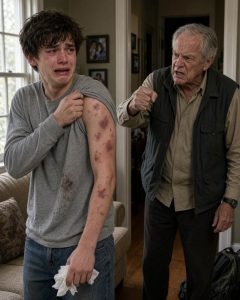
Then he asked about the bruises.
I told him what I had told Grandpa.
Not everything.
Not all at once.
Just enough.
When I looked toward the doorway, Miranda was no longer smiling.
Grandpa stood several feet behind her with his arms at his sides.
No threats.
No yelling.
Just waiting.
The officer glanced toward his partner.
Then back at me.
“Has a doctor seen these injuries?”
“Not yet.”
Grandpa spoke from the doorway.
“That was where we were going this morning.”
The officer nodded slowly.
Then Miranda said the one thing she probably thought would end the conversation.
“I’m a nurse. I know what accidental bruising looks like.”
The officer looked at her.
“So do doctors.”
For the first time since she arrived, Miranda had nothing ready to say.
That silence frightened me more than her yelling usually did.
Miranda was never quiet when she believed she had control.
She corrected.
Explained.
Reframed.
Made herself sound reasonable and everyone else emotional.
Now she stood on Grandpa’s porch with two officers between us, and nobody was letting her finish my sentences.
The officer sitting across from me kept his voice even.
“Do you want your grandfather to stay in the room?”
I looked at Grandpa.
He did not nod.
Did not answer for me.
He waited.
“Yes.”
“Okay.”
Grandpa came inside and sat in the chair farthest from me.
That surprised me.
I thought he would sit beside me.
Instead, he gave me space.
The officer asked another question.
“Did the injuries happen at the same time?”
I looked at my arms.
Some were fading.
Others were darker.
“No.”
“How many times?”
My throat tightened.
“I don’t know.”
That was the truth.
There had been too many moments I had tried to forget as soon as they happened.
A hard grab.
Being shoved into the hallway wall.
Fingers closing around my arm when I talked back.
A hand at my shoulder.
None of it had seemed large enough, on its own, to become the thing that finally made me tell someone.
That was how Miranda worked.
Nothing dramatic when another adult was around.
Nothing obvious enough that I thought anyone would automatically believe me.
Then afterward:
Look what you make me do.
You’re impossible.
You’re lucky your father has me.
And the sentence I heard more than any other:
Nobody is going to believe you.
The officer let me speak at my own pace.
He did not ask why I waited.
That mattered too.
People always imagine telling as one clean decision.
You know something bad is happening.
You tell.
Adults fix it.
But when the person hurting you lives in your house, prepares dinner, signs school forms, and speaks politely to neighbors, the truth starts feeling like a dangerous thing to carry.
What if Dad believed Miranda?
What if he didn’t?
What if he confronted her and then went back to work that night?
What if she came upstairs afterward?
Those questions had kept me quiet longer than fear alone.
The officer asked, “Where is your father?”
“At work.”
“What does he do?”
“Night shift.”
Grandpa answered this one only after looking at me first.
“He should be getting off soon.”
The officer nodded.
“Can you call him?”
Grandpa took out his phone.
Miranda immediately spoke from outside.
“I already tried Daniel. He isn’t answering.”
One officer turned toward her.
“Ma’am, please let us handle this.”
Her mouth snapped shut.
Grandpa dialed.
No answer.
Again.
No answer.
He left a message.
“Daniel, it’s Dad. Call me the second you get this. It’s about your daughter.”
No extra detail.
No accusation.
Then he put the phone down.
The second officer asked Miranda for her account.
I could hear part of it from the living room.
She said Grandpa had become emotional.
She said I was angry about household rules.
She said I bruised easily.
She repeated the bicycle story.
The bicycle story bothered me because I had fallen off my bike.
That part was true.
Three weeks earlier.
One scraped knee.
Miranda had taken that real thing and stretched it until it covered everything else.
That scared me.
Because lies built around one fact are harder to fight.
I looked at the officer.
“I did fall.”
He nodded.
“Okay.”
“But not like this.”
“Okay.”
No surprise.
No accusation.
Just okay.
For the first time, I began to understand what Grandpa meant when he said Miranda thought a child had no witness.
A witness did not only mean someone who watched the moment happen.
A witness could be someone willing to look carefully afterward.
Grandpa had looked.
The officers were looking now.
And soon, if Grandpa got his way, a doctor would too.
The officer stood.
“We’re going to need to get you medically evaluated.”
My stomach tightened.
“Do I have to go with her?”
He understood immediately.
“No.”
I looked at Grandpa.
He was already standing.
“I’ll take her.”
The officer nodded.
Miranda stepped through the doorway before anyone invited her.
“No. Absolutely not.”
The first officer moved between us again.
“Ma’am.”
“She’s a minor.”
“And we are addressing that.”
“She belongs at home.”
Grandpa’s voice changed for the first time.
Not louder.
Harder.
“She belongs somewhere safe.”
Miranda turned toward him.
“You’re accusing me of something you do not understand.”
Grandpa looked at my arms.
“I understand enough.”
That sentence almost made me cry.
Not because it was comforting.
Because it was so simple.
For weeks, Miranda had told me everything was complicated.
That I was difficult.
That stress made her lose her temper.
That Dad working nights made things hard.
That families argued.
That nurses knew what real abuse looked like and I was being dramatic.
Grandpa looked at bruises and understood enough.
Maybe adults sometimes hide behind complexity because simple truths require action.
Miranda’s voice became sharper.
“Daniel left me responsible for her.”
Grandpa looked at the officers.
“Then Daniel can answer for why he didn’t know what was happening in his own house.”
That landed on me too.
Dad.
I had spent the whole night avoiding that part.
It was easier to think about Miranda.
She was the one hurting me.
Dad was just working.
Just tired.
Just missing things.
But missing things still mattered.
The front tires of a car hit the gravel.
Everyone turned.
Dad’s truck.
My stomach dropped so quickly I felt dizzy.
He parked crooked.
Engine still running.
Then he came toward the porch wearing his work jacket and looking completely confused.
“What’s going on?”
Miranda moved first.
Of course she did.
“Daniel, thank God.”
She rushed toward him.
“Your father took her last night and now they’re accusing me because she has bruises from falling off her bike.”
Dad looked at Grandpa.
Then the officers.
Then me.
His eyes dropped to my arms.
He stopped moving.
I had imagined this moment a hundred times.
In most versions, Dad defended her.
Or demanded explanations.
Or looked angry at me for creating trouble.
What actually happened was worse in a different way.
He looked lost.
“Sweetheart?”
I hated that one word.
Because it sounded like him.
Like the father I remembered.
Like the man who used to pack extra snacks in my school bag and leave notes beside my cereal.
My eyes filled.
Miranda saw it.
She stepped closer to him.
“See? She’s emotional. Your father scared her.”
Dad did not look at Miranda.
He kept looking at me.
“What happened?”
My mouth would not work.
Grandpa spoke.
“No.”
Dad turned.
Grandpa pointed toward me.
“She tells you.”
That was twice in one morning he had given my voice back to me.
Dad looked at me again.
I tried once.
Nothing.
Then I forced the words out.
“Miranda did it.”
Dad went completely still.
Behind him, Miranda laughed.
Not loudly.
A shocked little sound.
“Daniel, come on.”
I continued before I lost my nerve.
“She grabs me.”
Dad’s face changed.
“She shoves me.”
“Stop.”
Miranda’s voice was sharper now.
The officer raised his hand.
“Ma’am.”
I looked at Dad.
“She said you’d believe her.”
His eyes closed.
Just for a second.
Then opened.
“Why didn’t you tell me?”
There it was.
The question I knew would come.
I looked down.
Grandpa leaned forward.
“Wrong question.”
Dad stared at him.
Grandpa’s voice stayed flat.
“Ask why she was afraid to.”
Dad flinched.
Nobody spoke.
I think that was the moment he really understood.
Not everything.
But enough.
The same word again.
Enough.
He looked toward Miranda.
For the first time, fear crossed her face.
Real fear.
Not panic about police.
Something more personal.
The realization that the person she counted on most was no longer automatically standing beside her.