My brother’s silence told me more than his first answer did.
I was sitting on the edge of my couch with my laptop open, the banking app glowing on my phone and Abigail’s purple backpack resting against the coffee table.
She was asleep down the hall.
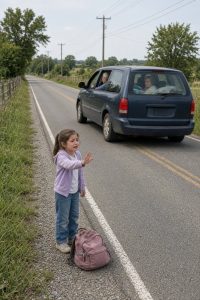
Less than twelve hours earlier, that backpack had been pressed against her chest while she stood alone beside a highway waiting for somebody to come back.
Nobody had.
I had come instead.
“Who was supposed to take Abigail?” I asked my brother again.
He exhaled slowly.
“I thought you were.”
The words made no sense at first.
I reminded him that our parents had invited Abigail on the trip.
They had picked her up that morning along with his two boys.
They had told all of us they were taking the grandchildren to the airport for the start of a family vacation.
My brother hesitated.
“That’s not what Mom told me.”
I stood up.
“What did she tell you?”
He said our parents had changed the plan days earlier.
They were no longer taking the children on the flight.
They had decided they wanted to travel alone.
My brother had agreed to meet them near the airport and pick up his sons before their shuttle arrived.
He assumed I had been given the same instructions about Abigail.
I had not.
There had been no message.
No call.
No request that I meet them anywhere.
My mother had never told me the trip had changed.
Instead, she had called at 11:37 a.m. and calmly informed me that my eight-year-old daughter had gotten sick, so they had put her out beside a road.
I asked my brother when he learned about the new plan.
“Two nights ago.”
My fingers tightened around the phone.
“Two nights?”
He apologized immediately.
He said he had assumed Mom had already spoken to me because she had been so specific about where everyone was supposed to go.
His sons would be collected.
My parents would take the shuttle.
Then they would catch their flight alone.
Everyone had a destination.
Everyone except Abigail.
That was when the one-way shuttle receipt stopped looking strange and started looking deliberate.
I asked him to forward every message our parents had sent him about the change.
Three minutes later, screenshots began arriving.
The timestamps mattered.
Two days before the trip, my mother had written that traveling with three children was going to be “too much.”
My father had replied separately that they had “earned some peace.”
My brother had asked whether they were canceling the entire family trip.
Mom said no.
They were still going.
Just without the children.
My brother then asked the obvious question: why had they invited the kids in the first place?
There was no answer in the screenshots.
But there was another message.
My father had written, “We’ll get your boys back to you before the airport.”
Your boys.
Not the kids.
Not all three grandchildren.
Your boys.
I scrolled through the thread twice before I noticed what was missing.
Abigail’s name did not appear anywhere.
My brother finally understood it at the same moment I did.
“Oh, God,” he whispered.
I said nothing.
He asked whether Abigail was okay.
I told him she was asleep.
Then I asked him why our parents would deliberately make arrangements for his sons but not my daughter.
He said he didn’t know.
I did not yell at him.
He had made a careless assumption, but he had not put my child beside that road.
The people who had done that were currently on their way to an airport using money I had helped provide.
That detail mattered.
For nearly six years, I had been quietly supporting my parents whenever their expenses outran their income.
It started with a utility bill.
Then came a car repair.
Then groceries.
Then insurance.
Sometimes they repaid me.
Usually they did not.
Every request came wrapped in the same language.
Family takes care of family.
You know we’d do the same for you.
We just need a little help this month.
A little help eventually became automatic transfers.
I covered several recurring expenses because it seemed easier than waiting for a crisis call.
When they planned the family vacation, I contributed again because I believed Abigail would get time with her grandparents and cousins.
I told myself that mattered more than the money.
That belief had kept me generous long after generosity stopped being healthy.
The highway changed that.
At 8:14 that night, I opened every account connected to them.
I made a list.
There was the card on which they were authorized users.
There were two bills I paid directly each month.
There was an emergency transfer I had set up years earlier and never canceled.
Then there was the vacation money.
I had transferred it because my mother told me the trip was “for the grandkids.”
Part of that money had paid for the transportation they were now using to leave those same grandchildren behind.
I stared at the transaction history until anger became something more useful.
Specificity.
I did not want revenge.
I wanted separation.
So I began with the things that were actually mine to control.