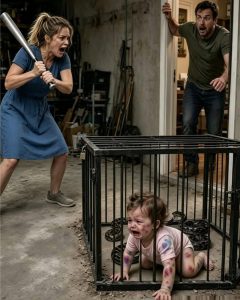
My wife said locking our toddler in a cage with venomous snakes was supposed to “stimulate her survival instincts” and help her learn to walk faster.
Swinging a baseball bat against the iron bars to make the snakes rear up, she screamed, “Stand up and run, or you’re dead!”
Our baby girl was still barely taking her first steps.
I heard the metal before I saw anything.
Three hard crashes came from the back of the house, followed by my wife’s voice shouting our daughter’s name.
At first, I thought something had fallen in the garage. Then another metallic bang echoed through the hallway, louder than the previous three.
I dropped the grocery bags in the kitchen.
“What are you doing?” I shouted.
There was no answer.
Another crash.
Then I heard my daughter crying.
I ran toward the sound and pushed open the back door.
For several seconds, my mind refused to understand what I was seeing.
My wife stood beside an old iron animal enclosure that had been sitting unused behind our storage shed since before we bought the property.
She had dragged it into the middle of the yard.
Inside was our eighteen-month-old daughter, Lily.
She was sitting on the ground, crying so violently that her entire little body shook.
And several feet away from her were snakes.
I froze.
My wife didn’t.
She raised the baseball bat again and slammed it against the outside of the cage.
The metallic explosion made Lily scream.
“Stand up!” my wife yelled.
I rushed forward.
“What the hell are you doing?”
She turned toward me with an expression of irritation, as though I had interrupted an important experiment.
“Don’t interfere.”
I stared at her.
“Get her out.”
“She needs to do this herself.”
I couldn’t understand the sentence.
Lily tried pushing herself upright using the bars. Her knees trembled. She slipped and dropped back onto the ground.
My wife struck the cage again.
“Come on, Lily!”
I grabbed the bat.
She tightened her grip.
For one surreal second, my wife and I stood wrestling over a baseball bat while our terrified daughter cried only feet away.
“Let go,” I said.
“You’re ruining it!”
“Ruining what?”
“Her survival response!”
I pulled the bat away and threw it across the yard.
Then I reached for the cage door.
My wife stepped in front of me.
“No.”
That single word frightened me almost as much as everything else.
Until that afternoon, I had believed I understood the woman I married.
We had been together for seven years.
She had always been intense.
When she became interested in something, she researched it obsessively. Parenting had become her biggest obsession after Lily was born.
At first, that seemed harmless.
Our shelves filled with books about infant development, nutrition, language acquisition, sleep patterns, motor skills, and early childhood psychology.
My wife watched lectures late into the night.
She created spreadsheets recording Lily’s meals, naps, vocabulary, height, weight, and physical milestones.
I sometimes teased her about it.
“You’re raising a baby, not launching a satellite,” I once joked.
She didn’t laugh.
“She has one brain,” she replied. “We don’t get another chance to develop it correctly.”
That sentence stayed with me.
But even then, I never imagined where her thinking might lead.
Lily began crawling slightly later than some children in our parenting group.
Our pediatrician wasn’t concerned.
My wife was.
Then other toddlers began walking.
Lily continued crawling.
Every photograph another parent posted online seemed to make my wife more anxious.
She started practicing with Lily every morning.
She placed toys on furniture and encouraged her to stand.
There was nothing unusual about that.
Then the sessions became longer.
If Lily sat down, my wife immediately encouraged her to stand again.
If she cried, my wife insisted she needed “productive discomfort.”
I started intervening.
“She is tired,” I would say.
“She is capable of more,” my wife would answer.
Eventually, we argued about it almost every evening.
I told her childhood wasn’t a competition.
She accused me of lowering expectations.
I suggested we speak with Lily’s doctor again.
She said doctors were trained to identify disease, not maximize human potential.
Then, about two weeks before the cage incident, my wife became fascinated with something she called “survival-driven development.”
She told me that modern children lived in environments that were too safe.
“Our ancestors didn’t have padded floors,” she said one evening.
“Our ancestors also had terrible child mortality rates,” I replied.
She rolled her eyes.
“You’re deliberately missing the point.”
According to her theory, fear could supposedly activate instincts that comfort suppressed.
I told her fear wasn’t a parenting strategy.
She insisted I was being emotional.
The irony of that statement became horrifying later.
Standing in our backyard, I finally understood that those conversations hadn’t been theoretical.
She had decided to test her belief on Lily.
I pushed past her and reached the enclosure.
My hands were shaking so badly that I struggled with the latch.
Behind me, my wife kept talking.
“Look at her legs,” she said. “She’s trying to stand.”
I couldn’t believe what I was hearing.
“She is terrified.”
“Exactly.”
I opened the door and lifted Lily into my arms.
She wrapped herself around me immediately.
Her tiny fingers grabbed my shirt.
I carried her toward the house.
My wife followed.
“You can’t keep rescuing her every time she’s uncomfortable.”
I turned around.
“This isn’t discomfort.”
“You don’t understand the science.”
“What science?”
She started explaining adrenaline, evolutionary pressure, instinctive movement, and neurological pathways.
I barely heard her.
I was looking at Lily.
Her face was wet with tears.
Her breathing came in short, frightened bursts.
I realized that debating my wife was pointless.
This was no longer an argument about parenting philosophies.
Something had crossed a line.
I locked myself inside the house with Lily and called emergency services.
My wife heard me through the door.
“You’re calling the police?”
“Yes.”
“Are you insane?”
That question nearly made me laugh.
Instead, I held Lily tighter.
My wife began knocking.
Then she started shouting that I was destroying our family.
I didn’t respond.