Part 1: The Daughter Who Refused to Say Goodbye
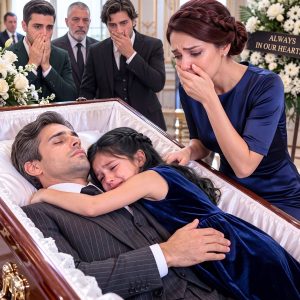
My eight-year-old daughter had been sitting beside her father’s casket for nearly seven hours when she finally said the words that changed everything. While relatives whispered that Chloe was in shock, she remained unusually calm, barely eating, barely drinking, and refusing to leave Mark’s side.
“Mommy, Daddy isn’t dead.”
The wake was being held at my mother-in-law Teresa’s house outside Chicago. Mark, my thirty-nine-year-old husband, had supposedly died that afternoon after suffering a sudden cardiac arrest during an inspection at one of the refrigerated warehouses owned by the logistics company he ran with his older brother Marcus.
Nothing about it made sense to me. Mark had been healthy, and only two days earlier he had warned me not to sign anything for Marcus if something strange happened at the company.
“If anything strange happens tomorrow, don’t sign a single thing for Marcus.”
When I asked what he meant, Mark only said he needed to verify something first. The next afternoon, Marcus called in a panic and told me Mark had collapsed at work, but by the time I reached the private clinic, my husband was already covered with a white sheet.
Dr. Salgado told me they had tried to revive him for nearly thirty minutes.
“I’m so sorry, Mrs. Vance. He didn’t respond.”
At the time, grief kept me from questioning anything. During the wake, however, Chloe’s behavior slowly pulled me out of that fog because my daughter was not crying, asking questions, or behaving the way she normally did when frightened.
She was watching.
At 11:20 that night, I asked her to come rest with me, but she refused. She kept staring closely at Mark’s face as though she were waiting for something.
“Daddy isn’t resting either.”
That answer sent a chill through me. I suddenly remembered that Marcus had insisted Mark be transferred quickly to a small funeral home run by someone he knew, claiming Mark had never wanted invasive procedures after death.
Then I noticed Mark’s watch.
A photograph I had taken at the clinic showed the watch reading 4:13 PM. Now, inside the casket, it showed 11:37 PM and was still ticking, which meant nobody had properly removed or prepared his belongings.
I leaned closer to Chloe.
“What did you see?”
She pointed beneath her own nose.
“Sometimes his nose moves just a little.”
Before I could respond, Marcus stepped behind me and sharply insisted Chloe needed to leave. His tone sounded less like grief and more like impatience, which immediately made me suspicious.
Then Chloe climbed directly into the casket before anyone could stop her. She curled against Mark’s chest and pressed her ear against his suit jacket while several relatives cried out in shock.
Marcus reached for her, but I pushed his arm away.
“Don’t touch her.”
Chloe looked up at me, pale but completely focused.
“Mommy, I felt two thumps.”
I pressed my fingers against Mark’s neck but felt nothing. Marcus exhaled in relief and called Chloe hysterical, but then she grabbed Mark’s hand and his index finger twitched twice.
I lowered my face over his nose and mouth and waited.
Then I felt it.
A tiny breath of warm air against my skin.
“Call 911!”
Marcus grabbed my arm, but I pulled away. As someone dialed emergency services, he backed toward the hallway with his phone in his hand.
Then Mark released a faint, raspy sound from deep in his throat.
Everyone turned toward the casket.
I turned toward Marcus’s glowing phone screen.
One message was visible.
He’s breathing. We have a problem.
Part 2: The Phone That Exposed the Plot
I snatched Marcus’s phone before he could lock the screen. He lunged toward me immediately, but I stepped back and held the device out of his reach.
“Who did you send that message to?”
“Give me the phone, Claire!”
I stared at him.
“Who is ‘we’?”
His face went pale, but he refused to answer. I shoved the phone into my purse just as emergency lights began flashing through the front windows and paramedics rushed into the house.
One medic climbed beside Mark and began checking his vitals while another cleared relatives away from the casket. Seconds later, the first medic looked up sharply.
“We have an extremely faint cardiac rhythm!”
Teresa screamed, and Marcus froze near the doorway. I heard him mutter under his breath.
“That’s impossible…”
Mark was rushed to Northwestern Memorial Hospital, and Chloe, Teresa, and I followed in an emergency vehicle. Marcus tried to climb into the front seat, but I stopped him before he could get inside.
“You’re not coming with us.”
At the hospital, the attending physician confirmed that Mark had a weak pulse, severe respiratory depression, and moderate hypothermia. None of those findings matched the simple cardiac-arrest story we had been given.
“We don’t know the full cause yet, Mrs. Vance, but your husband should never have been declared dead without a verified absence of brain and heart activity.”
This time, I refused to accept vague explanations. I demanded copies of his admission records, toxicology results, blood work, temperature readings, and every other document connected to his condition.