Part 1: The Scan My Husband Never Wanted Me to Take
My husband kept one hand against the small of my back as we entered St. Mercy Regional, and for the first time in twelve years of marriage, his touch made me uneasy. Trent had always built his reputation around being gentle and dependable, the kind of husband who remembered anniversaries, charmed nurses, and never raised his voice where anyone might hear.
Lately, however, something about his calmness frightened me. Whenever he touched me, some instinct I could not explain seemed to warn me that the man standing beside me knew more about my failing health than he was willing to say.
“You’re shaking.”
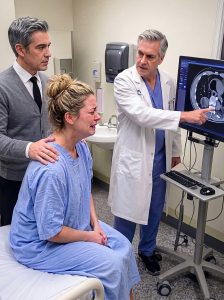
“I’m fine.”
“You’re not fine, Maren. That’s why we’re here.”
For almost a year, my body had been deteriorating without explanation. The exhaustion came first, followed by nausea, unexplained bruising, fainting spells, trembling hands, unstable blood pressure, weight loss, and a persistent ache along my left side.
Every doctor Trent took me to seemed to reach a similar conclusion. They blamed stress, hormones, anxiety, or grief over my mother’s death two years earlier, and Trent particularly loved that last explanation because it allowed him to explain almost anything I experienced.
My older brother Caleb never accepted it. As chief of surgery at St. Mercy, he became concerned after I collapsed in a grocery-store parking lot and learned that despite months of appointments, no one had ordered a complete abdominal CT.
“Has anyone done a full abdominal CT?”
“No.”
“Come to my hospital tomorrow.”
Trent pretended to support the idea, but I saw the tension immediately. His jaw tightened when I told him Caleb intended to supervise my testing, and later I caught him making a private phone call in the garage that ended the moment he noticed me nearby.
At the radiology desk the next morning, Trent tried to accompany me beyond check-in. When the receptionist explained that I would go back alone, he immediately told her I became nervous during medical procedures.
“I’ll stay with her.”
“For the CT, Mrs. Doyle will go back alone.”
“I’m okay.”
Trent looked at me with the patient expression he normally used when he wanted me to question myself.
“Honey.”
“I said I’m okay.”
The receptionist’s expression changed slightly, and she escorted me away before he could continue. As his hand slipped from my back, I realized how relieved I felt to put a locked hospital door between us.
The CT itself was strangely peaceful. I lay beneath the machine while the technician, Luis, explained each step, and for once I felt as though something was examining my body without already deciding what my symptoms were supposed to mean.
When the scan ended, however, Luis was different. He remained professional while helping me sit up, but the warmth had disappeared from his face.
“Is everything okay?”
“Dr. Whitaker is going to speak with you.”
“My brother?”
“Yes, ma’am.”
“Did you see something?”
“He’ll explain.”
I changed clothes with shaking fingers and stepped back into the hallway. Trent immediately rose from his chair, but before he could reach me, Caleb appeared at the opposite end of the corridor.
I barely recognized my brother’s expression. Caleb had been the calm one through our mother’s funeral and every family emergency I could remember, but now his face was pale and his eyes were fixed on me with unmistakable fear.
“Maren. Come with me.”
Trent moved between us.
“What’s going on?”
Caleb did not even look at him.
“I need to speak with my sister.”
“I’m her husband.”
“I know who you are.”
Trent laughed quietly and accused him of being dramatic. Caleb finally turned toward him, and whatever he saw in my brother’s expression erased the smile from his face.
“Sit down.”
Then Caleb led me away from radiology and into an administrative section of the hospital I had never visited before. He opened the door to the Director of Clinical Operations office, where a gray-haired woman in navy scrubs was already waiting for us.
“This is Dr. Helen Park, the hospital director.”
My heartbeat accelerated.
“Why is the hospital director here?”
Caleb closed the door behind me.
That was the moment I understood they had not brought me into that room simply because the scan showed I was sick.
They had brought me there because whatever was happening inside my body had made them afraid of the man waiting outside.
Part 2: What My Brother Saw in the Scan
Caleb waited until I sat down before taking the chair beside me. Dr. Helen Park remained near the desk, watching me with the careful expression people use when they already know the next sentence is going to divide your life into before and after.
“Maren, we found abnormalities on your scan.”
My hands tightened around each other.
“What kind of abnormalities?”
Caleb explained that the CT showed changes involving several organs that did not fit the explanations I had been given over the previous year. The pattern suggested prolonged exposure to something toxic, and he had already ordered additional laboratory testing because he did not believe the damage had developed naturally.
Dr. Park chose her words carefully.
“We are concerned that you may have been exposed to a toxic substance over an extended period of time.”
For several seconds, I could only stare at her. I had spent months wondering whether my body was failing because of some illness no doctor could identify, but the possibility that the cause had come from outside me felt even harder to understand.
“Are you saying this wasn’t an accident?”
Caleb looked at me.
“That is what we’re afraid of.”
The room became unbearably quiet. My thoughts immediately went to Trent because he controlled more of my daily life than anyone else, from the meals we ate to the supplements he reminded me to take whenever I complained of exhaustion.
I hated myself for thinking it.
Then I remembered his reaction when Caleb ordered the CT.
“Do you think Trent did this?”
Dr. Park did not answer the accusation directly. She explained that the hospital could not determine responsibility from a scan and that they needed toxicology results, a complete exposure history, and law enforcement involvement before anyone drew conclusions.
Caleb squeezed my hand.
“We don’t have every answer yet. But somebody needs to explain how this got into your system.”
The words made me think about the previous year in fragments that suddenly belonged together. Trent had accompanied me to almost every appointment, answered questions before I could, reminded doctors that I was grieving, and repeatedly insisted that anxiety made my symptoms worse whenever I tried to describe how frightened I was.
He had also taken over most of the cooking after my mother died. At the time, I had thought it was kindness.
Dr. Park asked whether I felt safe returning home with him.
I realized I could not say yes.
“I don’t know.”
That answer seemed to settle something for both of them.
Dr. Park explained that with my permission, the hospital would contact authorities and document everything they had found. Until they knew more, they wanted me to remain at St. Mercy where Trent could not control my food, medication, or access to medical information.
“What am I supposed to tell him?”
“You don’t have to tell him anything yet.”
Caleb’s voice became firmer.
“You are not leaving with him.”
For once, I did not argue.
Dr. Park asked whether there was anyone besides Caleb whom I trusted enough to call. My mind went immediately to Sarah, my closest friend, one of the few people Trent had never managed to convince that my illness was mostly emotional.
“I can call Sarah.”
“We’ll make sure she can come up.”
Caleb stood, but before opening the door he turned back toward me.
“There’s one more thing.”
My stomach tightened again.