Part 1: The Janitor They Underestimated
My name is Caleb Vance, and for seventeen years I worked nights cleaning the Livingston County courthouse in a small Colorado town. To everyone who passed me in those marble hallways, I was simply an aging janitor in worn boots and a faded work shirt, and that was exactly how I preferred it.
Before becoming a husband and father, I had lived a very different life. I spent nearly two decades serving in elite military units, leading dangerous operations overseas, but when I met Laura and our son Ethan was born, I walked away from that world and never looked back.
One night, while I was wringing out a mop, my phone suddenly vibrated. Laura never called during my shifts, so the instant I heard her crying on the other end, I knew something terrible had happened.
“Caleb… it’s Ethan.”
My grip went numb, and the mop slipped from my hands.
“What happened?”
“There’s been a shooting. Mercy General. Please, just hurry.”
I barely remembered the drive to the hospital. All I could think about was seventeen-year-old Ethan, the captain of his high-school basketball team, and whether I would arrive in time to see him alive.
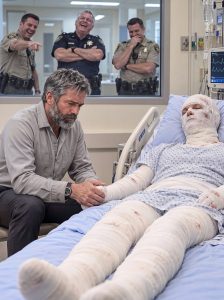
Laura was waiting outside Trauma Bay Three when I reached the emergency department, shaking so badly she could hardly stand. Through the glass, I saw our son lying on the bed with both legs heavily bandaged, his face drained of color from pain.
Then the trauma surgeon stepped into the hallway, and I immediately recognized him. Marcus and I had served together years earlier, and the hesitation on his face told me the situation was worse than I wanted to hear.
“How bad is it?”
Marcus explained that Ethan had suffered devastating injuries to both knees and would require several surgeries. Recovery could take months or longer, and nobody could yet promise how completely he would regain his mobility.
“Who did this?”
Marcus glanced down the hallway before answering quietly.
“Sheriff Vance.”
Everyone in Livingston County knew the sheriff. He was powerful, deeply connected, and accustomed to behaving as though his badge gave him authority over anyone who crossed his path.
I went into Ethan’s room and took his hand. His eyes opened slowly, and the moment he recognized me, tears began running down his face.
“Dad?”
“I’m here.”
“He shot me.”
I squeezed his fingers and tried to keep my voice steady.
“He laughed, Dad. He said I shouldn’t have looked at him wrong.”
Ethan stared toward his bandaged legs, fear overtaking the pain in his expression.
“Dad… I don’t think I’ll ever walk again.”
I leaned down, kissed his forehead, and promised him that we would deal with everything one step at a time. But as I stood beside that hospital bed, a part of myself I had buried seventeen years earlier began waking up again.
While Ethan underwent surgery several hours later, I sat alone in the hospital parking lot and opened a contact list I had not touched in nearly two decades. Sheriff Vance believed his position, connections, and reputation made him untouchable, but he had no idea who the gray-haired courthouse janitor had once been.
I found one number and pressed call.
The man answered after a single ring.
“Reaper?”
I looked up toward the hospital window where my son was fighting for his future.
“Get the team together.”
The silence on the other end lasted only a few seconds.
Then I knew they understood.
Part 2: The Gathering Shadow
Thirty-six hours after my call, four men from a life I had left behind arrived in Livingston County. They came separately, avoided attracting attention, and met me at an old storage warehouse outside town that I had quietly purchased years earlier.
They looked nothing like soldiers anymore. Faded jeans, canvas jackets, work boots, and baseball caps made them resemble truckers or laborers, but I knew exactly what each of them was capable of.
Jackson had once specialized in intelligence and surveillance. Miller was the man we trusted when an operation became physically dangerous, James had saved more than one life in the field, and Scythe had spent years watching targets from distances most people could barely imagine.
Jackson studied my gray hair and janitor’s clothes before speaking.
“We saw the news. They’re saying Ethan was involved in a suspected drug transaction and that the shooting happened during an altercation.”
My jaw tightened.
“He was coming home from basketball practice. Sheriff Vance stopped him at a gas station, accused him of having a broken taillight, and demanded his phone. When Ethan reached for his wallet, Vance dragged him out and shot him through both knees.”
The warehouse went silent.
James asked whether any video existed. I told them the sheriff’s department claimed the patrol camera had malfunctioned, while the gas station’s recording equipment had conveniently been destroyed in a fire shortly after deputies collected the footage.
The local prosecutor was already supporting Vance’s version of events. Worse, they were preparing to accuse Ethan of assaulting an officer while my son was still lying in a hospital bed.
“The system here isn’t failing,” I told them. “It’s doing exactly what Vance built it to do.”
Jackson had spent the previous night tracing the sheriff’s financial and professional network. What he had found suggested that Vance’s corruption extended far beyond one violent encounter with my son, involving suspicious money, protected associates, and years of abuse hidden beneath official authority.
“We found enough to bring federal attention if we can preserve the evidence,” Jackson said.
“I don’t want revenge,” I replied. “I want everything he buried brought into the light.”
Miller watched me carefully.
“That doesn’t sound like the Caleb we used to know.”
“That Caleb is gone.”
I meant it.
Seventeen years earlier, I had walked away from violence because I wanted Ethan to grow up with a father who came home every night. I had spent those years cleaning floors, packing school lunches, attending basketball games, and pretending the old instincts had disappeared.
They had not disappeared. They had simply gone quiet.
I opened an old storage compartment containing equipment from my former life, much of it untouched for years. The others understood immediately that I had kept those things not because I intended to return, but because a part of me had never completely trusted peace to last forever.