The metal bolt slid into place before my mother could get the back door open.
My stepfather had moved around her just quickly enough to reach it first, and now the three of us were standing in the same kitchen where, not long before, he had crushed two of my fingers in a drawer over a cookie.
I was nine years old.
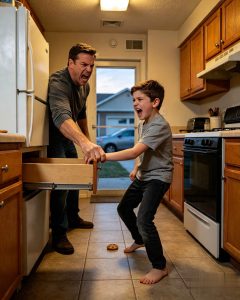
One sneaker was still only halfway on my foot.
My injured hand was pressed against my chest because letting it hang made the throbbing worse, and my mother was between me and him with the car keys locked inside her fist.
The strange thing is that when I remember that night, the deadbolt is not the first sound I hear.
I hear the drawer.
I had taken a cookie before dinner.
That was it.
No broken window. No screaming fit. No stolen money. No enormous childhood disaster that required an adult to regain control of a dangerous situation.
A cookie.
My stepfather saw it and decided I needed discipline.
He slammed my hand in the drawer.
The pain came so fast that for a moment I could not understand what had happened. Then two of my fingers began swelling, turning deep purple while he stood over me yelling about rules and obedience.
The cookie had fallen beside my bare feet.
I remember looking down at it while he talked.
That detail stayed with me because the cookie looked so ordinary.
It had not changed.
My hand had.
He kept talking as though the real problem in the kitchen was what I had done, as though the drawer and my fingers were simply consequences I had arranged for myself by wanting something sweet before dinner.
I did not argue with him.
At nine, I already understood something children should never have to learn: when an adult is determined to explain your pain as your own fault, the argument can become another punishment.
So I waited.
When he turned away, I used my foot to kick the cookie underneath the refrigerator.
There was blood near it.
I knew my mother would eventually come home, and I knew she would see things adults usually noticed when they were cleaning or putting groceries away.
I did not have a plan beyond that.
I was not building a case.
I was nine.
I only knew he might clean my hand, or tell me to wash it, or invent a story before she arrived.
But I did not think he would bother looking under the refrigerator for the cookie.
So I put it where I hoped she would find it.
Then I sat at the kitchen table for the next twenty minutes with my injured hand tucked between my knees.
The refrigerator hummed behind me.
Every time my stepfather crossed the room, the floorboards felt cold under my bare feet, and I stared down at the table rather than risk giving him another reason to start.
He told me twice to stop sulking.
I said nothing.
That silence would become important later because he used it the way he used everything else.
My pain became attitude.
My fear became defiance.
My refusal to speak became evidence that his version of the evening must be the reasonable one.
When Mom finally came in, he reached her with the story before I could reach her with the truth.
He told her I had been sneaking food again.
He said I had thrown a tantrum when he corrected me.
What I remember most was his tone.
He did not sound furious anymore.
He sounded tired.
Almost amused.
He made himself sound like the patient adult who had been forced to deal with an exhausting child.
Mom set down her bag and looked at me.
I kept my injured hand hidden.
That part can seem strange when I think about it now.
I had deliberately left a clue for her, yet when she was finally standing in the kitchen, I still could not simply hold up my hand and say what he had done.
Fear does not always disappear because the safer person walks into the room.
Sometimes fear has already taught you to wait and see which version of reality the adults are going to accept.
Mom asked what happened.
He answered for me.
“He caught his hand in the drawer.”
I looked at him.
He looked at Mom.
He kept explaining.
He kept adding details.
He kept turning my silence into something that seemed to support him.
And for a few seconds, I could feel the danger of his story becoming the official one.
Then Mom bent down near the refrigerator.
She picked up the cookie.
There was a dark smear beside it.
She remained crouched for a moment.
Then she looked beneath the table at my bare feet.
Her eyes moved back to the cookie.
Then to me.
Then, finally, toward the hand I was trying so hard to hide.
“Show me.”
My stepfather sighed.
“It looks worse than it is.”
Mom did not answer him.
That was the first change in the room.
Until then, he had controlled every explanation.
He had decided what the injury meant, why it had happened, how serious it was, and what I was supposedly feeling.
Mom did not challenge all of that with a speech.
She simply stopped treating his interpretation as necessary.
I slowly brought my hand up and placed it on the table.
Two fingers were swollen and deep purple.
Trying to straighten them hurt badly enough that I stopped almost immediately.
Mom’s mouth tightened.
She still did not yell.
“Which drawer?” she asked.
My stepfather pointed toward the counter.
“That one. He yanked it shut on himself.”
The explanation was ready.
That frightened me almost as much as his anger had.
A person yelling can look out of control.
A person calmly explaining why you caused your own injury can sound believable.
Mom looked at me.
“Did you?”
I shook my head.
My stepfather stepped closer.
“Don’t start encouraging him to lie.”
That sentence changed something inside me.
I could feel the story moving again.
If Mom asked another question, he could call it coaching.
If I answered, he could call it lying.
If I cried, he could call it a tantrum.
If I stayed quiet, he could point to my silence.
At nine years old, I did not have language for that kind of trap.
I only knew that every possible reaction seemed to belong to him before I made it.
Then Mom touched the edge of the cookie with one finger.
“Why was this under the refrigerator?”
My throat tightened.
I had imagined her finding it.
I had not imagined having to explain why I had put it there.
I had not rehearsed anything.
There had been no clever plan, only a frightened child realizing that an object might survive the evening more reliably than his own words.
So I gave her the smallest truth I could manage.
“I kicked it there for you.”
Her eyes came back to mine.
“For me?”
I nodded.
“So you’d know where it happened.”
My stepfather laughed once.
Short. Dismissive.
“Listen to this. Now he’s making up clues?”
Mom did not look at him.
Instead, she asked me another question.
“Did he close the drawer on your hand by accident?”
“No.”
“Did he know your hand was there?”
“Yes.”