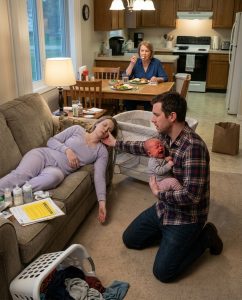
I returned home far earlier than planned and discovered my wife barely responsive on the couch while my mother sat only a few feet away, quietly eating the meal she had forced her to cook.
Our newborn baby was screaming for attention, but Mom did not even attempt to comfort him.
When she looked toward Clara’s motionless body and casually called her a “drama queen,” I finally accepted something I had refused to see for most of my life: the woman who had raised me was capable of terrifying heartlessness.
What I did next wiped the smug expression from her face.
I heard my son crying before my key even reached the lock.
It was not the ordinary restless crying of a newborn who wanted another ounce of formula or needed a diaper changed.
His screams came straight through the front door—sharp, urgent, panicked, and impossible to dismiss.
My hand stopped against the lock for half a second, and every muscle in my body tightened before I even knew what was waiting on the other side.
I pushed the door open and stepped inside.
The first thing that hit me was the smell.
Warm baby formula hung in the air with burned rice and vegetables that had been left cooking too long, creating the strange mixture of a house where someone had been trying to keep up with ordinary chores while something was going very wrong.
The kitchen lights were glaringly bright.
A laundry basket had been knocked over in the living room, leaving clothes scattered near the couch.
A paper grocery bag sagged close to the back entrance, its damp bottom slowly weakening beneath whatever had been packed inside.
Nothing about the room looked dramatic in the way my mother would later try to describe it.
It looked unfinished.
It looked like somebody had run out of strength in the middle of trying to do too much.
Then I saw the baby bottles.
They were sitting beside Clara’s hospital discharge papers from two days earlier.
The bright yellow warning sheet was still on top where neither of us could have missed it.
I knew that sheet because I had read it more than once after we brought Clara home.
The instructions were simple enough that there was no room for interpretation.
Seek urgent medical help for dizziness, confusion, fever, severe weakness, or difficulty staying conscious.
Two days earlier, those symptoms had been printed warnings on a piece of paper.
Now I was looking at my wife.
Clara was stretched across the couch, almost completely colorless.
One arm hung over the edge of the cushion, her hand loose, her fingers suspended only inches above the carpet.
She was not sleeping the way exhausted new parents sometimes collapse for twenty minutes between feedings.
There was no peacefulness in her posture.
There was no sense that she had chosen to lie down and rest.
She looked as if her body had simply stopped cooperating with her.
Beside the couch, our newborn son screamed from his bassinet.
His little face was bright red from crying, and his hands opened and closed again and again as though he were searching for the person who normally appeared when he needed something.
Every sound coming out of him seemed to make the rest of the room harder to understand.
Then I saw my mother.
She was sitting at the dining table only a few feet away.
Eating.
There was roasted chicken on her plate, rice beside it, vegetables arranged neatly along the edge.
A full dinner.
Not takeout.
Not something reheated from the refrigerator.
Someone had prepared all of it from scratch.
That detail would have seemed ordinary in almost any other house on almost any other evening.
In that room, with Clara barely responsive on the couch and our newborn screaming beside her, it was horrifying.
That morning, Clara had told me she could barely remain on her feet long enough to make toast.
She had been home from the hospital for only forty-eight hours and was still recovering from giving birth.
We both knew she was weak.
We both knew she needed rest.
And anyone who had looked at the yellow discharge sheet beside those bottles knew exactly which symptoms were not supposed to be brushed aside.
My mother lifted another forkful of food toward her mouth.
She glanced in Clara’s direction with the irritated expression of someone being inconvenienced by a performance she had already decided not to believe.
Then she muttered, “Such a drama queen.”
Something inside me went completely still.
I had imagined moments of anger differently my entire life.
I always thought the breaking point would feel hot.