For the next six hours, Nola Vance forgot entirely that Garrick Hale had rejected her.
There was no room for wounded pride beside a feverish child.
She sent Eli downstairs for every clean cloth he could find and put Clara to work carrying small cups of water from the kitchen. The little girl took the responsibility with grave importance, her bare feet pattering along the hallway while she held each cup with both hands.
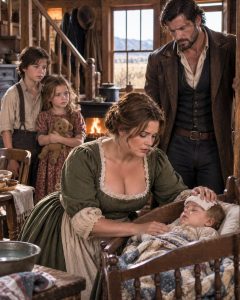
Weston fought the water at first.
His tiny mouth turned away from the spoon, his cheeks flushed crimson beneath damp curls.
“Easy,” Nola murmured.
She slipped one arm beneath him and lifted him against her shoulder.
The baby felt frighteningly light.
“That’s it. You don’t have to like me. Just swallow.”
Eli watched from the foot of the bed.
“Pa tried giving him milk.”
“I know.”
“Did he do it wrong?”
Nola glanced at the boy.
He asked the question carefully, as though criticizing Garrick might somehow be dangerous.
“No,” she said. “Your father did what he knew.”
“But it wasn’t enough.”
Nola wrung out another cloth and placed it across Weston’s forehead.
“Sometimes what we know isn’t enough.”
Eli’s eyes dropped.
Something about the expression was far too old for a ten-year-old child.
Nola noticed.
She noticed most things.
That had once been an advantage.
Sometimes it was a burden.
“Your mother taught you to care for him?” she asked.
Eli nodded.
“She said I was her dependable one.”
The pride in his voice lasted only a moment.
Then came the guilt.
“I should’ve known he was getting worse.”
Nola stopped what she was doing.
“Look at me.”
Eli did.
“You are ten years old.”
His jaw tightened.
“I know.”
“No, I don’t think you do. Ten-year-old boys are supposed to forget chores and tear their trousers and track mud across clean floors. They are not supposed to know how to nurse sick babies.”
His eyes flickered toward Weston.
“Mama needed me.”
“I’m sure she did.”
“And Pa needs me now.”
“That doesn’t mean everything is your responsibility.”
Eli looked almost offended by the suggestion.
“Somebody has to do it.”
Nola recognized those words too.
She had lived half her life beneath them.
Somebody has to do it.
Someone had to keep the accounts.
Someone had to sit beside the sickbed.
Someone had to bury the dead.
Someone had to keep moving afterward.
People rarely noticed how those four words could become a prison.
Nola softened her voice.
“Well, tonight that somebody is me. So go downstairs and eat something.”
“I’m not hungry.”
“I didn’t ask.”
For the first time, the corner of Eli’s mouth moved.
Not quite a smile.
But close.
He went.
By midnight Weston’s fever had begun to lower.
Not enough to satisfy Nola, but enough that his breathing no longer frightened her with every shallow pause.
She sat beside the cradle under the dim flame of an oil lamp, listening to the old house settle around her.
Wind brushed the walls.
Somewhere downstairs, a door creaked.
Nola had nearly convinced herself Garrick was still outside with the cattle when she heard heavy footsteps on the staircase.
He entered without speaking.
Dust covered his boots and trousers. His shirt was dark with sweat beneath the arms, and his face looked sharper than it had at sunset.
But his first glance went to the cradle.
“How is he?”
“Better.”
Garrick released a breath.
Only then did Nola realize he had probably been holding it from the moment he entered the house.
“He drank water,” she said. “The fever’s breaking, but I want to watch him through the night.”
Garrick crossed the room.
He touched the back of two fingers against Weston’s cheek.
His expression changed.
Barely.
A small loosening around the eyes.
“He feels cooler.”
“He is.”
Garrick remained beside the cradle.
For a moment neither spoke.
Then he said, “Thank you.”
Nola looked at him.
The words seemed difficult for him.
“That wasn’t so painful, was it?”
He almost smiled.
Almost.
“I suppose I deserved that.”
“You deserved worse.”
“That I believe.”
Nola leaned back in the chair.
Her shoulders ached.
“You should sleep.”
“I’ve got fence posts to reset at first light.”
“Then you should especially sleep.”
Garrick looked at the sleeping baby.
“I’ll sit with him.”
“No.”
His eyes shifted toward her.
“You’ve been traveling three days.”
“And you’ve apparently been trying to run a ranch without sleeping since February.”
His jaw hardened.
Nola immediately understood she had stepped too close to something.
“I manage,” he said.
“So you keep saying.”
“I do.”
Nola looked around the neglected bedroom, then toward the pile of unwashed clothes, the empty water pitcher and the exhausted child sleeping in the cradle.
“Mr. Hale, there are many words for what’s happening in this house. Managing is not one of them.”
His face closed.
Nola regretted the sentence almost immediately.
Not because it was false.
Because truth could still be cruel when delivered carelessly.
Garrick turned toward the doorway.
“I’ll bring more wood.”
“That isn’t necessary.”
“I said I’ll bring it.”
He left.
Nola rubbed her forehead.
“You have a gift,” she muttered to herself, “for making friends.”
Weston made a small sound in his sleep.
Nola looked down.
“You keep your opinions to yourself.”
The baby slept on.
A few minutes later Garrick returned carrying enough firewood to heat the room for three winters.
He stacked it silently beside the stove.
Nola pretended not to notice.
Then he stopped at the doorway.
“You can stay.”
She raised an eyebrow.
“I thought I already was.”
“I mean after tonight.”
His gaze remained on the floor.
“Thirty dollars a month. Like the agency promised. If you still want the work.”
Nola studied him.
“You were ready to send me back before I crossed the porch.”
“I was wrong.”
“That quickly?”
Garrick finally looked at her.
“My son was burning alive in that bed and I didn’t know what to do.”
Something raw entered his voice.
“You did.”
Nola’s irritation faded.
He continued.
“I don’t expect you to forget how I spoke to you.”
“I won’t.”
Another almost-smile.
“No. I suppose not.”
“But I’ll stay.”
His shoulders loosened.
“For now,” she added.
There it was again—the guarded look.
“As long as you need?”
“As long as I choose.”
Garrick considered that.
Then nodded.
“Fair enough.”
He disappeared downstairs.
Nola remained awake until dawn.
And when the first pale stripe of morning appeared beyond the window, Weston opened his eyes.
He stared at her solemnly.
Then sneezed.
Nola laughed.
It surprised her so much she nearly cried.
—
By breakfast, the Hale household had undergone a transformation nobody had authorized.
Nola found flour in a tin, eggs beneath an indignant hen behind the barn, and a strip of bacon Garrick claimed they had been saving.
“For what?” she asked.
“Later.”
“It is later.”
He stared at her.
She stared back.
The bacon went into the pan.
Clara climbed onto a chair and watched biscuits rise inside the oven as though witnessing a miracle.
Eli sat at the table with his hair sticking in five different directions.
Garrick entered from outside, carrying Weston.
That image stopped Nola for half a second.
The rancher held the baby awkwardly but carefully, one broad hand supporting the child’s back.
Weston had slept through most of the morning and was now awake enough to inspect his father’s shirt buttons.
“His fever?”
“Gone,” Garrick said.
Nola crossed the room and touched the baby’s forehead.
Cool.
She allowed herself a breath of relief.
“Keep giving him water today.”
Garrick nodded.
Clara suddenly announced, “Papa doesn’t know how.”
Garrick looked wounded.
“I know how.”
“You spilled it on him.”
“That happened once.”
“Twice.”
Eli smirked into his plate.
Garrick gave his eldest son a warning glance.
It was the first ordinary family moment Nola had seen since arriving.
So ordinary that it hurt.
She turned quickly back to the stove.
“Breakfast.”
They ate like people who had forgotten meals could involve conversation.
At first, only Clara spoke.
She told Nola the names of the chickens.
Apparently none had sensible names.
The large red hen was Duchess.
A thin gray bird was Reverend.
One particularly hostile rooster was called Mr. Buttons.
“Why Mr. Buttons?” Nola asked.
Clara shrugged.
“He looks like one.”
Nola accepted this explanation.
Halfway through breakfast, Garrick reached for another biscuit.
His hand stopped.
He looked at Nola.
“Is there enough?”
The question was quiet.
Nola understood immediately.
Food was scarce.
Perhaps scarcer than he wanted the children to know.
“There will be,” she said.
His gaze held hers briefly.
He took half a biscuit instead.
Afterward Nola began inspecting the house.
The results were discouraging.
There were potatoes enough for two weeks if used carefully, beans for perhaps a month, a little cornmeal, some flour, six jars of preserved peaches, three jars of green beans, and a crock of something Nola decided had ceased being recognizable as food.
The smokehouse contained almost nothing.
The garden had been neglected.
The root cellar smelled damp.
The pantry shelves held a disturbing number of empty spaces.
Garrick found her standing inside it.
“What are you doing?”
“Counting.”
“What?”
“Everything.”
“I know what’s in there.”
Nola turned.
“Do you?”
His expression said he disliked the question.
She held up the flour tin.
“You’ll need more before the end of the month.”
“We’ll buy some.”
“With what?”
Silence.
Nola put down the tin.
“How bad is it?”
“The ranch?”
“The money.”
Garrick leaned against the pantry door.
“Manageable.”
Nola folded her arms.
“You’ve ruined that word for me.”
He rubbed the back of his neck.
“We had a hard winter.”
“So did everyone.”
“Lost cattle.”
“How many?”
“Enough.”
Nola waited.
Garrick sighed.
“Thirty-seven.”
Her expression changed.
Thirty-seven cattle was not a bad winter.
Thirty-seven was disaster.
“Disease?”
“No.”
“Storm?”
“Some.”
“Then what happened to the rest?”
His gaze shifted toward the kitchen window.
“I don’t know.”
Nola heard something in those words.
Not uncertainty.
Avoidance.
“Cattle don’t usually vanish, Mr. Hale.”
“They didn’t vanish.”
“Then?”
“Some broke fences. Some wandered. Some were found dead.”
“From what?”
“I said I don’t know.”
The sharpness returned.
Nola let the silence sit between them.
Garrick looked immediately ashamed.
“I’m sorry.”
“You do that strangely well.”
“What?”
“Apologize after being rude.”
His mouth twitched.