He had barely opened the thread when a fresh text from his mother slid into view at the bottom.
His thumb stopped above the screen.
A moment earlier, he had been insisting that the first message was being misunderstood. He had grabbed his phone quickly, unlocked it, and opened the conversation as though scrolling backward would prove that everyone else in the exam room had gotten the wrong idea.
Then another message arrived.
The pediatrician was still there. I was still there. Our eight-year-old daughter was still beside me, wrapped in the same blanket she had been using to hide what had happened to her hair.
And my husband was holding the phone.
That mattered.
Because this had never really been about whether a haircut could grow back.
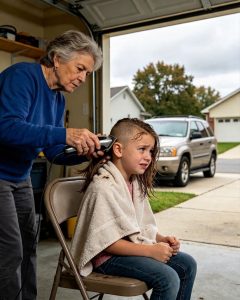
It had started the day before, when my mother-in-law decided our daughter had taken too long brushing her hair before school. She did not shorten it. She did not trim a difficult section. She shaved her head.
When I picked my daughter up afterward, she would not look into a mirror.
She would not talk.
She kept a blanket pulled over her head even though the house was warm, as if hiding under fabric was easier than letting anyone see what had been done to her.
I expected my husband to see that and understand why I was alarmed.
Instead, he looked at the situation as if I were creating the problem by reacting to it.
“Hair grows back. Stop making this bigger than it is,” he told me.
I had argued at first.
Then I stopped.
There are moments when continuing an argument only gives the other person more chances to shrink what happened into something easier to dismiss. My daughter was sitting there under a blanket, refusing to look at herself. I did not need another debate about whether I was being dramatic.
I needed someone to look at her.
So the next morning, I took her to her pediatrician.
The appointment changed almost immediately.
The pediatrician examined my daughter’s scalp. Then she noticed something else: the way my daughter reacted when her grandmother’s name came up.
She flinched.
The pediatrician did not make a speech about it. She did not announce a conclusion. She simply pulled her stool closer to the exam table and asked my daughter if she wanted me to stay beside her.
My daughter nodded.
The blanket stayed on.
That small choice set the tone for everything that followed. The pediatrician did not demand eye contact. She did not push my daughter to tell the story quickly. She asked plain questions and allowed the answers to come at the pace an eight-year-old could manage.
Who had been there?
What happened before the clippers came out?
Had anyone told her that she could get up and leave the chair?
At first, my daughter did not answer with words.
She squeezed my fingers.
That was enough to tell me she was listening.
The pediatrician waited.
Eventually, my daughter whispered that Grandma had said she was making everyone late.
The pediatrician wrote it down.
Then my daughter explained what came next. Her grandmother had told her that if she wanted to act like a baby about her hair, then she did not need long hair.
Another note went onto the page.
My stomach tightened.
I wanted to speak. I wanted to tell the pediatrician what I thought those words meant. I wanted to explain how my daughter had behaved when I picked her up and how my husband had dismissed everything when we got home.
But I kept quiet.
This part belonged to my daughter.
She needed to answer without me filling in the spaces.
Then the pediatrician asked whether anyone else had heard Grandma threaten to cut her hair before that morning.
For the first time, my daughter looked up.
“Dad did,” she said.
I thought I had heard her wrong.
She repeated it.
“Dad did.”
Those two words rearranged the entire story for me.
Until then, I had believed my husband had encountered the aftermath. I thought he had seen his daughter upset, decided his mother had made one bad decision, and reacted by minimizing it.
That would have been painful enough.
But my daughter described something earlier.
According to her, the night before the haircut, Grandma had complained that brushing her hair took too long. She said that if it happened again, she would “take care of the hair problem herself.”
My daughter had been close enough to hear my husband’s response.
The pediatrician asked what he had said.
My daughter pulled the blanket more tightly around herself.
Then she answered.
“He said, ‘Good.’”
One word.
That was all.
But it meant my husband’s later defense of his mother could no longer be separated from what he had apparently heard the night before.
He had known she was angry about the hair.
He had heard the threat.
And when our daughter came home unable to face a mirror, he still told me I was making too much of it.
I did not know yet what he would admit. I did not know whether he would claim he had misunderstood his mother’s words. I only knew what our daughter had just told the pediatrician.
The pediatrician kept documenting.
I sent my husband a single text telling him that we were still at the pediatrician’s office.
His phone calls started almost immediately.
I did not pick up.
He called again.
Then again.
About twenty minutes later, his voice carried down the hallway outside the exam room.
He had come in person.
When he entered, he was carrying our daughter’s school backpack in one hand. Frustration was already written across his face.
His first question was not whether she was okay.
It was why I had brought her there “over a haircut.”
The pediatrician did not argue about the wording.
She had the reporting forms beside her, and she asked him directly whether he had heard his mother threaten to cut our daughter’s hair the previous night.
He looked at me instead of answering her.