The deadbolt clicked before I had a chance to respond. The front door started moving inward.
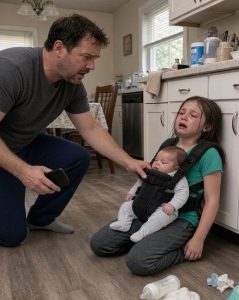
I stood up with Miles against my chest and the second phone in my hand, while Tessa stayed curled against the kitchen cabinets with a glass of water beside her.
Their mother stepped inside and stopped when she saw me.
She had no grocery bags.
That detail hit harder than it should have, because less than a minute earlier Tessa had told me exactly what she had been instructed to say if I came home early: Mom went to get groceries.
Her eyes moved from me to Miles, then to Tessa.
Then she saw the phone.
She froze.
Not confused. Not curious. Not even surprised that I was home.
She knew exactly what I was holding.
“Grant,” she said quietly. “Why do you have that?”
I had expected denial first.
Instead, she asked why I had found the thing she had hidden.
“Tessa showed me where it was.”
Her face tightened.
“Tessa, I told you never to touch that.”
“Don’t,” I said.
My voice came out sharper than I intended, and Miles startled against me.
I lowered it immediately.
“She is nine years old. She is exhausted. She has been alone with an eight-month-old baby since before lunch. You are not making this her problem.”
Their mother looked at Tessa again.
Tessa pulled her knees closer to herself.
That was enough for me.
I carried Miles into the living room, settled him against my shoulder, and told Tessa she could sit on the couch where I could still see her from the kitchen.
“You don’t have to explain anything else right now,” I told her. “You don’t have to listen to anything either.”
She nodded and climbed onto the couch without arguing, which somehow made me feel worse.
Tessa was normally the kid who negotiated everything from bedtime to how many strawberries counted as a serving.
That afternoon she looked too tired to negotiate where she sat.
I went back to the kitchen.
Their mother was standing near the counter with both hands pressed flat against it.
“It isn’t what you think,” she said.
I looked at the hidden phone.
“I haven’t told you what I think.”
“Grant—”
“Who is R?”
She didn’t answer.
The phone buzzed again.
Neither of us touched it at first.
Then the screen lit up with another preview.
R: “Are you coming back?”
A second message arrived under it.
R: “You said he wouldn’t be there until tonight.”
Their mother reached for the phone.
I moved it back, not dramatically, just far enough that she stopped.
“This belongs to me,” she said.
“Maybe it does. But those messages mention me. They mention Tessa. They mention leaving my kids here.”
She rubbed her forehead.
“I needed a break.”
I stared at her.
Of all the things I expected, that wasn’t one of them.
“A break?”
“I have been overwhelmed. Miles barely sleeps. Everything has been nonstop. I was supposed to be gone a few minutes.”
“Seventeen.”
She looked at me.
“What?”
“You told Tessa seventeen minutes. Not a few minutes. Seventeen.”
Her mouth opened, then closed.
I continued before she could reshape it.
“And you left before lunch.”
“I lost track of time.”
“You told our nine-year-old not to call me.”
“I told her to call if something was wrong.”
“Something was wrong the second an elementary-school kid became responsible for an infant without another adult in the house.”
She flinched at that, but I wasn’t trying to win an argument.
I was trying to understand how a person could walk out the door, keep walking, and somehow make a child believe the dangerous part was disappointing her mother.
She said she had only meant for Tessa to sit with Miles while he napped.
She said she had expected to be back quickly.
She said Miles had been fed.
She said Tessa was responsible for her age.
She said a lot of things that afternoon.
None of them changed the kitchen floor.
None of them changed Tessa’s shaking hands.
None of them changed the fact that my daughter had whispered, “Dad, I can’t hold the baby anymore,” because she thought making that call might get her in trouble.
I set the hidden phone on the counter between us.
“Unlock it.”
She stared at me.
“No.”
“Then don’t.”
That caught her off guard.
I wasn’t going to wrestle a phone away from her or turn the kitchen into something the kids would remember for the rest of their lives.
“But don’t stand here and tell me this was one mistake if you’re not willing to show me the one thing that could settle that.”
She looked toward the living room.
Tessa was leaning sideways on the couch, watching Miles chew on the edge of his soft bib while I held him.
Their mother whispered, “Can we talk about this later?”
“We can talk about us later. We are talking about the kids now.”
That distinction mattered to me.
I could survive finding out someone had lied to me.
What I couldn’t accept was discovering that my daughter had been recruited into maintaining the lie.
The hidden phone buzzed again.
This time their mother grabbed it before I could even look at the preview.
She held it against her chest.
“Please don’t do this in front of Tessa.”
“I agree.”
I nodded toward the hallway.
“So we’re not.”
I took Miles to the couch and sat beside Tessa while their mother went into the bedroom.
For the next several minutes, I did nothing except take care of the two people who should have been taken care of all day.
I warmed Miles’s food.
I brought Tessa something easy to eat.
I found the blanket she liked and put it over her legs.
I answered her when she asked whether she was in trouble.
“No.”
“Is Mom in trouble?”
I chose my words carefully.
“The adults are going to handle the adult part.”
She looked toward the hallway.
“Are you mad at me for showing you the phone?”
“Not even a little.”
“Mom’s going to be.”
There it was.