I Left Home at 15 After My Brother Hurt Me Years Later, My Parents Begged Me to Protect Him
I fled home at fifteen with a kitchen towel pressed against my ribs and blood soaking through the little yellow flowers printed on it.
My brother had slashed me with a broken beer bottle because I locked my bedroom door.
That was all. That was the entire reason.
He wanted my old laptop, the one I used for school. When I said no, he kicked the door until the frame cracked and the strike plate came off the wood. I ran for the hallway phone and he caught me near the top of the stairs.
The glass went in hot, and then it went cold.
My mother stood in the living room with one hand over her mouth and did not move.
My father looked down at the blood on the carpet and said, “You always push him too far, Mara.”
That sentence has stayed louder in me than my own screaming.
I left before sunrise.
I took forty-two dollars out of the junk drawer. I wrapped my side in duct tape and gauze from the bathroom cabinet, because I was fifteen and had no better idea, and I walked six miles to the Greyhound station in Dayton in the dark.
I changed my name from Mara Whitmore to Mara Bell on the first job application I ever filled out.
Legally I stayed the girl my family blamed for everything Caleb broke. But on paper, at a diner counter in another town, I got to be somebody else.
Twelve years went by.
I became a surgical intake coordinator at St. Anne’s Medical Center in Columbus. I rented a quiet apartment with plants in the windows and three locks on the door.
I told people my family was complicated, which was true the same way a house fire is warm.
Then my parents found me.
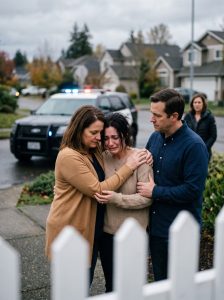
They turned up in the hospital parking garage on a Thursday evening. Older and smaller than I remembered them, which is the thing nobody warns you about.
My mother wore her pearls. My father held his hat in both hands.
“Mara,” he said. Like he had the right.
I almost walked straight past them.
My mother stepped into my path.
“It’s Caleb.”
The scar under my blouse tightened the way it does in cold weather.
“What did he do?”
Neither of them answered right away. My father looked at the concrete. Then he lowered his voice.
“A woman is missing. Her name is Elise Porter. Caleb was seeing her.”
My mother’s eyes were glassy. Not from grief.
From fear.
“He came to us last night,” she whispered. “There was blood in his truck.”
The parking garage tilted around me.
My father reached out and put a hand on my arm.
“He says it was an accident. He just needs some time.”
“No.”
“Mara. Please.” His grip tightened. “If anyone asks, you tell them he was with you Tuesday night.”
I stared at them both.
“You want me to lie to police.”
And my mother’s face hardened into the woman from the living room. Twelve years and it came back in half a second.
“You owe this family.”
The next morning, two detectives knocked on my apartment door.
One of them held up a badge.
“Mara Whitmore?”
Nobody had called me that in twelve years.
Detective Nora Quinn was the one who noticed my hand shaking on the doorframe.
Her partner, Detective Luis Ortega, didn’t say anything at first. He stood half a step behind her, and his eyes moved over my apartment with a kind of careful patience.
The deadbolt. The chain. The chair angled under the knob, even though I live on the third floor.
I saw him see all three, and I saw him decide not to comment.
“We’d like to ask you some questions about Caleb Whitmore,” Quinn said.
I let them in, because refusing was only going to delay it.
They sat on my gray couch. I sat across from them with my hands folded so tightly my knuckles burned.
Quinn opened a small notebook.
“When was the last time you saw your brother?”
“Yesterday,” I said.
Both of them looked up at once.
“In the parking garage at St. Anne’s. Not him. My parents.”
Ortega leaned forward. “What did they want?”
For one second I saw my father’s hat twisting in his hands. My mother’s pearls. Her mouth shaping the old verdict.
You owe this family.
“They asked me to give Caleb an alibi.”
Quinn’s pen stopped moving on the page.
I told them everything.
Not dramatically. Not through tears. I have spent twelve years learning how to report my own pain like it belongs to somebody else, which turns out to be a useful skill in exactly one situation and this was it.
I told them Caleb had been dating Elise Porter. That my parents said she was missing. That he’d come to their house with blood in his truck. That they wanted me to say he’d been with me Tuesday.
Then I stood up, went to the hall closet, and brought back a plastic storage box.
Inside were things I had planned to burn about nine separate times.
Hospital discharge papers from when I was fifteen. A blurred photograph of the stitches along my ribcage, taken by a nurse who asked if I wanted a copy and then, when I said yes, printed two. A school counselor’s handwritten notes. And three voicemails I’d saved off an old phone years later.
Quinn picked up the photograph first.
“That scar,” she said, careful. “Caleb did this?”
“Yes.”
“And your parents reported it?”
I almost laughed.
“They reported me missing after I ran away. They never reported what he did to me.”
Ortega’s jaw moved once.
I played the voicemails.
My mother’s voice came out into that apartment, sweet and cold.
You know how Caleb gets when people betray him.
The next one.
Your father and I cannot survive another scandal.
And the last one, recorded two years after I left home, when I was seventeen and living in a rooming house and had finally answered.
You were always so dramatic, Mara. He barely touched you.
Detective Quinn asked me to email copies of everything.
I did it right there while they sat on my couch.
Then she showed me a photograph.
Elise Porter. Twenty-nine years old. Dark curly hair. A bright, slightly crooked smile. A real estate agent out of Cincinnati.