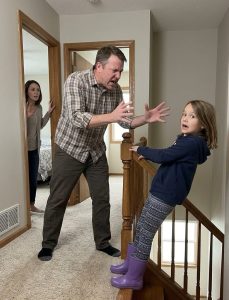
My seven-year-old daughter found my husband and my sister in my bed, and he threw her down the stairs to keep her quiet. When the hospital called, my baby whispered, “Mom, I’m sorry,” then told me they were still home drinking whiskey—because the town’s perfect father and her favorite aunt thought I would shatter before I fought back.
The call came while I was stitching a border collie’s shoulder.
The treatment room smelled like antiseptic, wet fur, and that faint copper edge that always clings to fresh blood. My hands were steady around the needle. The dog’s breathing had finally slowed, and my assistant was keeping gentle pressure where I needed it.
Then my phone lit up on the stainless-steel counter.
County General Hospital.
I stared at the screen for less than a second, but something inside me went completely quiet before I answered.
“This is Victoria Hawthorne.”
The woman on the other end spoke with the careful tone people use when they are trying not to frighten you before they know whether you can handle being frightened.
“Mrs. Hawthorne, you need to come to the emergency room immediately. It’s your daughter.”
Meadow.
Seven years old. Missing one front tooth. Purple rain boots in every season if I let her get away with it. A stuffed triceratops named General Pickles tucked beside her every night like he was responsible for guarding the entire house.
For one strange second, all of those ordinary details crowded out everything else.
Then the words emergency room reached me.
I don’t remember pulling off my gloves. I remember the sharp snap of latex against my wrist. I remember my assistant looking at my face and immediately stopping whatever she had been about to say.
“Cancel the rest of the day,” I told her.
She nodded.
I was already moving.
The drive to the hospital blurred around me, but my training did what it had always done. I didn’t let panic take the wheel. I stayed inside the lane. I watched intersections. I kept both hands where they belonged. I did not allow myself to imagine what the woman on the phone had refused to explain.
Not yet.
For twenty years, the military had taught me how dangerous uncontrolled fear could become. Three tours had taught me that the person who could keep thinking when everything around them turned chaotic was often the person other people depended on.
There was a Bronze Star sitting in a box in my closet at home.
I almost never talked about it.
In our small Nebraska town, I was not Victoria Hawthorne, veteran, medal recipient, or anything else that sounded impressive on paper.
I was Doc Tori.
People called me when a mare went into trouble after midnight, when a calf stopped eating, when the family dog tore itself open on old fencing, or when somebody’s barn cat disappeared for three days and came home limping.
They knew I could look at blood without flinching.
They knew I could make hard decisions without making a show of them.
They did not know what that kind of calm had cost me to learn.
None of it mattered when I walked into the emergency department and said my daughter’s name.
The receptionist looked at her screen, then back at me.
Her expression changed.
That frightened me more than shouting would have.
A nurse approached holding a clipboard against her chest. She was professional, composed, and unable to quite hold my gaze.
“Mrs. Hawthorne, your daughter is in critical condition. The doctor will explain what we know, but you should prepare yourself.”
Prepare yourself.
I had heard versions of those words before.
I had stood in places where people had to make decisions with very little time and no good choices. I had watched strong adults go silent when the world changed in a single sentence.
But I had never been asked to prepare myself for Meadow.
The doctor met me in the hallway and began explaining as we walked.
A reported fall down the stairs.
Imaging.
A shoulder injury.
Observation.
Concern about possible internal trauma.
Meadow had arrived at 2:17 p.m.
I held on to that time because numbers were easier than fear.
Two seventeen.
A fact.
A fixed point.
Something I could put my hands around while the rest of the world threatened to come apart.
Then the doctor opened the door.
My daughter looked impossibly small beneath the hospital blankets.
One arm was wrapped. One shoulder was braced. Dark bruising marked her small body, visible even against the clean hospital linens. Machines beside the bed beeped with the cruel steadiness of ordinary equipment doing an extraordinary job.
For years, I had treated frightened animals by making myself smaller, quieter, safer. I knew how quickly pain could turn touch into another threat.
So when I approached my own child, I moved carefully.
“Meadow?”
Her eyelids lifted.
She looked at me, and whatever discipline had carried me through the hospital hallway nearly failed right there.
“Mom,” she whispered. “I’m sorry.”
Sorry.
My injured seven-year-old daughter had seen me walk into the room and believed the first thing she needed to do was apologize.
I bent over her, terrified that even the pressure of my hand might hurt.
“No, sweetheart. You do not apologize. Not to me. Not ever.”
Her eyes shifted toward the door.
It was a tiny movement.
It changed everything.
Until that moment, I had been looking at her injuries and thinking only about pain.
Now I understood that she was afraid.
Not afraid of the hospital.
Not afraid of the machines.
Afraid someone might hear her talking.
I lowered my voice.
“You can tell me.”
She swallowed.
“I saw Dad,” she whispered. “With Aunt Serena.”
The names landed one at a time.
Dennis.
Serena.