The lunch rush at the Rusty Spoon usually followed a predictable rhythm.
Truck doors slammed in the gravel lot. Coffee cups clicked against saucers. Nora moved between the counter and the booths with the same quick half-step she had used for years, topping off mugs before anyone had to ask.
That Tuesday, Logan Mercer sat across from his wife with a turkey club between them and a cup of black coffee cooling near his right hand.
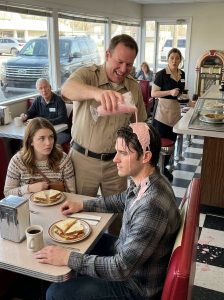
He had grease under one thumbnail from a pickup he had finished repairing that morning.
Amelia had noticed it when they sat down.
She had sighed, reached across the table, and said, “You could at least try to look presentable when we go somewhere together.”
Logan had rubbed the mark with his napkin.
It did not come off.
Three years earlier, she had called those hands steady.
Back then, she liked watching him work in the garage behind their rented house, especially when he brought an old engine back to life. She would stand in the doorway with a paper cup of coffee and ask questions she did not really care about just to keep him talking.
After he retired from the Navy, that ordinary life had felt like a gift.
He did not miss the noise.
He did not miss sleeping lightly.
He did not miss rooms where every chair, doorway, and hand movement needed to be measured before a man could let himself breathe.
What he wanted was simple.
A garage.
A marriage.
A town small enough that people waved when his truck passed.
For a while, he thought he had found it.
Then Amelia began changing.
It happened slowly enough that he could explain each piece away.
She started caring more about who saw them than where they went.
She corrected the way he spoke in front of certain people.
She stopped introducing him as a veteran and began calling him “a mechanic,” with a little smile that made the work sound smaller than it was.
Logan never argued.
Fixing engines paid their bills.
It kept his hands busy.
It gave him a reason to wake before sunrise and a place to put the discipline he had carried home.
Amelia knew he had served in the Navy.
She knew he had been away for long stretches.
She knew there were boxes in the garage she had never opened and names he never discussed.
She did not know the whole file.
That was not because Logan wanted mystery.
It was because some stories belonged to people who were not there to give permission.
Other stories could not be explained without reopening doors he had spent years learning to close.
He had told her what mattered.
At least, he had believed he had.
The bell above the diner door rang at 12:16 p.m.
Nora glanced up.
The man who entered wore a tan county sheriff’s uniform, polished boots, and the relaxed expression of someone who expected the room to adjust around him.
Dominic Vance did not wait to be seated.
He walked past the host stand, exchanged a quiet word with a man at the counter, and moved toward Logan’s booth.
Amelia saw him first.
Her shoulders changed.
It was a small movement, almost nothing, but Logan noticed.
She straightened her back.
Her hand went to her hair.
Then she looked down at her phone as if she had not noticed the sheriff coming.
Dominic stopped beside the booth.
“Mercer,” he said.
Logan looked up.
“Vance.”
The sheriff smiled.
There was no friendliness in it.
Dominic had been in the garage twice during the previous year.
The first time, he brought in a department SUV with a grinding front wheel and expected Logan to move it ahead of three customers who had already paid deposits.
Logan refused.
The second time, Dominic arrived after closing and told him it would be smart to remember who handled problems in town.
Logan had answered that wheel bearings did not care who wore a badge.
After that, small things began happening.
A patrol car sat across from the garage for twenty minutes without pulling anyone over.
A county vehicle inspector stopped by and asked questions that led nowhere.
A supplier mentioned that someone had been asking whether Logan’s paperwork was clean.
Nothing rose high enough to call a threat.
Nothing stayed low enough to ignore.
Logan documented each incident and said nothing.
At the diner, Dominic placed one hand on the top of the booth.
“Having a nice lunch?” he asked.
Amelia gave a short laugh.
Logan looked at her.
She lifted one shoulder as if the sound had escaped by accident.
“We were,” Logan said.
Dominic’s eyes moved to the milkshake sitting near the edge of the table.
Amelia had ordered it and changed her mind after two sips.
It was strawberry, pale pink beneath a cap of melting whipped cream.
The sheriff picked it up.
Nora stopped behind the counter.
Clyde, an older veteran seated near the window, lowered his coffee mug without drinking.
Logan watched Dominic’s hand close around the cold glass.
The sheriff tilted it once, studying the shake as it slid along the inside.
Then he stepped behind Logan.
The first touch was a cold stripe at the back of Logan’s head.
A second later, the entire milkshake poured through his hair.
It went under his collar and down his back.
The cold shocked his skin, but it was the smell that hit him hardest.
Strawberry syrup.
Sweet cream.
The chemical-clean scent of Dominic’s cologne.
The three smells locked together so sharply that Logan knew he would remember them long after the shirt had been washed.
The diner went silent.
A fork stopped in front of a man’s mouth.
A woman near the pie case held her water glass without lowering it.
Nora’s coffee pot remained tilted above an empty mug while one dark drop gathered at the spout and fell onto the counter.
The ceiling fan clicked overhead.
A country song continued playing from the jukebox near the restrooms, suddenly too cheerful for the room.
Nobody moved.
Dominic lifted the empty glass and laughed.
“Look at this trash,” he said. “He won’t do a thing.”
His voice carried easily.
It was meant to.
Public humiliation only works when the target understands that the audience is part of the weapon.
Logan kept both hands beneath the table.
He felt milkshake run along his ribs under the flannel.
He could see Dominic reflected in the chrome napkin holder.
Six feet two, maybe two hundred forty pounds.
Right shoulder lower than the left.
Weight forward.
Feet too close together.
Chin high.
Dominic believed he was standing over an aging mechanic who would either swing wildly or sit still and accept the lesson.
He did not know Logan had spent years studying what people did with their bodies before they understood they had made a decision.
If Logan moved, the sheriff would hit the tile before the empty glass landed.
Logan knew the sequence.
Turn left.
Trap the wrist.
Break the balance.
Drive the shoulder.
Control the weapon side.
End it.
The entire calculation took less than a second.
Then he dismissed it.
That was what Dominic wanted.
A public reaction would become an arrest.
An arrest would become a story.
The story would become a warning to anyone else who considered resisting him.
Anger loses control.
Bait wants you to.
Logan looked at Amelia.
She sat with her purse in her lap and her phone glowing beside her plate.
Her lipstick was perfect.
Her face was not shocked.
Her eyes went from the milk on Logan’s hair to Dominic’s uniform, then toward the window as though the true humiliation was being married to the man in the booth.
“Logan,” she whispered.
He waited.
“Why do you always have to make things worse?”
For a moment, he thought he had misheard her.
Milkshake dripped from his eyebrow onto the table.
Amelia leaned closer.
“You’re embarrassing me. Just sit there.”
Something in Logan settled.
It was not calm.
Calm was softer.