“You Can’t Sit In First Class,” A Veteran Flight Attendant Told A Quiet 6-Year-Old Boy Before Grabbing His Arm To Escort Him Away… But The Moment Another Crew Member Checked His Passenger Record And Went Pale, The Entire Cabin Realized This Child Wasn’t In The Wrong Seat At All…
My name is Ryan Carter, and after almost eight years as a flight attendant for one of the largest airlines in America, I thought I had seen every kind of argument people could start inside a metal tube at 35,000 feet.
I had watched businessmen curse over reclined seats as if three inches of space were a personal betrayal.
I had seen exhausted mothers close themselves inside airplane bathrooms for thirty seconds just to breathe while their babies screamed over the engines.
I had listened to passengers threaten lawsuits over weather delays, as though enough anger could force a storm to move somewhere else.
After enough years, cabin life starts to feel predictable.
People board. People complain. People land.
Somewhere in between, we keep the peace.
Then Flight 271 boarded in Seattle for New York.
The jet bridge smelled like wet coats, burnt airport coffee, and that sharp metallic chill that rolls through an aircraft when the forward door is still open.
Boarding was almost finished. Overhead bins slammed shut. Suitcase wheels rattled over the threshold. Passengers squeezed sideways into their rows while trying not to spill coffee or hit anyone with a backpack.
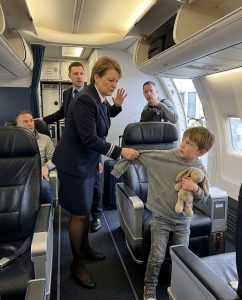
That was when I noticed the boy in 2A.
He looked about six years old.
I later learned his name was Noah Parker.
He wore a gray zip-up hoodie that hung a little too loosely from his shoulders, faded jeans, and worn sneakers. In his lap sat a stuffed rabbit with one crooked ear that had been sewn back on by hand.
He was alone in first class.
That detail was apparently enough to make someone suspicious.
Nothing about Noah matched the picture some people carried in their heads of who belonged in those seats. Around him were polished leather armrests, expensive watches, hard-shell carry-ons, pressed jackets, and paper coffee cups brought in from airport lounges.
But Noah wasn’t bothering anyone.
He wasn’t kicking the seat.
He wasn’t shouting.
He wasn’t running up and down the aisle.
He sat quietly by the window with both hands wrapped around his boarding pass.
Seat 2A.
Flight 271.
Seattle to New York.
The paper had been squeezed so tightly that its edges were soft with creases.
Then Linda Mercer stopped beside him.
Linda had worked for the airline for nearly twenty-five years. She knew every service sequence, every emergency phrase, and almost every excuse passengers had ever used while trying to claim a seat that wasn’t theirs.
Experience can make someone excellent at recognizing patterns.
It can also make someone dangerously certain that every new situation fits an old one.
Once Linda decided a rule had been broken, changing her mind was difficult.
She looked down at Noah.
“Sweetheart,” she said, “I think you’re sitting in the wrong section.”
Noah looked up quickly.
“My ticket says this seat.”
His answer wasn’t defiant. He sounded confused, like a child who had followed instructions carefully and suddenly discovered an adult was telling him the instructions were wrong.
Linda folded her arms.
“First class is reserved for premium passengers.”
Noah looked at the boarding pass again, almost as if the printed number might have changed while he wasn’t looking.
“But my dad bought it for me.”
A couple across the aisle glanced over.
A man who had been tapping on his phone stopped.
A woman near the galley lowered her magazine just enough to watch over the top edge.
That is something you learn quickly on airplanes: a disagreement may begin between two people, but inside a cabin there is almost no such thing as a private scene.
Linda’s voice hardened.
“Honey, you need to gather your things and move to the back before we finish boarding.”
Noah barely shook his head.
“My dad told me to stay right here and wait for him.”
That sentence changed the feeling of the moment for me.
Adults move constantly during boarding. They switch rows, step into the aisle, go back for bags, return to the gate, or get separated for a few minutes while dealing with luggage or paperwork.
A six-year-old doesn’t think that way.
If his father had told him, Stay in this seat, then as far as Noah was concerned, leaving that seat meant disobeying the one person he trusted to come back for him.
I stepped out of the forward galley.
“Linda, I can check the passenger record.”
She didn’t look at me.
“I know what I’m looking at, Ryan.”
That bothered me more than her first assumption had.
Checking would have taken less time than arguing.
There was a seat number on the boarding pass. There was a passenger record. There was a simple way to settle the question without frightening a child.
Noah squeezed the stuffed rabbit until the fabric bunched beneath his fingers.
His lower lip trembled once, but he refused to cry.
“Please,” he whispered. “My dad said not to move.”
Linda bent toward him.
I saw her hand reaching for his arm and felt my stomach tighten.
“Linda,” I said.
Noah pulled himself closer to the window, pressing the rabbit and his boarding pass against his chest.
The passengers nearest us were openly watching now.
A suitcase remained halfway inside an overhead bin because the man holding it had stopped moving.
Someone held a coffee cup without taking another sip.
The woman with the magazine had lowered it completely.
“Ma’am,” I said, sharper this time, “don’t grab him.”
But Linda’s fingers had already closed around the sleeve of Noah’s gray hoodie.
He jerked backward instinctively.
Not far. There wasn’t anywhere for him to go.
The window was behind him, the seat around him, and Linda stood in the aisle.
His boarding pass slipped from one hand and landed against his knee.
The stuffed rabbit stayed pinned to his chest.
“I said my dad told me to stay here,” Noah whispered again.
This time his voice cracked.
I moved beside Linda.