Grandpa stopped eating when he found out I was paying my parents rent while my sister lived in the same house for free with her two children.
Dad said Claire needed more help, as though my own life, bills, and plans carried less weight because I did not have children.
The conversation began in the middle of Thanksgiving dinner, when everyone was supposed to be relaxed and grateful and willing to ignore the subjects that could ruin a holiday.
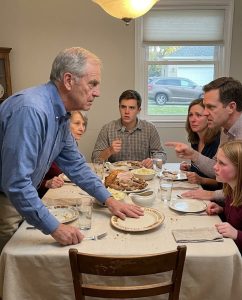
Grandpa had been eating quietly when something Dad said made him stop with his fork halfway between his plate and his mouth.
“Wait,” he said. “You pay your parents rent?”
I froze in almost the same position, my own fork suspended over my plate as every face at the table turned toward me.
Mom’s expression tightened immediately, not because the information was false, but because it had been said in front of the one person she did not want asking questions.
Claire lowered her eyes toward her mashed potatoes and began moving her fork through them without taking a bite.
Dad reacted first.
He waved one hand as though Grandpa had misunderstood something simple and unimportant.
“His sister has two kids,” Dad said. “She needs help more.”
The room changed after that sentence.
It was not loud, and no one shouted, but the ordinary sounds around the table seemed to stop because everyone understood what Dad had just admitted.
He had not denied that I paid rent.
He had explained why he believed I should pay while Claire should not.
Grandpa lowered his fork to his plate with deliberate care.
“No,” he said quietly. “I asked Ethan.”
My stomach dropped.
I had spent so long avoiding that conversation that being invited to answer honestly felt more frightening than remaining silent.
Dad leaned back in his chair and stared at Grandpa.
“Dad, don’t start.”
Grandpa did not look at him.
His eyes stayed on me while the Thanksgiving food cooled between us.
“How much?” he asked.
I swallowed before answering.
“Eight hundred a month.”
Grandma stared at me as though she was waiting for me to correct myself.
“Eight hundred?” she whispered.
Mom spoke quickly.
“It isn’t rent,” she said. “He helps with household expenses.”
The difference mattered to her because calling it help made the arrangement sound generous and voluntary.
Calling it rent raised questions about what I received in return and why the same rule did not apply to Claire.
I looked at Mom, then at Dad, and felt the pressure of every month I had kept quiet.
“I live in the basement,” I said. “I buy my own groceries. I pay for my phone, car insurance, gas, and half the utilities.”
No one interrupted me during that list.
Those were not dramatic expenses, but they were the ordinary costs that decided whether I could save money, replace something that broke, or make plans outside the house.
Every month, the eight hundred dollars came first because I knew what would happen if I questioned it.
Mom would say the family depended on me.
Dad would remind me that adults contributed.
Then, if I mentioned moving out, both of them would act as though I had announced that I intended to disappear and never speak to them again.
Claire finally looked up.
“You make it sound like you’re being abused,” she said.
“I didn’t say that.”
“But you’re acting like it,” she replied. “I have two children, Ethan. Do you know how expensive daycare is?”
The answer came out before I could soften it.
“You don’t pay for daycare. Mom watches them five days a week.”
Claire’s cheeks reddened.
She knew I was not criticizing her children, and I was not claiming that raising them cost nothing.
I was pointing out that the expense she had used to justify our different treatment was another expense our parents had already taken from her shoulders.
Dad brought his palm down against the table.
He did not hit hard enough to spill a drink or knock over a dish, but the silverware jumped, and the sound was enough to remind everyone that he expected the conversation to end when he said it ended.
“That’s enough.”
For years, that tone had worked on me.
It had taught me to stop explaining before my explanation became an argument and to accept whatever version of the situation kept the house calm.
Grandpa did not react to the warning.
He was no longer eating.
His face had gone still in a way I had seen only once before, at my uncle’s funeral, when he had listened to relatives avoid saying what everyone already knew.
“Claire,” he said, “do you pay anything to live here?”
Claire opened her mouth.
For a moment, I expected her to list small purchases or occasional errands and present them as though they matched eight hundred dollars every month.
Instead, she closed her mouth again.
Dad answered for her.
“She’s rebuilding.”
Grandpa nodded slowly.
“How long has she been rebuilding?”
Mom’s voice came out thin.
“That’s not fair.”
The word fair hung over the table because fairness was exactly what no one had been allowed to discuss.
“No,” Grandpa replied. “What isn’t fair is charging one child rent while giving the other a free room, free childcare, free meals, and then calling it family.”
Dad’s jaw tightened.
“Ethan is twenty-six. He should contribute.”
Grandpa did not disagree that an adult child could contribute to a household.
That was what made his response harder to dismiss.
“And Claire is thirty-two,” he said. “She has two children she chose to have and a man she chose to marry, divorce, and keep letting back in whenever he knocks.”
Claire shoved her chair backward and stood so quickly that its legs scraped across the floor.
“How dare you.”
Grandpa stayed seated.
He did not raise his voice or point at her.
“Sit down.”
Something in his tone cut through the anger.
Claire sat, though she remained rigid, both hands near the edge of the table.
Grandpa turned toward me again.
“Ethan, where does your money go?”
A laugh slipped out of me, but it carried no humor.
“To them.”