“Glare.”
The word made the Boston specialist follow my eyes to the twenty-foot window. Sunlight was pouring across the marble and bouncing straight into Eli’s face while the dark lobby screen had been flashing beside him.
“Can those shades come down?” I asked.
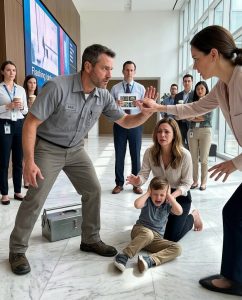
The receptionist reached under her desk and pressed a control. Motorized shades began sliding over the glass, cutting the white reflection into narrower bands. Eli kept screaming, but the pitch changed. It broke in the middle, as if his body had finally found one less thing to fight.
Vivian started toward him.
“Stay where he can see you,” I said. “Don’t touch him yet.”
Every part of her wanted to ignore me. I saw it in her hands, opening and closing at her sides. But she stopped.
I put my left hand flat on the floor between us, palm down, not close enough to trap him. A black crescent of grease still marked the side of my thumb from the hinge upstairs.
Eli’s eyes flicked toward it.
That was the first time he had looked at anything instead of trying to escape everything.
I did not praise him. I did not tell him he was doing great. Praise can be another demand when a child is already carrying too much. I simply turned my wrist a fraction, slow enough for him to predict.
His scream dropped into a ragged cry.
The neurologist leaned forward, and Vivian lifted one hand without taking her eyes off Eli.
“No,” she said. “Nobody moves unless Dale says.”
The richest woman in the building had just handed control of her lobby to the man who fixed its doors.
Then Eli pulled one hand away from his ear and reached—not for his mother, not for the specialist, but for the grease mark on my thumb.
I kept my hand still.
His fingers stopped an inch above mine, trembling from the effort of holding them there.
He was not asking me to take his hand. He was checking whether I would move before he was ready.
I had learned that difference with Danny after years of getting it wrong.
When my son was four, I thought every outstretched hand was a request for help, so I grabbed it, guided it, washed it, dressed it, or pulled him toward whatever I believed came next.
I called those things care because I loved him.
Danny experienced them as surprises he could not escape.
It took me too long to understand that love could still hurt when it arrived without warning.
Eli lowered his fingertips until they barely touched the greasy crescent on my thumb.
I did not close my hand around his.
I let him decide how long the contact lasted.
His scream broke again, dropping into a rough sob that sounded small after everything that had filled the lobby.
Vivian made a noise behind me, but she caught it before it became his next demand.
The Boston specialist shifted the laminated chart against her chest.
“He may be responding to the visual contrast,” she whispered.
“Maybe,” I said, keeping my voice low. “Or maybe he finally knows no one is going to grab him.”
The neurologist straightened, irritation tightening his face.
“We were attempting to evaluate his safety.”
“I know,” I said. “But he didn’t know that.”
Vivian looked at the neurologist, then at the two private aides who had been hovering over her son.
“Move to the hallway,” she told them.
One aide started to protest that they needed to remain close.
Vivian shook her head.
“Close is the problem right now.”
They backed through the glass doors leading toward the elevators.
The employees remained along the walls, trying not to stare while still staring.
I lifted my eyes toward the nearest group and pointed to the corridor.
“Coffee break,” I said.
No one laughed.
They began moving anyway, cups in hand, badges swinging against their shirts as they slipped toward the stairwell and side hallways.
Within a minute, the lobby that had felt like an arena held only Vivian, Eli, the specialist, the neurologist, the receptionist, and me.
The building had not become silent.
Air still moved through vents above us, shoes squeaked in distant corridors, and traffic pressed faintly against the glass from outside.
But those sounds no longer arrived as one solid wall.
Eli dragged one fingertip across the grease on my thumb, leaving a faint gray streak on his skin.
His breathing came in sharp pulls, but each one was a little farther from the last scream.
I turned my hand slowly, showing him my palm.
He watched the movement.
Then he copied it.
One small hand opened on the marble between us.
I tapped my index finger once against the floor.
Eli stared at the spot and tapped once with his own finger.
I waited.
He waited.
I tapped twice.
He tapped twice.
The neurologist glanced at the specialist, but neither interrupted.
This was not a treatment plan, and I was not pretending it was one.
It was simply a predictable exchange between a frightened child and an adult who was finally moving slowly enough to be understood.
Danny and I had once spent forty minutes on a grocery store floor doing something similar with the wheel of a toy car.
People had stepped around us with carts and annoyed expressions while I rolled the wheel once, stopped, and waited for him to decide whether it should move again.
That day, I had gone home embarrassed because strangers thought I had lost control of my child.
Years later, Danny told me in the few words he used carefully that he remembered the wheel.
He remembered that I waited.
Eli tapped the marble three times.
I repeated three taps.
His shoulders dropped half an inch.
Vivian saw it and covered her mouth with both hands.
I looked at her without turning my body fully away from Eli.
“Sit down,” I said.
She lowered herself to the floor five feet behind him.
“Closer?” she whispered.
“Let him choose.”
She nodded, tears sliding down her cheeks.
For a woman who had spent her adult life making decisions faster than everyone around her, waiting looked almost physically painful.
She tucked her bare feet beneath her, rested her hands visibly on her knees, and did nothing.
Eli noticed.
His eyes moved to her for less than a second, then returned to the grease on my thumb.
That second nearly broke her.
She did not move.
I tapped once more, and Eli answered.
The Boston specialist crouched farther away, keeping her chart lowered.
“Does he use a communication device?” I asked Vivian.
“At home and school,” she said. “It was in the car. Everything happened so quickly.”
Her voice began speeding up as she explained that a routine visit to the office had changed when the lobby filled for a company announcement, the display brightened, the fountain came on, and several people greeted Eli at once.
Eli’s breathing sharpened at the increase in her voice.
Vivian stopped mid-sentence.
“Sorry,” she whispered.
I shook my head gently.
“You don’t have to apologize to us. Just slow down for him.”
She drew one deliberate breath through her nose and released it.
Eli watched her chest rise and fall.
She did it again.
This time, his next breath almost matched hers.
The neurologist folded his arms.
“His pulse may still be elevated,” he said quietly.
“Probably is,” I answered. “Mine would be too if six people crowded me on the floor.”
His jaw tightened, but he stayed where he was.
Vivian looked at him.
“Can you assess him without touching him?”
“Not completely.”
“Then wait until he can consent to being approached.”
The doctor glanced at Eli, then gave one short nod.
It was not a defeat, and it did not need to be.
He had been trying to make sure the boy was physically safe.
The mistake was believing that professional urgency automatically felt safe to the person receiving it.
Eli removed his second hand from his ear.
The lobby seemed to inhale around him.